

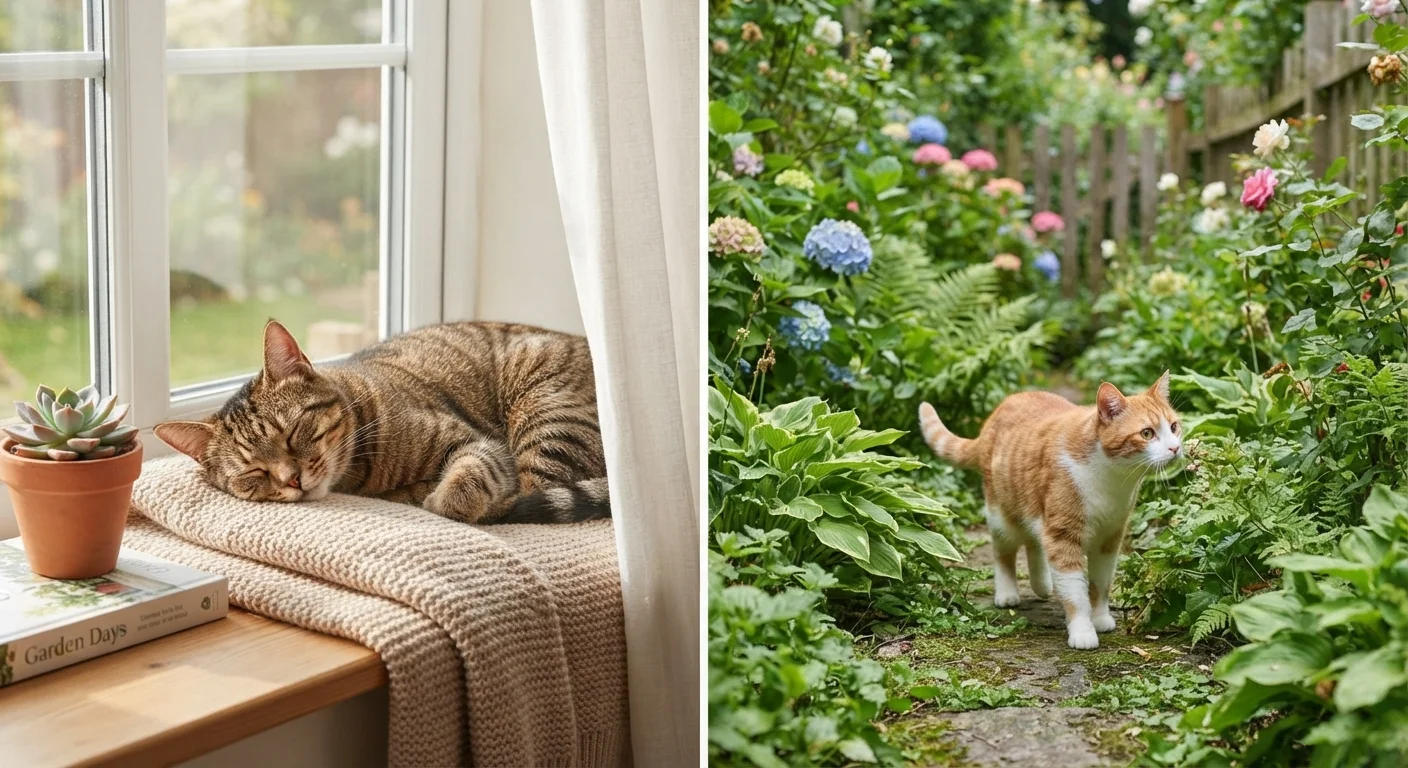
Key Takeaways
- Indoor cats generally live longer due to reduced exposure to trauma, predators, and infectious disease.
- Outdoor cats face higher risks of injury, parasites, and disease, but get more physical and sensory stimulation.
- Indoor cats are prone to obesity, stress-related illness, and boredom without adequate enrichment.
- Vaccination, parasite prevention, and enrichment needs differ significantly between the two lifestyles.
- A cat's individual temperament and history should influence which environment is chosen.
Option A
Indoor cat
The protected, controlled environment choice.
Best for: Owners who want to minimize injury and disease exposure and can invest in environmental enrichment.
Option B
Outdoor cat
The free-ranging, stimulation-rich alternative.
Best for: Cats with strong predatory instincts in areas where supervised or safe outdoor access is realistic.
If your cat has always lived indoors or was adopted as a kitten
Indoor cat
Cats raised indoors typically lack the road awareness and territory knowledge that help outdoor cats survive. Keeping them inside avoids risks they are not equipped to handle.
If you live in a rural area with low traffic and can provide supervised access
Outdoor cat
With appropriate vaccinations and parasite control in place, outdoor access in low-risk environments can support physical health and natural behaviour.
If your cat shows signs of boredom, anxiety, or redirected aggression indoors
Indoor cat
Structured enrichment, vertical space, and interactive play address the root cause more safely than releasing an anxious cat into an unpredictable outdoor environment.
If safety outdoors cannot be guaranteed (urban traffic, local predators, neighborhood toxins)
Indoor cat
The measurable risks of outdoor life in high-hazard environments consistently outweigh the stimulation benefits, especially when enrichment indoors is thoughtfully provided.
How each lifestyle shapes physical health
The most concrete difference between indoor and outdoor cats is the injury and disease profile each carries. Outdoor cats face a substantially higher risk of road trauma, bite wounds from other cats or wildlife, and predator attacks. Cat bite abscesses are among the most common reasons outdoor cats visit veterinary clinics, because a puncture wound from another cat's tooth introduces bacteria deep under the skin.
Infectious disease exposure is also higher outdoors. Feline leukemia virus (FeLV) and feline immunodeficiency virus (FIV) spread through close contact and bites, and unvaccinated outdoor cats carry a meaningful risk. Respiratory viruses, ringworm, and intestinal parasites circulate more readily where cats share territory.
Indoor cats sidestep most of those hazards, but face a different set. Reduced movement and caloric intake that does not adjust to match can lead to weight gain over time. Excess weight in cats is connected to diabetes, joint disease, and a shorter lifespan, so it is worth treating as a genuine health concern rather than a minor cosmetic one. Indoor cats also have higher rates of lower urinary tract disease, which veterinary research has associated with stress and low water intake.
| Criterion | Indoor cat | Outdoor cat |
|---|---|---|
| Injury risk | Low (household hazards only) | High (traffic, fights, predators) |
| Infectious disease exposure | Low | Higher (FeLV, FIV, parasites) |
| Obesity risk | Higher without enrichment | Lower with active roaming |
| Natural behavioral stimulation | Requires owner effort | Built into environment |
| Average lifespan (general estimates) | Longer on average | Shorter on average |
| Parasite prevention needs | Moderate | High, year-round |
| Vaccination protocol | Core vaccines | Core plus FeLV recommended |
Mental stimulation and behavioral health
Outdoor life provides continuous sensory input: changing scents, visual movement, hunting opportunities, and territorial patrol. These experiences meet a cat's natural behavioral needs without any intervention from the owner. A cat that roams freely is less likely to develop the repetitive, stress-driven behaviors such as over-grooming or redirected aggression that sometimes appear in confined cats.
That does not mean indoor cats are inevitably bored or distressed. It means their owners carry more responsibility for providing stimulation. Puzzle feeders, climbing structures, window perches, and regular interactive play sessions all help. Environmental enrichment for indoor cats covers the specific approaches that behavioral science supports, including scent work and vertical territory. Play also shifts in purpose and intensity as cats age, so the enrichment strategy that works at two years may need adjusting at ten.
Outdoor cats are not free from behavioral problems either. Territory disputes with neighboring cats cause chronic stress, and cats in dense urban areas may have smaller effective territories than their instincts call for.
Lifespan: what the numbers suggest
Veterinary organizations and feline welfare groups generally report that indoor cats live longer on average than outdoor cats. Estimates vary, but the pattern is consistent across surveys: outdoor and free-roaming cats face a higher rate of early death from trauma and disease. This does not mean every outdoor cat will die young, or that every indoor cat will thrive, but the aggregate picture favors the controlled environment when lifespan alone is the measure.
Lifespan is not the only way to weigh quality of life, though. A long life spent under-stimulated and overweight is not straightforwardly better than a shorter life with richer physical experience. Most veterinary guidance frames the goal as maximizing both length and welfare, rather than treating them as competing values.
10-15 years
Typical indoor cat lifespan
Veterinary organizations commonly cite this range for indoor cats living in stable home environments.
2-5 years
Median lifespan estimate for free-roaming cats
Feline welfare researchers have cited substantially shorter median lifespans for unsupervised outdoor and feral cats.
Up to 13x
Higher FeLV risk for outdoor cats
Outdoor access is consistently identified as the primary risk factor for feline leukemia virus exposure in peer-reviewed feline medicine literature.
Preventive care requirements for each lifestyle
Both indoor and outdoor cats need core vaccinations, but outdoor cats typically require a broader protocol. FeLV vaccination is recommended for cats with outdoor access, and rabies vaccination is legally required in many US states regardless of lifestyle. Parasite prevention, including flea, tick, and heartworm treatment, is more pressing for outdoor cats but is not irrelevant indoors: fleas can enter on clothing, and indoor cats with no prevention are not fully protected.
Spaying or neutering reduces roaming behavior and lowers the risk of reproductive cancers. For outdoor cats, it also reduces fighting, which directly cuts the risk of FIV transmission. Lifetime health considerations include how preventive needs shift as a cat moves from kittenhood into senior years, indoors or out.
Diet also intersects with lifestyle. An outdoor cat burning energy on territory patrol has different caloric needs than an indoor cat sleeping on a heated blanket. Wet versus dry food matters here too, since hydration is harder to maintain in indoor cats who often drink less water than they need.
This article is for general informational purposes only and is not a substitute for personalized veterinary advice. Consult a licensed veterinarian about the specific health needs of your cat.