

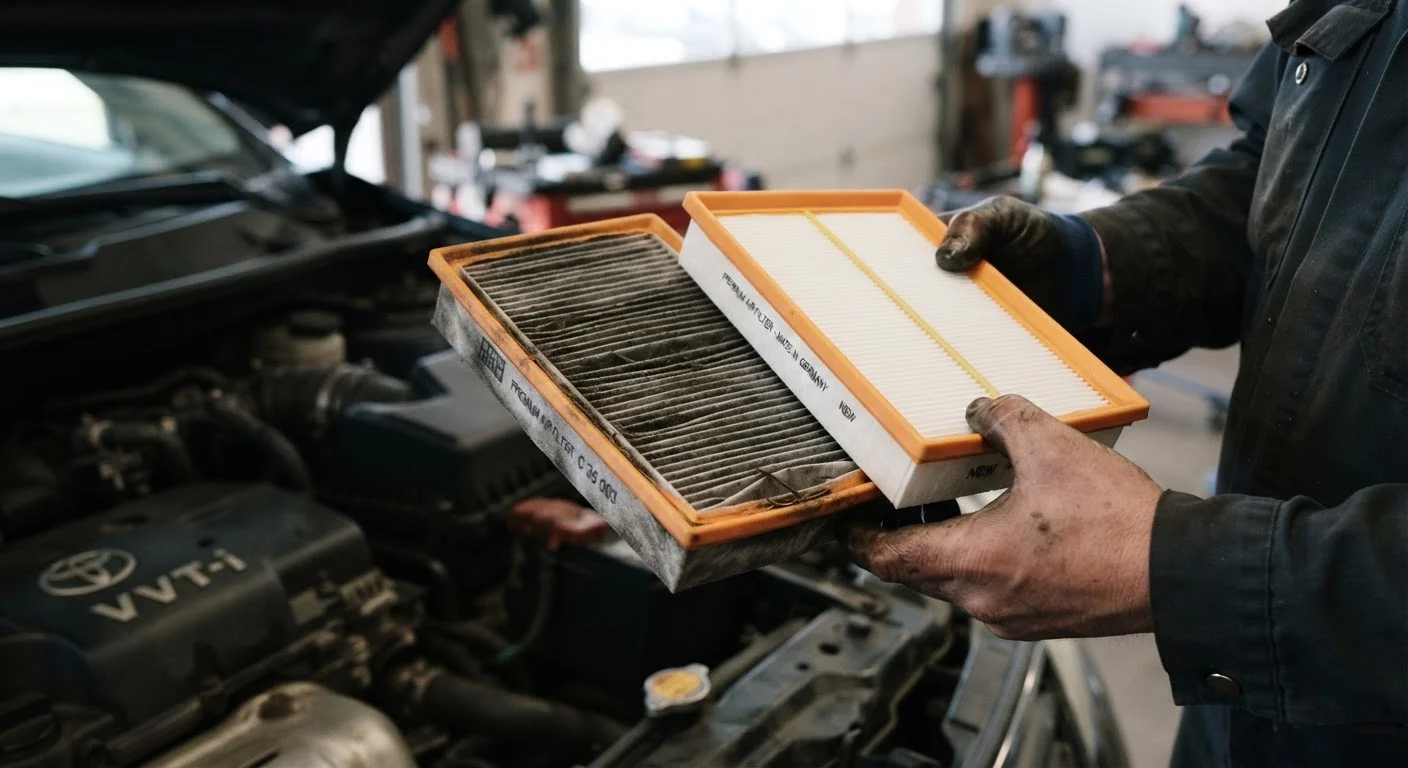
Key Takeaways
- Engine and cabin air filters are separate components with different replacement schedules.
- A clogged engine air filter can reduce fuel economy and cause rough idling.
- Cabin air filter condition directly affects air quality inside the passenger compartment.
- Most engine air filters need replacement every 15,000 to 30,000 miles, depending on driving conditions.
- Visual inspection is a reliable first check, but mileage intervals should not be ignored.
Vehicle air filter
A vehicle air filter is a component that removes contaminants from air before it reaches a sensitive system. Cars have two distinct filters: an engine air filter that cleans air entering the combustion chamber, and a cabin air filter that cleans air flowing into the passenger compartment. Each filter traps dust, pollen, debris, or other particles that would otherwise cause damage or discomfort.
Engine air filters are typically rated by their ability to restrict airflow (measured in CFM) while capturing particulates; cabin filters often include activated carbon layers to adsorb odors and exhaust gases.
Two filters, two jobs
Most drivers think of an air filter as a single item, but every car has at least two: one protecting the engine and one protecting the people inside. Treating them as the same part leads to missed service intervals and preventable problems.
The engine air filter sits inside a housing in the engine bay, usually connected directly to the intake duct. Its job is to stop dust, sand, insects, and road debris from entering the combustion chamber, where even small abrasive particles can wear cylinder walls and damage pistons over time.
The cabin air filter is located in the HVAC (heating, ventilation, and air conditioning) system, typically behind the glove box, under the dashboard, or beneath the hood near the base of the windshield. It filters the air that enters through the vents, trapping pollen, exhaust fumes, mold spores, and fine particulates before they reach passengers.
Both filters use pleated filtration media, but they are different shapes, installed in different locations, and replaced on different schedules. Knowing which one you are dealing with is the starting point for any maintenance decision. For a broader look at routine intervals, see our routine maintenance guide.
What a clogged engine air filter does
An engine needs a precise ratio of air and fuel to combust efficiently. When the air filter is heavily loaded with debris, it restricts airflow into the intake manifold. The engine management system compensates, but only up to a point.
Common effects of a clogged engine air filter include:
- Reduced fuel economy, because the engine works harder to draw adequate air
- Rough idling or hesitation during acceleration
- A check engine light, particularly on modern vehicles where sensors detect abnormal airflow
- In severe cases, black smoke from the exhaust caused by an over-rich fuel mixture
The filter itself does not typically fail suddenly. Restriction builds gradually, so the effects can be subtle at first. That gradual change is one reason mileage-based intervals exist: waiting for obvious symptoms usually means the filter is already well past its useful life.
Check the filter at every oil change
Engine oil and air filters are on similar service timelines for many vehicles. Pulling the air filter housing during an oil change takes less than a minute and gives you a current picture of filter condition without requiring a separate appointment or additional labor time.
When to replace each filter
Replacement intervals vary by vehicle and by driving environment. Manufacturer guidance in the owner's manual is always the most reliable reference.
Engine air filter: General guidance points to 15,000 to 30,000 miles. Vehicles driven regularly on unpaved roads, in dusty agricultural areas, or in heavy construction traffic need more frequent checks. High-mileage vehicles accumulate filter load faster simply because of the greater volume of air processed.
Cabin air filter: Most manufacturers suggest replacement every 15,000 to 25,000 miles, or roughly once a year for average drivers. Anyone who parks under trees, drives with the windows down frequently in urban areas, or notices reduced airflow from the vents should check the filter sooner.
Visual inspection supplements mileage tracking. Pull the filter and hold it up to a light source. An engine filter that is uniformly gray or black across its surface area, or one where debris falls out when handled, is due for replacement. A cabin filter showing heavy pollen accumulation, dark streaking, or visible mold growth should come out immediately.
What to expect during replacement
Both filters are generally accessible without specialized tools, though cabin filter access varies more by vehicle model than engine filter access does. Some cabin filters require removing the glove box entirely; others slide out through a panel without any disassembly.
The engine air filter housing is almost always secured with clips or a few screws. The filter inside lifts straight out. Installation is the reverse: the new filter seats in the same orientation, and the housing clips back into place. The entire process typically takes less than ten minutes.
When purchasing a replacement, the vehicle's year, make, model, and engine size determine the correct part. Using the wrong size filter can allow unfiltered air to bypass the media entirely, which defeats the purpose of the component.
For drivers who want a mechanic to handle it, filter replacement is a straightforward add-on during any scheduled service visit. It is also a task that commonly comes up alongside other accessory drive maintenance; our serpentine belt overview covers another component worth checking at similar intervals.
This article is for general informational purposes only. Always consult your vehicle's owner's manual and a qualified mechanic for guidance specific to your car and driving conditions.