

| Recommended play sessions for adult cats | 2 per day, 10 to 15 minutes each (General guidance from feline behavior specialists) |
| Age range considered senior for cats | 7 to 10 years and older (American Association of Feline Practitioners guidelines) |
| Kitten peak socialization window | 3 to 16 weeks of age (Feline behavioral development research) |
| Recommended kitten play session length | 5 to 10 minutes, several times daily (General guidance from feline behavior specialists) |
| Recommended senior cat play session length | 5 to 8 minutes with rest between sessions (Adapted from senior feline care guidance) |
Why play is never just play for cats
For cats, play is a rehearsal of predatory behavior. Every pounce, stalk, and swat maps directly onto the hunt sequence: locate, stalk, chase, catch, kill. That sequence is hardwired, and it does not disappear when a cat has a full food bowl. What changes across a cat's life is how intensely that drive expresses itself, how long each session should last, and what form the play should take.
Owners sometimes underestimate play as optional entertainment. Animal behavior research positions it differently: regular, appropriately structured play supports weight management, reduces anxiety-driven behavior, and maintains cognitive sharpness. The environmental enrichment guide for indoor cats covers how play fits alongside other forms of mental stimulation.
Predatory play sequence
The series of behaviors cats instinctively perform when hunting: orient, stalk, chase, pounce, and catch. Play mimics this sequence even when no actual prey is involved.
Bite inhibition
A learned control over how hard a cat bites during social interaction. Kittens develop it through feedback from littermates and humans during play.
Orienting reflex
An automatic behavioral response to a new or unexpected stimulus. In cats, novel objects or movements trigger this reflex, which is why rotating toys sustains engagement.
Redirected aggression
Aggression directed at a person or pet that was triggered by an unrelated stimulus, such as seeing another animal through a window. It commonly results from unmet predatory drive.
Cognitive dysfunction syndrome
A condition in older cats that resembles dementia, involving disorientation, altered sleep, and reduced interaction. It can lower a senior cat's willingness to engage in play.
Kittens: play as survival school
From roughly 3 to 16 weeks of age, kittens use play to calibrate reflexes, learn bite inhibition, and practice social negotiation with littermates. A kitten that bites too hard gets a sharp yelp and a temporary end to the game; that feedback shapes how hard an adult cat will grab during play with humans. This is why hand-play (using fingers as toys) during kittenhood can lead to biting and grabbing habits that are hard to reverse.
Kitten play sessions should be short and frequent: 5 to 10 minutes several times a day suits their burst energy and short attention spans. Understanding kitten body language and play patterns helps owners tell genuine play from overstimulation. A kitten that suddenly flattens its ears, lashes its tail, or bites harder than before is telling you the session has gone on too long.
Rotate toy types every few days. Novel objects trigger the orienting reflex, and kittens that always have the same toys available stop engaging with them faster than kittens whose environment changes slightly.
Adult cats: maintaining the hunt without the hunt
Between roughly 1 and 7 years, a cat has its full athletic capacity but may spend most of its day indoors with no actual prey to pursue. This gap between physical capability and environmental opportunity is where behavioral problems often start: redirected aggression, destructive scratching, and excessive vocalization can all trace back to insufficient predatory outlet.
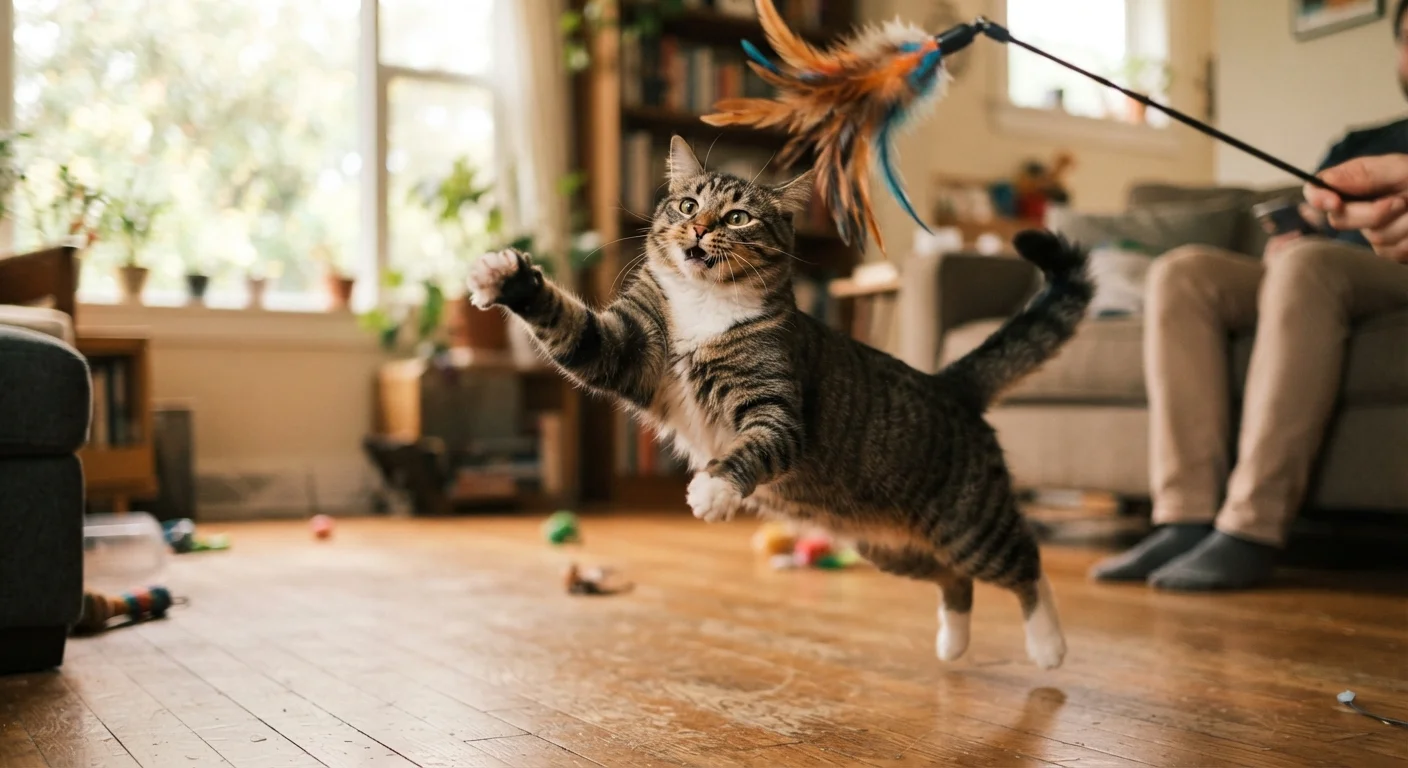
Adult cats generally benefit from two dedicated play sessions per day, each lasting 10 to 15 minutes. Wand toys that mimic the erratic movement of birds or mice are more engaging than static toys because they allow the full chase-and-catch arc. Ending each session with a small food reward or a toy the cat can "kill" and carry away lets the predatory sequence complete, which matters more than most owners realize.
Both indoor and outdoor lifestyles affect how much supplemental play an adult cat needs. The comparison of indoor and outdoor cat health trade-offs explains why indoor cats typically carry a higher need for structured play. Solo play matters too: puzzle feeders, crinkle balls, and cardboard boxes scattered around the home let a cat initiate its own engagement between owner-led sessions.
| Recommended play sessions for adult cats | 2 per day, 10 to 15 minutes each (General guidance from feline behavior specialists) |
| Age range considered senior for cats | 7 to 10 years and older (American Association of Feline Practitioners guidelines) |
| Kitten peak socialization window | 3 to 16 weeks of age (Feline behavioral development research) |
| Recommended kitten play session length | 5 to 10 minutes, several times daily (General guidance from feline behavior specialists) |
| Recommended senior cat play session length | 5 to 8 minutes with rest between sessions (Adapted from senior feline care guidance) |
Senior cats: keeping play on the menu
Cats older than 7 to 10 years slow down, but the instinct to hunt does not vanish. What changes is endurance and joint comfort. A senior cat with arthritis (a condition vets estimate affects a significant proportion of older cats) may show less interest in vigorous jumping but will still track, stalk, and swipe at ground-level targets.
Adapting play for a senior cat means lowering the physical demand without removing the cognitive and sensory stimulation. Wand toys waved slowly along the floor, feather teasers that settle rather than dart upward, and food puzzles at ground level all let an older cat engage without pain. Sessions of 5 to 8 minutes with rest between them tend to suit seniors better than longer bouts.
A sudden drop in play interest that is not explained by age-related slowing warrants a veterinary check. Pain, hyperthyroidism, dental disease, and cognitive dysfunction can all dampen a cat's willingness to engage. Owners sometimes attribute a senior cat's withdrawal to "just getting old" when an underlying condition is actually driving the change.
Play also has a social dimension that matters at every age. Cats often engage more readily with humans they trust, and interactive play is one of the ways that trust builds. What research says about cat-owner bonds challenges the assumption that cats are indifferent to human interaction during play.
This article is for general informational purposes only and is not a substitute for professional veterinary advice. If you have concerns about your cat's health or behavior, consult a licensed veterinarian.