

Key Takeaways
- Working one room at a time prevents the overwhelm that stops most decluttering efforts before they finish.
- A three-category sorting system (keep, donate, discard) is enough structure for any room in any home.
- High-traffic areas like kitchens and entryways produce the fastest visible results and build momentum.
- Closets and bedrooms benefit from seasonal rotation to prevent clutter from accumulating between sessions.
- Short daily habits do more to maintain order than occasional large purges.
Start here
Why a room-by-room approach works
Next
Before you start: a simple sorting system
Then
Kitchen and living areas
Continue
Bedrooms and closets
Almost done
Bathrooms and entryways
Wrap up
Keeping it from piling up again
Why a room-by-room approach works
Trying to declutter an entire home in one sweep is the fastest path to abandoning the project midway. When everything comes out at once, the volume is disorienting and decision fatigue sets in quickly. A room-by-room method gives you a defined start and finish point for each session, so progress is visible and the task stays proportionate to the time you have.
This framework is part of a broader approach to organizing your home from scratch, but it stands on its own for anyone who wants to address clutter before setting up formal systems. You do not need special equipment or an entire weekend free. What you need is a repeatable process you can apply in any room, in any order that suits your life.
Before you start: a simple sorting system
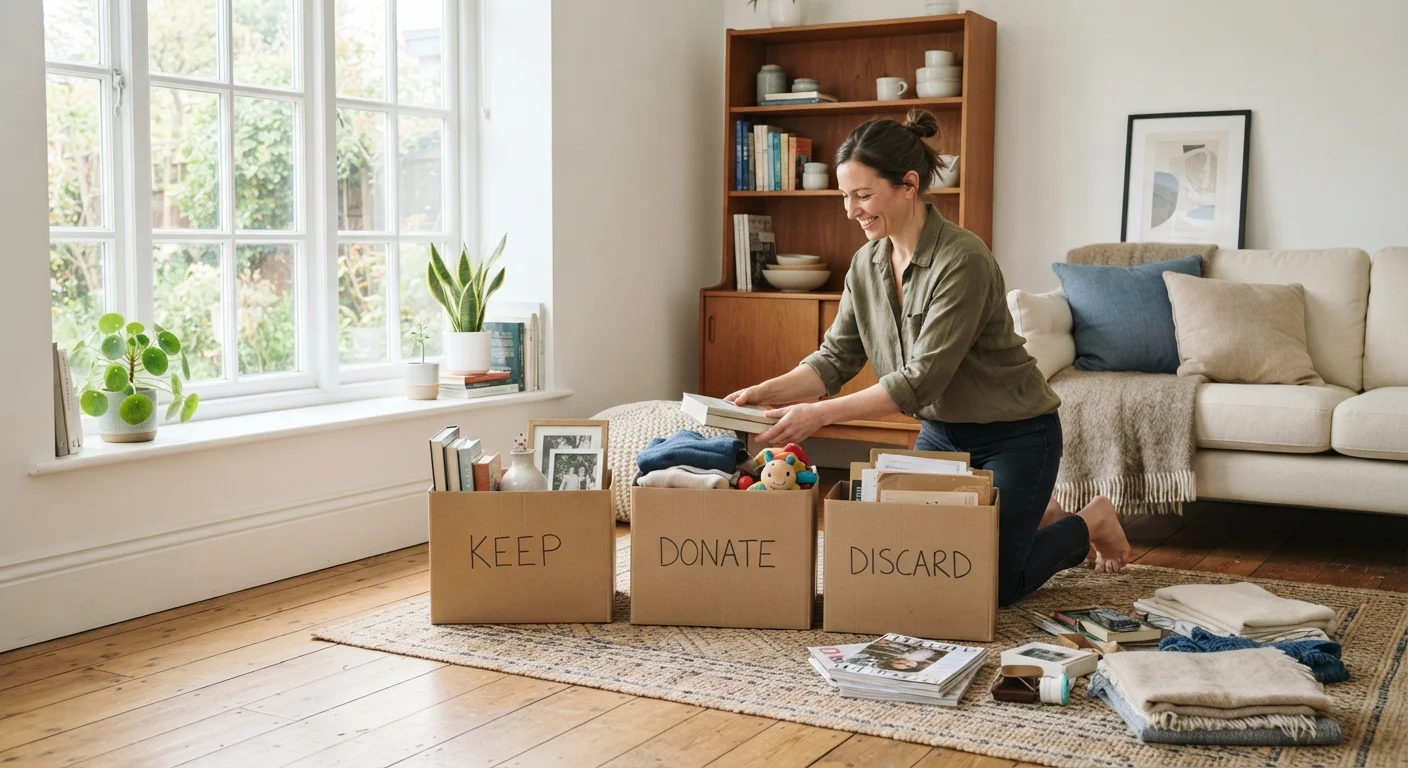
Before touching a single drawer, set up three containers: one for items you are keeping, one for donations, and one for trash. Label them clearly. This prevents the default behavior of picking something up, feeling unsure, and setting it back down.
Decluttering
The process of removing items from a space that are no longer used, needed, or wanted, so what remains has a clear purpose.
Donation box
A container set aside for items in working condition that you no longer use, intended to be given to a charity or community organization.
One-in, one-out rule
A habit where every new item brought into the home is matched by removing one comparable item, keeping overall volume steady.
Decision fatigue
The mental exhaustion that comes from making too many choices in a short period, which can cause people to stall or make poor decisions during a decluttering session.
Landing zone
A designated spot near the entrance of a home where everyday items like keys, bags, and mail are placed consistently so they are easy to find and do not spread into other rooms.
For each item you handle, ask one question: does this have an active use in my home right now? If yes, it goes in the keep box. If it works but you no longer use it, it goes to donations. If it is broken, expired, or genuinely unusable, it goes in the trash.
Set a timer for each session. Forty-five minutes to an hour is enough for most people to make real progress without burning out. When the timer ends, remove the donation box from your home as soon as possible, ideally the same day or the next morning.
Kitchen and living areas
The kitchen accumulates more redundant items than almost any other room. Duplicate tools, expired pantry goods, and gadgets used once are common culprits. Start with the pantry and pull everything out onto a counter. Check dates, consolidate duplicates, and return only what you actively cook with. Then move to drawers and cabinets in the same way.
In the living room, flat surfaces collect the most visual clutter. Go through items on shelves, tables, and the floor before addressing storage furniture. A good test: if you would not want a guest to see it sitting out, it either needs a designated home or it needs to go.
For a more detailed look at transforming a room without major effort, the weekend home improvement projects guide covers achievable changes that complement a decluttering session well.
Bedrooms and closets
Bedrooms hold two categories of clutter: items that drifted in from other rooms and clothing that has outgrown its usefulness. Start with everything that does not belong in a bedroom and return those items to their correct rooms first. Then address the surfaces: nightstands, dressers, and floors.
Closets deserve their own dedicated session. Pull everything out, then return only what fits and what you wear. Seasonal clothing that is not currently in rotation can be stored elsewhere to free up space. The seasonal clothing rotation guide walks through a clear process for this. If you have a small bedroom, storage and layout habits for small bedrooms offers practical strategies once the clutter is cleared.
Try the 30-day holding box method
When you are unsure whether to keep something, place it in a labeled box with a date written on the outside. If you have not retrieved the item within 30 days, remove it from your home without reopening the decision. This removes the pressure of deciding in the moment while still letting you catch genuine mistakes.
Bathrooms and entryways
Bathrooms are usually the fastest room to declutter because the categories are clear: expired products, duplicates, and items that belong somewhere else. Check expiration dates on medications and personal care products. Remove anything stored in the bathroom purely out of habit rather than convenience.
The entryway controls how clutter enters your home in the first place. Shoes, bags, mail, and outerwear pile up here because there is no system to catch them. Declutter the space first, then consider what a functional landing zone would look like. The entryway organization guide covers how to design one that holds up under daily use.
Keeping it from piling up again
After completing each room, the goal is not to achieve a permanent state of perfect order but to make the baseline easier to maintain. Two habits have an outsized effect on this. First, a daily two-minute reset where items return to their designated spots before bed. Second, a one-in, one-out rule: when something new comes into the home, something comparable leaves.
Physical clutter and digital clutter often grow together. Addressing both produces a more complete sense of order at home. For households where different people have different habits, the guide to organizing shared living spaces offers strategies that do not rely on everyone having the same standards.