

Key Takeaways
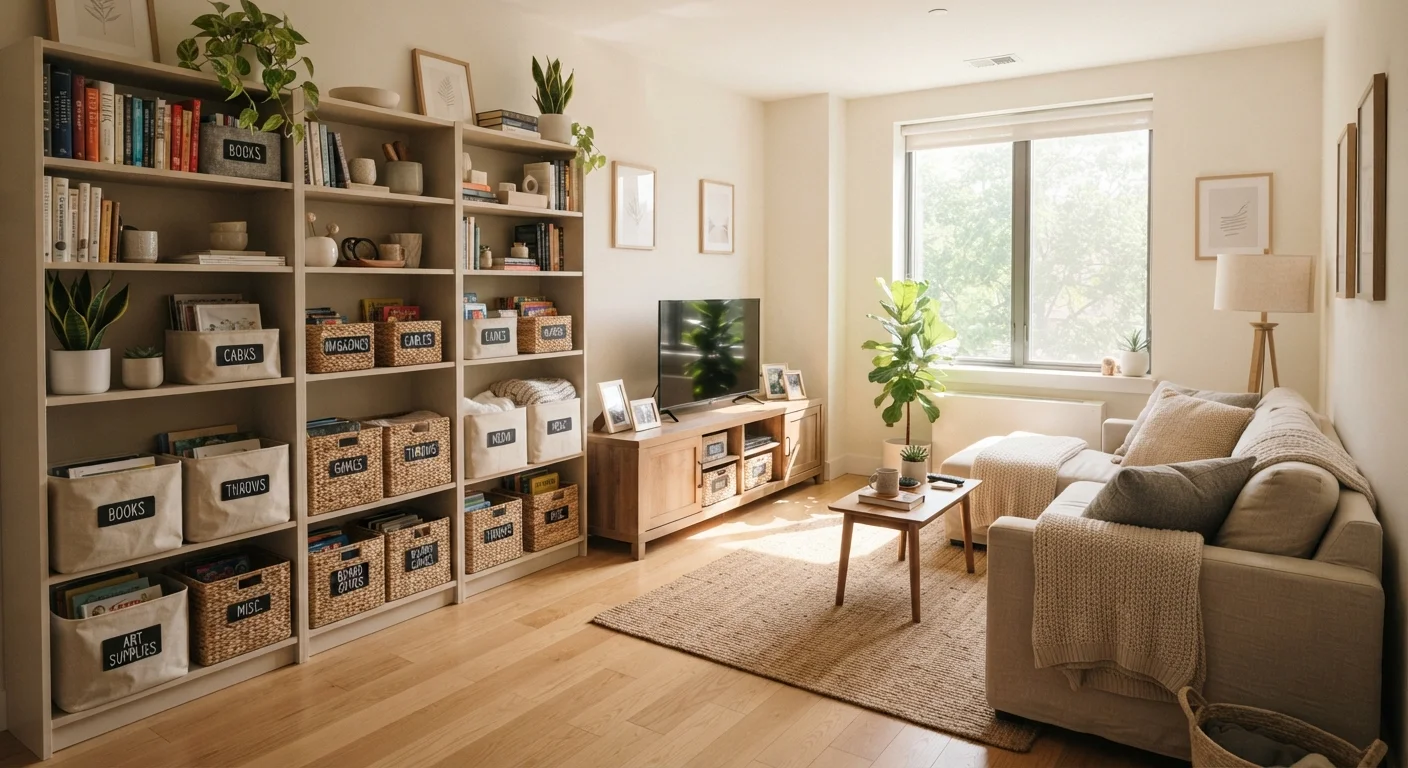
- Shared spaces work better when systems are visible and require minimal effort to maintain.
- Negotiating a few non-negotiable standards protects household harmony without demanding identical habits from everyone.
- Designated zones for individual items reduce conflict over shared surfaces and communal areas.
- Regular, short household check-ins are more effective than infrequent deep-clean marathons.
- Low-friction storage, meaning things put away in seconds, is the most reliable predictor of lasting tidiness.
Why shared spaces resist organization
Most organization advice assumes one person controls the space. In a shared home, that assumption fails immediately. A system one person finds intuitive may feel burdensome or arbitrary to another. When that friction builds, the path of least resistance wins: things land on counters, dishes wait in the sink, and shared surfaces become default storage.
The problem is rarely laziness. It is usually a mismatch between the system and the habits of the people using it. A filing cabinet is useless if one housemate thinks in piles. A shoe rack by the door fails if another person's first instinct is to kick shoes off in the hallway. Organization in a shared home has to account for actual behavior, not idealized behavior.
The complete guide to home organization covers room-specific systems in depth, but for shared households the starting point is agreement, not storage solutions.
Practices that work across different habits
The following approaches address the most common friction points in shared living. They work because they reduce the decision-making required at the moment someone needs to put something away.
Agree on a small set of non-negotiable shared-space standards.
Trying to enforce identical tidiness habits across a household creates resentment and rarely sticks. A short list of shared standards, dishes out of the sink by morning, no personal items left on the dining table overnight, gives everyone a clear minimum without demanding a personality change.
Give every shared surface a defined purpose.
Undefined surfaces become storage for whatever anyone is holding. When a surface has a clear function, people are less likely to deposit unrelated items there, and easier to remind when they do.
Use visual organization so the system is obvious without explanation.
When storage is hidden or unlabeled, each person defaults to their own interpretation. Labels, open bins, and color-coded sections let anyone maintain the system without a briefing.
Design storage so things can be put away in under ten seconds.
People do not fail to tidy because they are indifferent; they fail because the system requires too many steps. A hook beats a hanger for a coat someone wears daily. An open bin beats a lidded container for items used multiple times a week.
Schedule a brief weekly reset, not a deep clean.
Deep cleaning sessions are infrequent and exhausting. A 15-minute weekly reset where each person returns their items to their homes and wipes the surfaces they use keeps shared spaces from accumulating disorder.
Build in a clutter-prevention rule for incoming items.
Shared homes accumulate belongings fast when multiple people bring things in without a corresponding outflow. A simple incoming-item agreement prevents new clutter from outpacing the system's capacity.
Quick wins to start with today
Some changes take planning and household buy-in. Others can be done in an afternoon. The actions below have an immediate effect on shared-space function, even before a broader system is in place.
For entryway-specific strategies, see building a landing zone that holds up daily, which addresses the first point of friction in most shared homes.
Handling the spots that always slip
Every shared home has a few chronic problem areas: the kitchen counter that collects mail and keys, the bathroom shelf that overflows, the living room chair that becomes a clothes rack. These spots fail for a reason, usually because there is no clear home for the items that land there.
Kitchen drawers are a common breakdown point. The reasons kitchen drawer organization fails usually come down to too many items competing for ambiguous space. Assigning one drawer per household member for personal kitchen items, whether that is a preferred spatula, a particular mug, or a set of snacks, removes a surprising amount of daily friction.
Bathroom shelves work better when each person has a clearly bounded area, either a shelf, a bin, or a caddy. When storage is shared and unmarked, things migrate and resentment follows. Under-sink cabinet space is often overlooked but can absorb a significant amount of personal-care overflow without touching shared surfaces.
Paper is its own category. Mail, bills, and notices accumulate fast in shared homes because no one is sure whose job it is to deal with them. A single designated tray with a weekly clear-out habit, agreed upon by all residents, prevents the pile from becoming permanent. For more on why paper accumulates and how to stop it, see paper clutter at home.
Make the default action the tidy action
The most durable organization systems in shared homes are the ones that make tidying easier than not tidying. If the recycling bin is directly below the counter where packaging lands, it gets used. If it is across the room, packaging piles up. When setting up any shared storage, ask whether the tidy option is the path of least resistance. If it is not, move the storage, not the behavior.