

Key Takeaways
- Most kitchen drawer chaos starts before a single organizer is purchased.
- Skipping decluttering before organizing means you are just tidying clutter, not removing it.
- Zones and dividers only work when they match how your household actually cooks and moves.
- Maintenance habits matter more than the initial setup for keeping drawers functional long-term.
Why kitchen drawers are a special problem
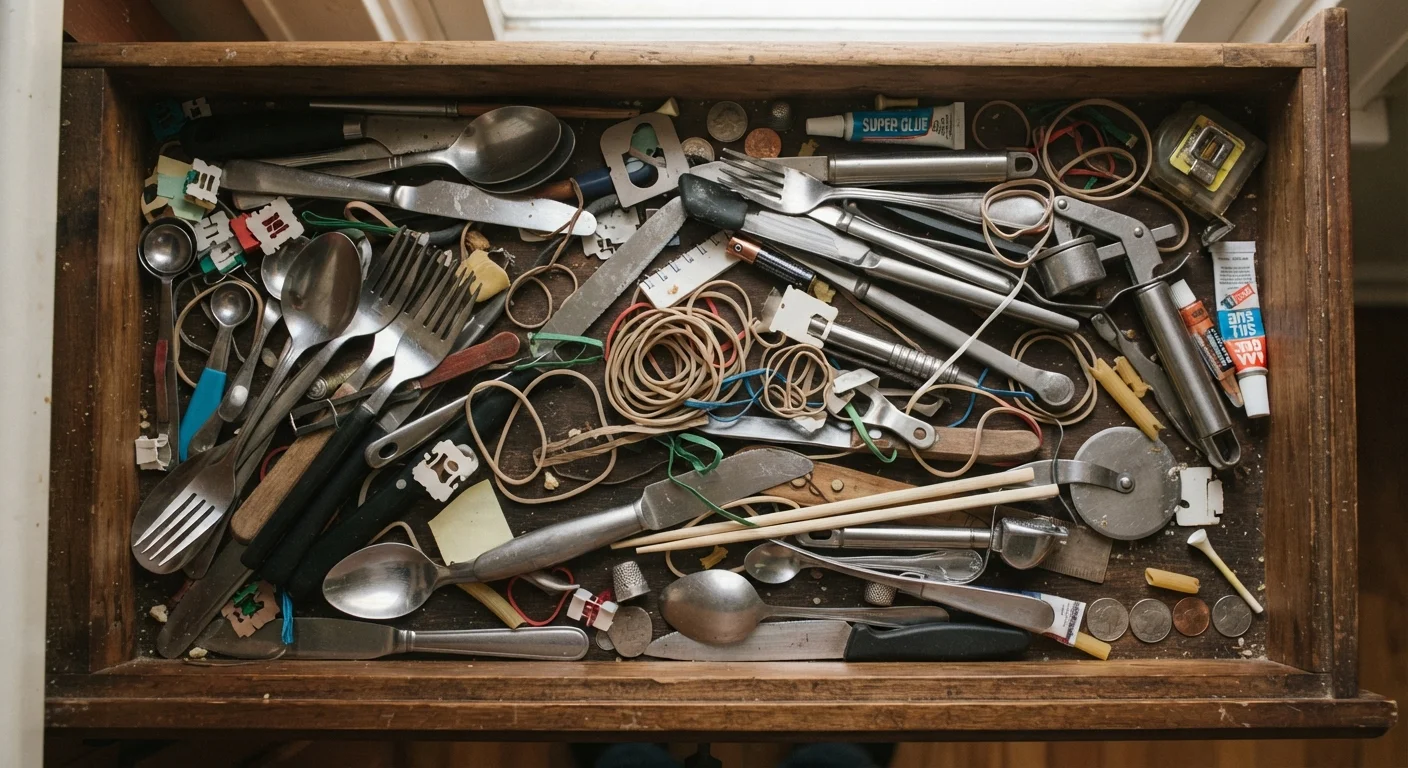
Kitchen drawers fail at organization more reliably than almost any other storage space in the home. They are deep enough to hide things, close easily to conceal the mess, and sit at the intersection of nearly every daily task: cooking, cleaning, snacking, mail sorting, and emergency repairs. That mix of functions is the first problem.
Unlike a pantry or a cabinet with visible shelves, a drawer rewards avoidance. You can shut it and not see the problem until the drawer stops closing properly. By then, months of small decisions have compounded into a genuine excavation project.
The good news is that the most common reasons drawers fall apart are predictable, and most can be addressed without buying a single storage product. For a broader view of how drawer organization fits into whole-home systems, see the complete home organization guide.
The mistakes that cause drawer chaos
These are the habits and decisions that break down most household kitchen drawer systems. Recognizing the pattern is the first step toward fixing it.
Organizing before decluttering.
Why it happens: Buying dividers and containers feels productive, so people set up systems while the drawer still holds items that should have been discarded or relocated weeks ago.
Treating one drawer as the default for everything without a category.
Why it happens: Households often designate a 'junk drawer' without defining its limits, so it absorbs every item that does not have another obvious home.
Using dividers or inserts that do not fit the actual contents.
Why it happens: People purchase organizers based on drawer dimensions alone, without measuring the tools they intend to store, leading to compartments that are too small, too shallow, or poorly shaped for the real items.
Not accounting for how the household actually uses the kitchen.
Why it happens: Organization plans often follow an idealized version of kitchen behavior rather than real patterns, so frequently used items end up in inconvenient spots.
No reset habit to catch gradual drift.
Why it happens: Even well-organized drawers accumulate misplaced items over time, but most households have no regular moment to address it, so small drift becomes large disorder.
If your drawers share space with paperwork, coupons, or mail, that overlap deserves separate attention. The paper clutter cycle follows its own logic and responds to different solutions than physical kitchen items do.
Building a system that holds up
Do not skip the empty-out step
Reorganizing around existing contents almost always fails. Items that have been living in the drawer through inertia rather than intention will undermine any new system. Pull everything out, sort on a flat surface, and only return what has a defined purpose in that space.
Once you have decluttered and identified what belongs in each drawer, the setup itself is straightforward. Assign each drawer a single category of use: cooking tools, baking supplies, cleaning accessories. Drawers with mixed purposes tend to revert to catch-all status because no one can tell at a glance where something should go.
Dividers help, but only if the compartment sizes match the actual items you own. Measure before purchasing any inserts. If your household includes multiple people with different organization instincts, the shared living spaces guide covers how to set up systems that more than one person will actually use.
For storage challenges in adjacent kitchen areas, the under-sink cabinet guide addresses the awkward but useful space below the kitchen sink. And if you are considering larger kitchen changes alongside your organization efforts, it helps to understand what drives kitchen renovation costs before committing to any structural solutions.