

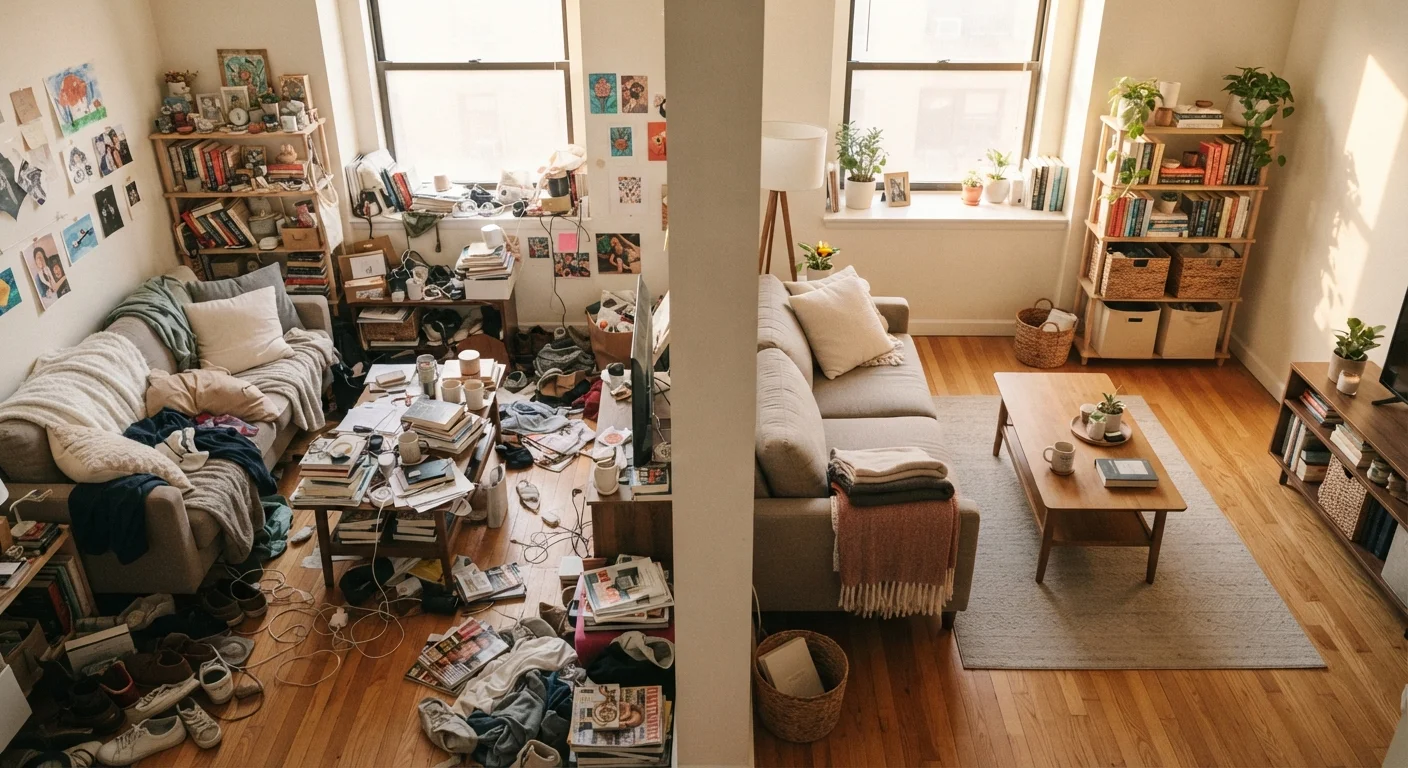
Key Takeaways
- Decluttering means deciding what to keep; organizing means assigning kept items a permanent, logical home.
- Organizing before decluttering wastes effort because systems built around excess items collapse when those items leave.
- The correct sequence is always: declutter first, then organize what remains.
- Many households mistake tidy-looking arrangements for organization, which is why clutter returns quickly.
- Maintaining an organized home is easier when the volume of possessions stays manageable over time.
Option A
Decluttering
The necessary first step: deciding what stays.
Best for: Anyone who wants to reduce the total volume of possessions before building any organizational system.
Option B
Organizing
The structural layer: giving what stays a permanent home.
Best for: Households that have already reduced excess and need reliable, maintainable systems for what remains.
If your home feels chaotic and you do not know where to begin
Decluttering
No organizational system can compensate for too much stuff. Reduce first, then build structure around what you choose to keep.
If you have already removed excess items and things still feel disorganized
Organizing
Once volume is under control, assigning fixed homes to remaining items and building consistent habits will make the difference.
If clutter keeps returning despite repeated tidying sessions
Decluttering
Recurring clutter usually signals that the total quantity of possessions exceeds available space; another round of decluttering addresses the root cause.
If you have a shared home with multiple people who have different habits
Organizing
After each household member has reduced their own excess, shared organizational systems give everyone clear expectations about where items belong.
What each word actually means
The two words get used interchangeably, but they describe completely different activities. Decluttering is a decision-making process: you go through your possessions and decide which ones to keep, donate, discard, or relocate. Nothing gets a permanent home yet. The goal is to reduce volume.
Organizing starts after that decision is made. It means assigning every kept item a specific, logical location that suits how you actually use it, then building habits that return items to that location after each use. A labeled bin, a drawer divider, or a shelf arrangement are all organizational tools. They only work on the items that belong in your home long-term.
The confusion between these two activities is not semantic. It produces a repeatable pattern: someone buys storage containers, fills them with everything currently on the counter, calls it organized, and finds the same surface covered in clutter three weeks later. The containers did not fail. The sequence did.
Why order matters more than method
When you organize before you declutter, you build a system around the wrong inventory. Consider a kitchen junk drawer that holds 14 pens, half of which do not work, three expired coupons, and a charger for a phone you no longer own. You could buy a drawer organizer, sort everything into compartments, and have it looking tidy in under an hour. Two months later, that same drawer is overflowing again.
The system failed because its foundation was excess. Once you pull everything out, test each pen, discard the non-functioning ones, remove the expired coupons, and decide that two or three pens are enough for a kitchen drawer, organizing becomes straightforward. There is simply less to manage. See how this plays out in detail in why kitchen drawer organization breaks down.
This is true in every room. Organizational systems are not infinitely elastic. They hold a certain volume of items efficiently, and that volume should be determined by actual need, not by what happened to accumulate.
| Criterion | Decluttering | Organizing |
|---|---|---|
| Primary goal | Reduce total volume of items | Assign permanent homes to kept items |
| When it happens | First, before any system is built | Second, after volume is reduced |
| Main activity | Deciding what to keep or remove | Sorting, labeling, and placing items logically |
| Tools involved | Donation bags, trash bags, decisions | Bins, dividers, labels, shelving |
| Result if done alone | Cleaner space, but no lasting system | Neat-looking space that clutter quickly refills |
| How often needed | Periodically, as possessions accumulate | Once established, maintained through daily habits |
For a structured, room-by-room approach to the decluttering phase, this decluttering framework walks through each space without making the process feel overwhelming.
What good organizing actually looks like
After decluttering, organizing has three practical requirements. First, every item that stays needs a single designated location. Vague zones do not work: "somewhere in the office" is not a home for a stapler. A specific drawer or shelf is.
Second, that location should reflect actual use patterns. Items used daily belong within easy reach. Items used seasonally can be stored higher or deeper. When a system fights how people naturally move through a space, it gets abandoned quickly.
Third, the system needs to be simple enough for everyone in the household to follow without instruction. If a guest cannot figure out where something belongs by looking at the space, the system is too complex. This matters more in shared homes, where organizing around different habits requires extra clarity about where things live.
Organization is also not a one-time event. It needs periodic review, particularly after life changes such as a move, a new family member, or a shift in routines. The one-in, one-out principle is one practical way to keep volume from creeping back up between those reviews.
Putting it together
The sequence that works is consistent: declutter, then organize. Remove what does not belong in your home before deciding how to store what does. This is true whether you are tackling a single drawer or working through an entire home with the help of a complete home organization guide.
Physical spaces are not the only places where this logic applies. Digital files, photos, and device storage follow the same pattern: delete before you sort. Digital clutter at home accumulates by the same mechanism and responds to the same approach.
Getting the order right does not make the work effortless, but it does make the results durable. A well-organized home with a reasonable volume of possessions is far easier to maintain than a cleverly arranged home with too much in it.