

Key Takeaways
- One-in, one-out is a maintenance habit, not a decluttering method.
- The rule works best when applied to categories, not your whole home at once.
- Friction at the point of purchase is where the rule has the most power.
- Shared households need explicit agreement for the rule to hold.
- Starting small with one category builds the habit before expanding it.
One-in, one-out rule
The one-in, one-out rule is a household habit where every time you bring a new item into your home, you remove an existing item of the same type. It is not a one-time decluttering method but an ongoing practice that prevents possessions from accumulating beyond your available space. The goal is to hold your total volume of belongings roughly steady over time.
In behavioral terms, the rule works as a "commitment device" that interrupts the default pattern of acquisition without disposal, which is the main driver of clutter returning after a clean-out.
Why clutter keeps coming back
Most households go through a version of the same cycle: a big weekend declutter, a clean and organized home for a few weeks, then a gradual return to the same crowded shelves and overstuffed drawers. The problem is rarely effort. The problem is that clearing out without changing incoming behavior leaves the door open for the same accumulation to happen again.
Clutter builds incrementally. A birthday gift here, a sale purchase there, a "just in case" item that never gets used. None of it feels significant in the moment, and that is exactly why the volume grows unnoticed. The one-in, one-out rule addresses this by creating a visible transaction at the point a new item arrives, before it disappears into a drawer.
If you have wrestled with this cycle, the related article on decluttering vs. organizing explains why sequencing matters and why organizing before you declutter tends to reset the cycle rather than break it.
How the rule actually works
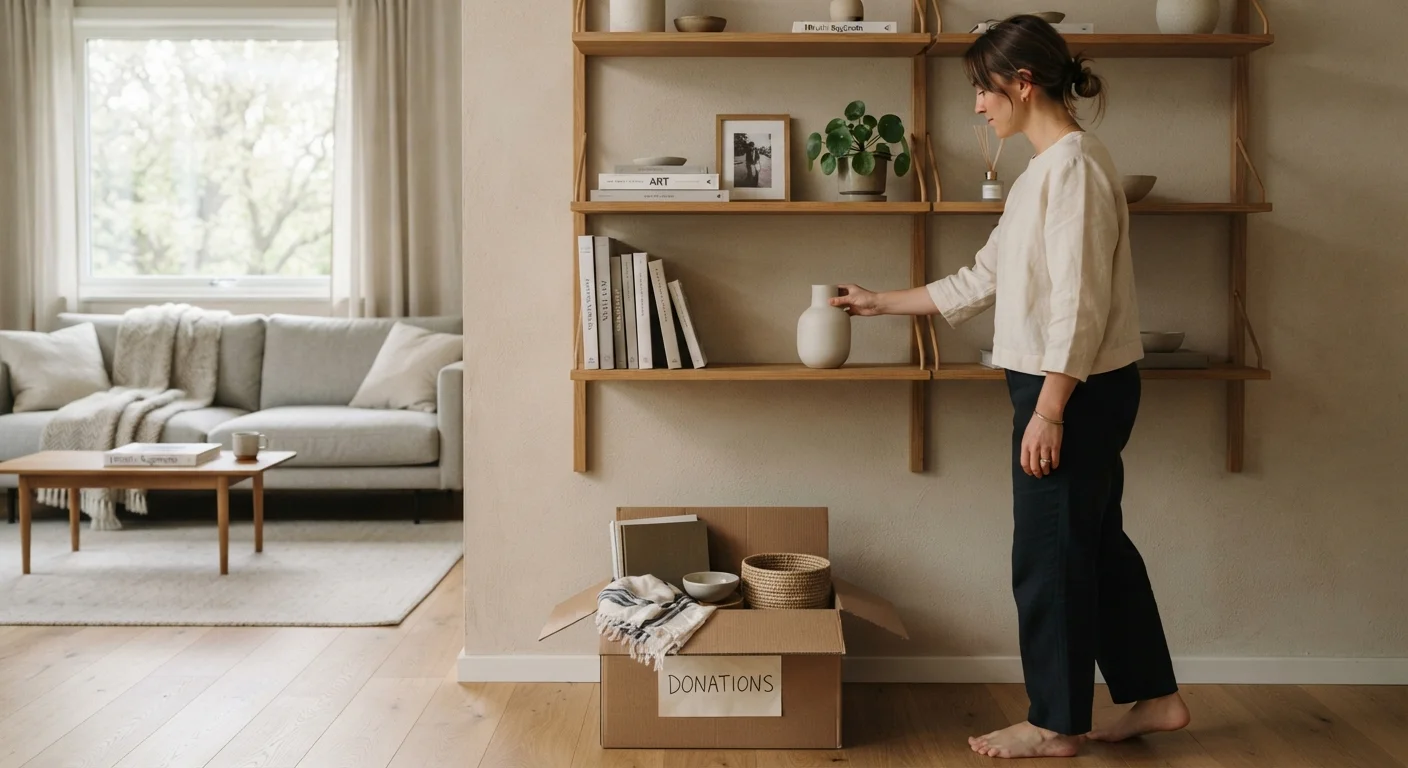
The mechanics are straightforward: when something new comes in, something comparable goes out. New running shoes mean an old pair leaves. A new kitchen gadget means an existing one goes to the donation box. The transaction is one-for-one, and it happens at the time of acquisition, not later.
The word "comparable" is doing a lot of work here. The rule is most useful when applied within categories because that is how storage actually functions. A closet has a fixed volume. A kitchen drawer has a fixed volume. Matching new items to the same category keeps the constraint real rather than theoretical.
Apply the rule before you buy
Asking "what goes out if this comes in?" at the point of purchase, not after the item arrives home, is where the rule has the most leverage. If you cannot name the outgoing item on the spot, that is a useful signal to wait. Waiting 24 hours before completing a non-essential purchase is a simple habit that pairs well with this approach.
Applying the rule at the moment of purchase, not after the item arrives home, is where it has the most stopping power. Asking "what leaves if this comes in?" while still in the store changes the calculus of whether to buy at all.
For closets specifically, a consistent rotation habit makes this easier to track. The guide on seasonal clothing rotation walks through a repeatable process that pairs well with one-in, one-out.
Where the rule tends to break down
The most common failure point is deferral. Someone brings in a new item with the intention of deciding what goes out later, and "later" never arrives. The outgoing item needs to be identified at the same time the incoming one is accepted, or the rule collapses into good intentions.
A second failure is poorly defined categories. If "household stuff" is the category, anything can substitute for anything, which means nothing actually has to leave. Specific categories, such as coffee mugs, throw blankets, or power tools, make the constraint concrete.
Shared households present a particular challenge. One person following the rule while another does not will not hold the household's volume steady. The rule needs to be a shared agreement, and that agreement needs to cover what happens with gifts and communal purchases. The article on organizing shared living spaces covers how to build systems when household members have different habits.
1 in 10
U.S. households renting a storage unit
The Self Storage Association has reported that approximately one in ten U.S. households rents off-site storage, a figure that points to how common overflow beyond home storage has become.
25%
Households with a garage too full to park a car
A widely cited statistic from the U.S. Department of Energy estimates that roughly a quarter of households with two-car garages have too much stuff inside to fit a vehicle.
Starting with the right category
Applying the rule to an entire home at once is ambitious to the point of being impractical. A better approach is to start with one category that already has a clear boundary and a recurring pattern of new items arriving.
Clothing is a natural starting point for most households because purchases are frequent and the storage space is bounded. Kitchen tools are another good candidate, especially in spaces where drawer overflow is already a problem. The article on kitchen drawer organization covers why that space tends to accumulate faster than others.
Once the habit is established in one category, extending it to others is much easier. The rule does not need to cover every corner of the home to be useful; even consistent application in two or three high-traffic categories will measurably reduce the rate at which clutter rebuilds. Digital possessions are a separate but parallel problem, and the approach carries over there too. The guide on digital clutter at home covers how the same accumulation pattern plays out with files, photos, and devices.