

Key Takeaways
- Tailgating is one of the most common factors in rear-end collisions, which account for a large share of US crash injuries.
- Human reaction time alone consumes most of a two-second following gap before braking even begins.
- Both aggressive drivers and inattentive drivers tailgate, though for different reasons.
- Wet, icy, or debris-covered roads extend stopping distances far beyond what most drivers expect.
- Increasing following distance is one of the lowest-effort, highest-impact changes a driver can make.
Tailgating
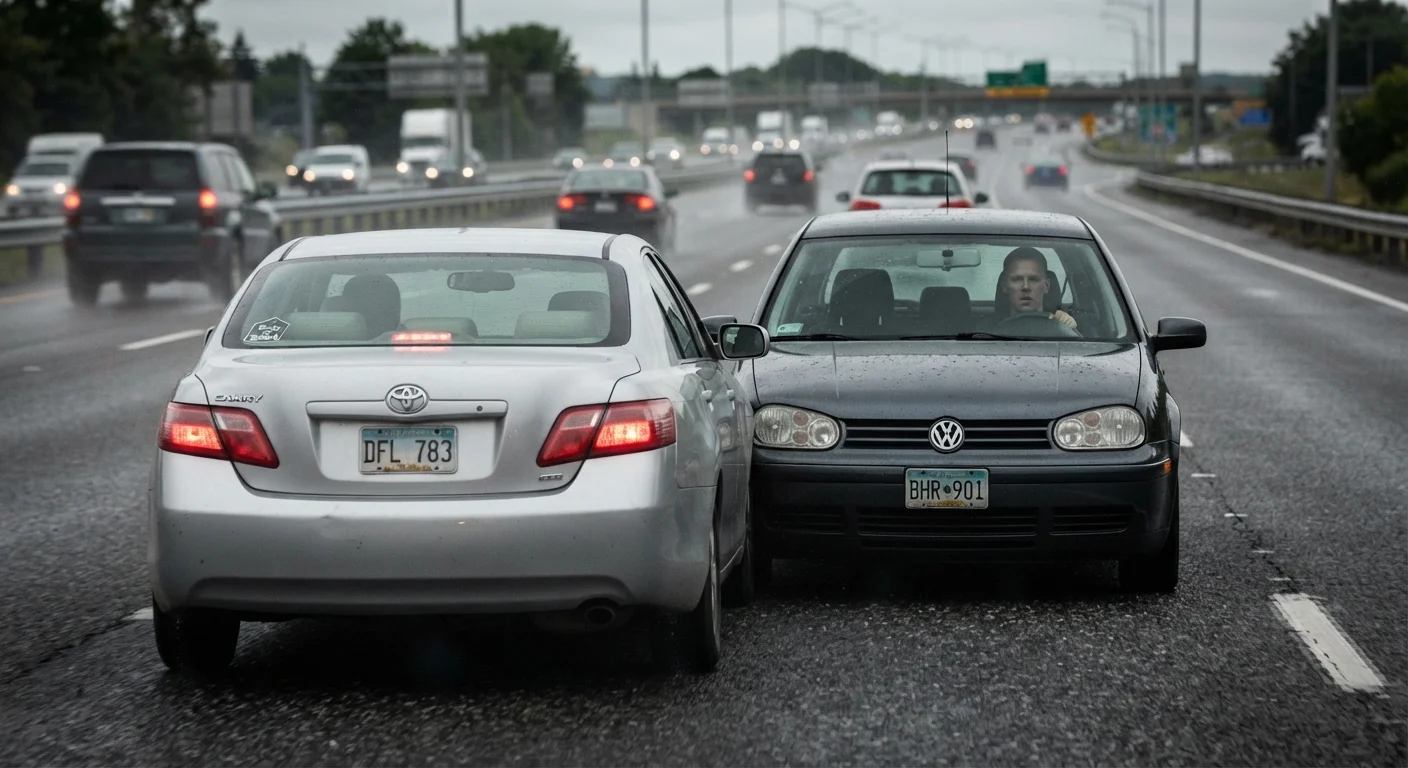
Tailgating means following another vehicle so closely that there is not enough space to stop safely if the car ahead brakes suddenly. Most driving safety guidance defines a safe following distance as at least two to three seconds of travel time behind the vehicle in front. Closing that gap below the recommended threshold is tailgating, whether intentional or not.
At highway speeds, a passenger vehicle traveling at 65 mph covers roughly 95 feet per second. A two-second following gap leaves approximately 190 feet of stopping distance, which is near the minimum for most dry-road braking scenarios.
What the physics actually look like
Stopping a vehicle is not instantaneous. Two separate time windows exist between a hazard appearing and the car coming to a complete stop: the driver's reaction time, and the mechanical braking distance. Reaction time for an alert driver is typically 1.5 seconds. During that window, a vehicle traveling at 60 mph travels 132 feet before the brakes even engage. Braking distance on dry pavement at 60 mph adds another 180 feet or more, depending on the vehicle and tires.
A driver following two car lengths back at that speed has perhaps 30 feet of buffer. The math does not work. Wet or icy roads multiply braking distance significantly, sometimes by a factor of two or three. This is why following distance recommendations are expressed in seconds rather than car lengths: seconds scale automatically with speed, car lengths do not.
29%
Share of all US crashes that are rear-end collisions
NHTSA crash data has consistently placed rear-end crashes as one of the largest single crash categories by frequency on US roads.
1.5 sec
Average driver reaction time before braking begins
Transportation safety research uses 1.5 seconds as a standard estimate for an alert driver's perception-reaction time under normal conditions.
2-3x
Increase in stopping distance on wet pavement
Vehicle braking performance drops substantially on wet roads, with stopping distances often doubling or tripling compared to dry asphalt at the same speed.
Fatigue makes the equation worse. A tired driver's reaction time stretches past two seconds in some conditions, consuming the entire recommended following gap before the foot even moves to the brake pedal. The article on driver fatigue and reaction time covers how drowsiness degrades the specific skills tailgating already tests.
Why drivers follow too closely
Tailgating falls into two broad categories that look similar from outside a vehicle but come from different mental states.
The first is deliberate aggressive following. A driver frustrated by what they perceive as slow traffic may close the gap intentionally, treating it as a signal or pressure tactic. This behavior is common during commutes, in construction zones, and on single-lane roads where passing is not possible. It frequently connects to the broader pattern of aggressive driving that separates high-risk from low-risk drivers.
The second category is inattentive drift. A driver focused on navigation, a conversation, or road signs may not consciously register that their following gap has shrunk. This type of tailgating is especially common at highway speeds, where relative motion feels slower and distances compress visually. The driver feels as if they are maintaining a reasonable gap because surrounding vehicles are all moving at roughly the same speed.
A third contributing factor is overconfidence in personal reaction time. Many drivers believe they can stop quickly enough regardless of following distance. Human perception research consistently shows that people overestimate their own reaction speed, particularly when they are mildly distracted.
The real-world crash picture
Rear-end collisions are among the most frequent crash types on US roads. The National Highway Traffic Safety Administration (NHTSA) has consistently identified them as a leading crash category, accounting for a substantial portion of injury crashes each year. Following-too-closely is one of the most commonly cited driver behaviors in police crash reports for these events.
The injuries from rear-end crashes often appear mild but carry lasting consequences. Whiplash-type soft tissue injuries of the neck and spine are common even in low-speed impacts. Occupants of the struck vehicle bear the greater injury burden, which means tailgating imposes risk primarily on others rather than only on the tailgating driver.
Highway chain-reaction crashes illustrate the cascading effect. When one driver brakes hard, the vehicle behind must brake harder to compensate for the shorter gap, and so on down the line. A sequence of drivers each following half a second too closely can produce a pile-up from a minor slowdown that would otherwise have been absorbed without incident.
How defensive driving addresses the gap problem
Maintaining following distance is one of the most concrete practices in defensive driving. The principle is straightforward: a driver who controls their own following gap removes themselves from the most common collision scenario without depending on other drivers to behave correctly.
Applying the two-second rule consistently is easier than it sounds once it becomes a habit. Count using a bridge pillar, road sign, or shadow line as the reference point. If three seconds pass comfortably before you reach that point after the car ahead does, the gap is adequate for normal dry-road conditions. In rain, drop speed and extend to four seconds.
Drivers who are new to unfamiliar roads benefit especially from this habit. The challenges of driving on unfamiliar routes include reduced attention for following distance as mental resources shift to navigation. Building a following-distance habit means it persists even when attention is divided.
Anxiety behind the wheel sometimes contributes to tailgating from a different direction. A driver who feels nervous about being passed or being perceived as slow may unconsciously close the gap ahead of them. Understanding that dynamic is covered in the discussion of driving anxiety and its causes.