

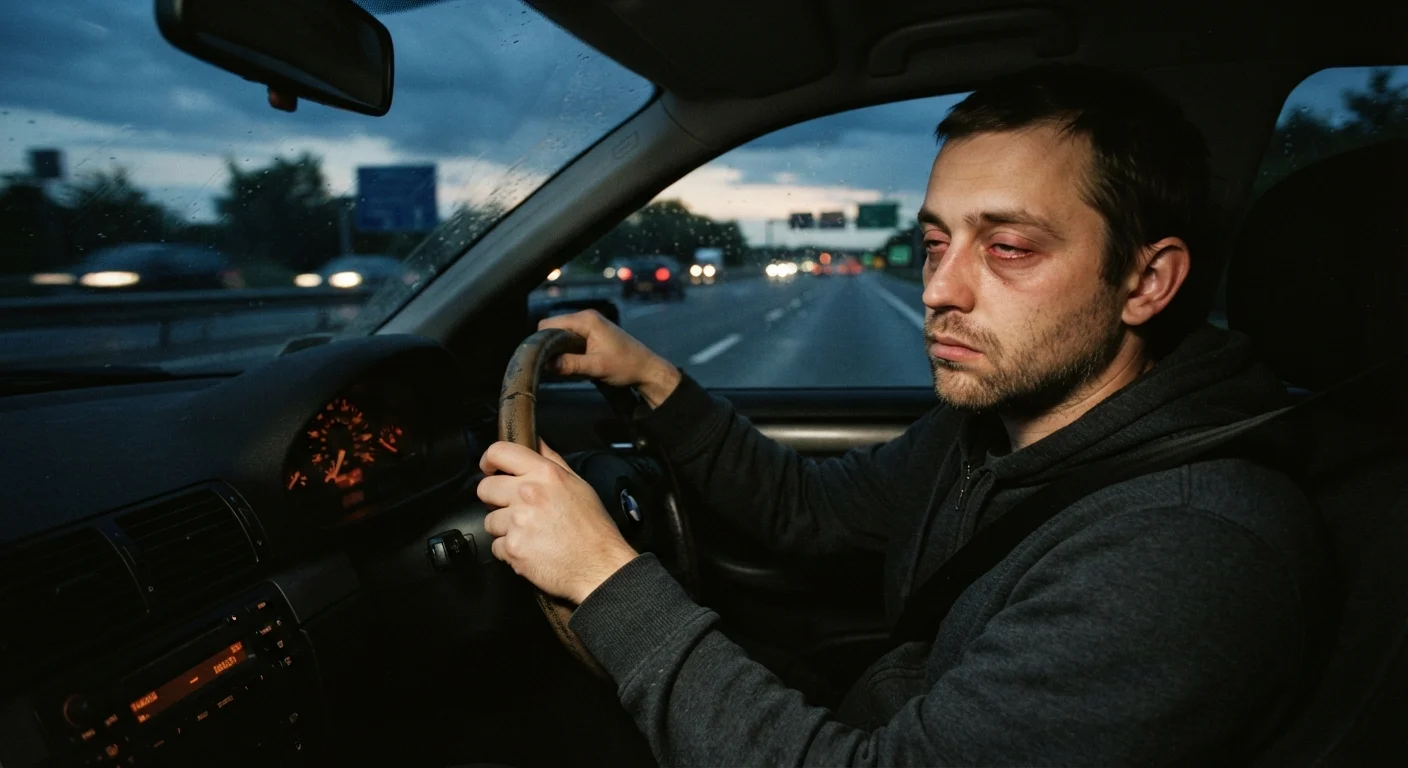
Key Takeaways
- Drowsy driving impairs reaction time to a degree comparable to driving with a blood alcohol concentration above the legal limit.
- Microsleeps, brief involuntary episodes of sleep lasting two to five seconds, can occur without any warning.
- The body's circadian dip between 2 a.m. and 6 a.m. and again in the early afternoon creates peak risk windows.
- Caffeine can reduce sleepiness temporarily but cannot replace the alertness that only sleep provides.
- If you notice warning signs of fatigue while driving, pulling off safely and resting is the only reliable response.
Driver fatigue
Driver fatigue is a state of physical or mental tiredness that impairs a driver's ability to operate a vehicle safely. It slows reaction time, reduces awareness of hazards, and can cause involuntary microsleeps lasting several seconds. Unlike many hazards on the road, fatigue can worsen gradually without the driver noticing.
Fatigue-related impairment is measurable through lane deviation, response latency, and eyelid closure frequency. Research published by the National Highway Traffic Safety Administration (NHTSA) has linked drowsy driving to tens of thousands of crashes annually in the United States.
What makes fatigue so dangerous behind the wheel
Most drivers can recognize when they are tired, yet many continue driving anyway. The problem is that fatigue does not simply make driving harder; it changes the brain's ability to process information, anticipate hazards, and execute the rapid corrections that safe driving requires.
Fatigue works against drivers in several ways at once. Reaction time slows, meaning the gap between seeing a hazard and responding to it grows. Peripheral vision narrows. Judgment about speed and distance becomes less accurate. Perhaps most dangerously, the brain begins to "fill in" gaps in attention, making drivers feel more aware than they actually are.
Microsleeps are a particular hazard. These are involuntary episodes of sleep that last two to five seconds. At 60 mph, a two-second microsleep means a vehicle travels roughly 176 feet with no one in control. Drivers often have no memory of a microsleep after it happens, which is why fatigue-related crashes frequently involve no skid marks: there was no braking at all.
The effect of fatigue on reaction time compounds with other factors. Driving at night already reduces visibility and depth perception; combined with fatigue, the risk increases substantially. See our guide on night driving hazards and skills for context on why these conditions overlap so often.
Who is most at risk and when
While any driver can become fatigued, certain groups face consistently higher risk. Commercial truck drivers on long-haul routes, night-shift workers commuting home in the early morning, and younger drivers (particularly men aged 16 to 25) appear most frequently in drowsy-driving crash data from NHTSA.
Timing matters as much as who is driving. The body's circadian rhythm creates predictable dips in alertness that occur regardless of how rested a person feels. The deepest dip runs between 2 a.m. and 6 a.m. A secondary dip occurs in the early-to-mid afternoon, typically between 2 p.m. and 4 p.m. Driving during these windows on insufficient sleep multiplies the risk further.
100,000+
Police-reported drowsy-driving crashes annually
According to NHTSA estimates, drowsy driving causes more than 100,000 reported crashes each year in the United States, though actual figures are considered higher due to underreporting.
0.10% BAC
Impairment equivalent after 24 hours awake
Research has found that 24 hours without sleep produces driving impairment comparable to a blood alcohol concentration of approximately 0.10 percent, above the US legal limit.
176 feet
Distance traveled in a 2-second microsleep at 60 mph
At highway speed, a two-second involuntary sleep episode means a vehicle covers roughly 176 feet with no driver input, equivalent to more than half the length of a football field.
Sleep debt is cumulative. A driver who gets five hours of sleep per night across a work week has not simply lost one night's rest; the cognitive impairment accumulates across days. Catching up on a single night does not fully restore performance, particularly in complex tasks like driving on unfamiliar routes.
Warning signs drivers should not ignore
Fatigue gives warning signs before a driver reaches the microsleep threshold. Recognizing them requires honest self-assessment, because the same impairment that causes drowsy driving also reduces a person's ability to accurately gauge their own state.
- Frequent, involuntary blinking or difficulty keeping the eyes open
- Drifting from the lane or running over lane markings
- Missing exits, turns, or road signs
- Difficulty remembering the last few miles of driving
- Repeated yawning
- Restlessness, irritability, or difficulty concentrating
Any one of these signals that fatigue has already begun to affect driving ability. Waiting for the feeling to pass without stopping is not a reliable strategy. Drowsy driving shares some cognitive territory with distracted driving: for related context, see how in-car distraction affects focus.
What actually helps and what does not
Several countermeasures are widely promoted but provide only minimal short-term benefit. Turning up the radio, opening a window, or drinking cold water can produce a brief alerting effect that fades within a few minutes. These are not solutions; they may give a false sense of having addressed the problem.
Caffeine works differently. It temporarily blocks adenosine, the chemical that builds up in the brain during wakefulness and produces sleepiness. A cup of coffee or an equivalent caffeine source takes roughly 20 to 30 minutes to take effect and can sustain alertness for 30 to 45 minutes. A short nap of 20 minutes taken before consuming caffeine can improve its effectiveness, since the caffeine activates as the driver wakes up. This approach is sometimes called a "nap-a-ccino," though it remains a short-term measure to get safely off the road, not a substitute for sleep.
The only effective response to significant fatigue is to stop driving and sleep. Pulling into a rest stop, a well-lit parking area, or a safe location and sleeping for 20 to 90 minutes restores more function than any stimulant. Planning long drives around sleep schedules, sharing driving duties where possible, and getting adequate rest before a trip are the most reliable preventive measures.
Drivers who find anxiety or apprehension compounds their fatigue on the road may benefit from reading about driving anxiety and its causes. Stress and tension can accelerate the onset of mental fatigue on long trips.