

| Minimum legal tread depth (US) | 2/32 inch (US Federal Motor Vehicle Safety Standards) |
| Recommended tyre pressure source | Driver's door jamb label |
| Centre wear cause | Over-inflation |
| Both-edge wear cause | Under-inflation |
| One-sided wear cause | Camber misalignment or suspension wear |
| Feathered/diagonal wear cause | Incorrect toe alignment |
| Cupping/scalloping cause | Worn shock absorbers, wheel imbalance, or bent wheel |
| Flat-spot cause | Hard braking (single spot) or balance issues (multiple spots) |
Why tyre wear patterns matter
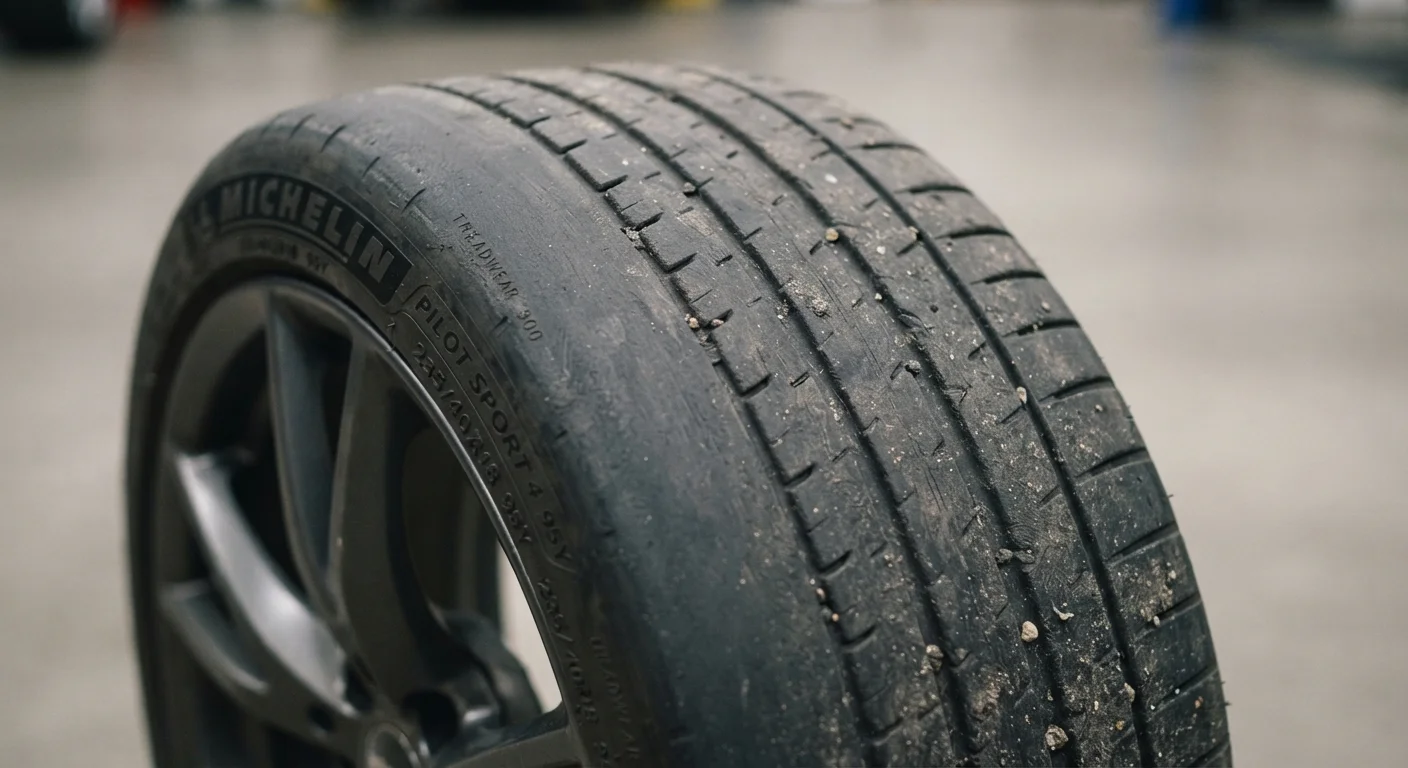
Tyres wear down over time, but the pattern of that wear tells you far more than a simple tread depth measurement. Even wear across the full contact patch is normal. Wear concentrated at specific points signals something else is happening: incorrect inflation, misalignment, worn suspension components, or aggressive driving habits.
Catching these patterns early matters because the underlying cause does not fix itself. A tyre worn unevenly from an alignment problem will continue wearing at the same accelerated rate until the root cause is corrected. By the time the tyre is visually degraded, you may also be facing suspension or steering repairs that could have been caught sooner.
Checking tyre wear takes about two minutes. Run your hand across the tread from inner to outer edge. Notice whether any section feels lower, smoother, or more scalloped than the rest. Compare that feel against the patterns below to narrow down the likely cause. For a complete pre-drive inspection routine, see our pre-trip vehicle checklist.
Camber
The vertical tilt of a wheel when viewed from the front. Negative camber means the top of the wheel leans inward; positive camber means it leans outward. Excessive camber in either direction causes one-sided tyre wear.
Toe alignment
The angle at which tyres point relative to the vehicle's centerline when viewed from above. Toe-in means the fronts of the tyres angle toward each other; toe-out means they angle away. Incorrect toe causes diagonal or feathered wear.
Cupping (scalloping)
A tyre wear pattern where the tread surface develops alternating high and low spots around the circumference. It typically results from worn shock absorbers, wheel imbalance, or a bent wheel.
Tread depth
The measurement from the top of the tread block to the base of the tread groove. In the US, a tread depth below 2/32 of an inch is the legal minimum, though handling degrades noticeably before that point.
Shock absorber / strut
A suspension component that controls wheel movement and dampens bounce. When worn, it allows the wheel to bounce excessively against the road, producing cupped or scalloped tyre wear.
Feathering
A diagonal wear pattern where each tread block is higher on one side and lower on the other. It is a sign of incorrect toe alignment dragging the tyre sideways during rotation.
Common wear patterns and what they indicate
| Minimum legal tread depth (US) | 2/32 inch (US Federal Motor Vehicle Safety Standards) |
| Recommended tyre pressure source | Driver's door jamb label |
| Centre wear cause | Over-inflation |
| Both-edge wear cause | Under-inflation |
| One-sided wear cause | Camber misalignment or suspension wear |
| Feathered/diagonal wear cause | Incorrect toe alignment |
| Cupping/scalloping cause | Worn shock absorbers, wheel imbalance, or bent wheel |
| Flat-spot cause | Hard braking (single spot) or balance issues (multiple spots) |
Centre wear
The centre of the tread is more worn than the outer edges. This happens when a tyre is consistently over-inflated. An over-inflated tyre bulges in the middle, concentrating contact with the road in the centre strip and lifting the edges slightly off the surface.
Edge wear (both sides)
Both outer edges are more worn than the centre. This is the opposite problem: chronic under-inflation. A tyre without enough air spreads outward under load, putting more contact pressure on the edges. It also runs hotter, which accelerates wear and increases blowout risk. The safety consequences of incorrect inflation go beyond tread life alone.
One-sided edge wear
Only one edge, inner or outer, is more worn than the other. This pattern points to a wheel alignment problem, specifically incorrect camber. Negative camber tilts the top of the wheel inward; if it is excessive, the inner edge takes most of the load. Positive camber has the opposite effect. A mechanic can measure and adjust camber, but worn ball joints or control arm bushings can prevent alignment from holding, so those should be inspected too. See how suspension problems show up in vehicle stance for related indicators.
Diagonal or feathered wear
The tread blocks are higher on one side and lower on the other in a repeating diagonal pattern, sometimes called feathering or sawtoothing. This typically comes from incorrect toe alignment. Toe refers to whether the fronts of the tyres point slightly inward (toe-in) or outward (toe-out) relative to each other. Incorrect toe drags the tyre sideways slightly with every rotation, shaving the edges of each tread block at an angle.
Cupping or scalloping
The tread has a wavy, scooped appearance with high and low spots alternating around the circumference. This pattern usually means a shock absorber or strut is worn and no longer damping wheel bounce effectively. Each time the wheel bounces, it hits the road with uneven force, gouging the tread in patches. Cupping can also result from wheel imbalance or a bent wheel, though those tend to produce different wear distributions.
Patchy or flat-spot wear
One or more flat spots appear at specific points around the tyre. A single flat spot is often caused by a hard braking event that locked the wheel and scraped the tread on the road surface. Multiple flat spots in a regular pattern around the tyre may indicate a wheel balance problem or a tyre that has developed a stiff spot from sitting stationary for a long period.
What to do after identifying a pattern
Reading the pattern is only useful if the next step is action. For inflation-related wear, check and correct tyre pressure using the vehicle manufacturer's specification, which is printed on a label inside the driver's door jamb, not on the tyre sidewall itself. Do this when the tyres are cold, before the vehicle has been driven.
For alignment or camber issues, have the alignment checked by a qualified shop with the appropriate equipment. A standard two-wheel or four-wheel alignment service addresses toe and camber settings. If worn suspension components are preventing proper alignment, those need to be replaced first. Brake components are often inspected at the same time, since alignment visits give a technician access to the full wheel assembly.
For cupping from shock absorber wear, have the shocks or struts inspected. A worn shock may still function partially, making the problem easy to overlook until tyre wear becomes obvious.
After correcting any mechanical issue, the affected tyre may or may not be salvageable depending on how much tread remains and whether the wear is structurally compromising. Have a tyre professional assess remaining depth and evenness. Tyre rotation, done on the schedule in your owner's manual, helps catch developing patterns before they become severe. For the broader maintenance context, see routine car maintenance every owner should understand.