

Key Takeaways
- New brake pads typically start at 10 to 12 mm of friction material; replacement is generally needed at 2 to 3 mm.
- You can often see pad thickness through the wheel spokes without removing the wheel.
- Squealing, grinding, and a soft brake pedal are warning signs that should not be ignored.
- Driving on worn pads extends stopping distances and can damage the brake rotor.
- Front pads wear faster than rear pads on most vehicles and need more frequent inspection.
What brake pad thickness numbers actually mean
Brake pads consist of a metal backing plate bonded to a layer of friction material. The friction material is what contacts the rotor to slow the vehicle, and its thickness is what mechanics and manufacturers measure when assessing wear.
Most new pads carry 10 to 12 mm of friction material. As pads wear down toward 4 mm, they are approaching the end of their useful life. At 2 to 3 mm, replacement is generally overdue. A built-in wear indicator, a small metal tab attached to the pad, contacts the rotor at around this threshold and produces the familiar high-pitched squeal intended to alert the driver.
What makes this worth understanding is that thin pads do not just reduce braking power in a linear way. A pad worn to 2 mm has far less ability to absorb heat than one at 6 mm, which increases the risk of brake fade under repeated or hard stops. Pair this with aging brake fluid, and stopping performance can degrade substantially before the driver notices anything unusual.
How to check brake pad thickness yourself
A visual inspection requires no special tools in most cases. On vehicles with open-spoke alloy wheels, the brake caliper and pad are often visible without removing anything. Here is how to do a systematic check.
Position yourself to see the brake assembly
Park on a flat surface and turn the steering wheel to full lock in one direction. This rotates the front wheel outward and gives a clearer line of sight to the brake caliper behind the spokes. Use a flashlight if the light is poor.
Locate the brake pad inside the caliper
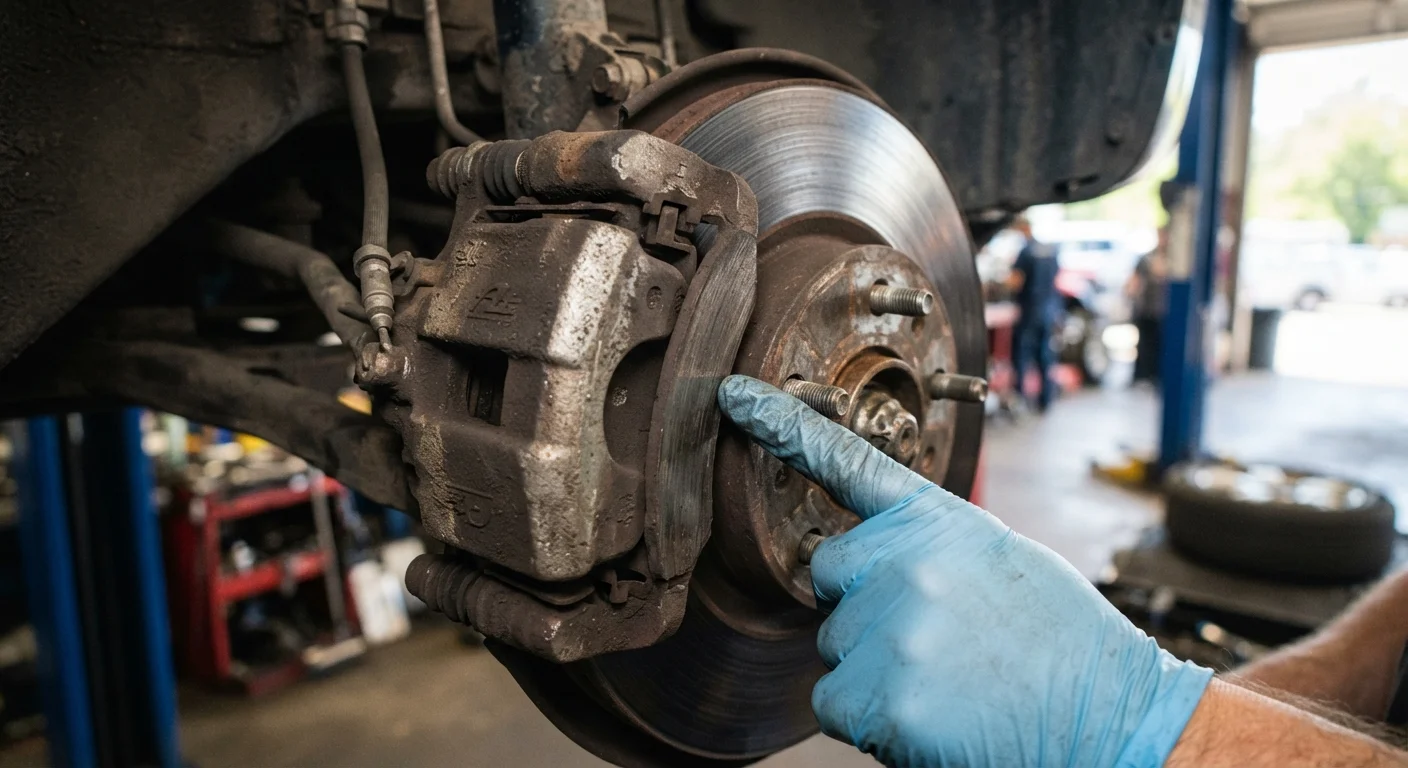
Look through the wheel spokes for the caliper, the C-shaped clamp that grips the rotor (the large metal disc). The brake pad sits between the inner face of the caliper and the rotor. You will see the friction material as a flat layer pressed against the rotor's edge.
Estimate the remaining friction material
Compare the visible thickness of the friction layer against a reference. A thickness roughly equal to the width of a US quarter coin (approximately 2.5 mm) is at or below the replacement threshold. If the friction material looks thinner than that, or if you can barely see any material at all, the pads need to be replaced promptly.
Check the rotor surface while you are there
Run a finger along the outer edge of the rotor (with the vehicle stationary and cool). A rotor in good condition feels relatively smooth. Deep grooves or a pronounced lip at the rotor's outer edge indicate that past pad wear has already scored the surface and the rotor may need machining or replacement alongside the new pads.
Repeat for all four wheels
Rear pads typically have more material remaining than fronts, but they should still be checked. Uneven wear between left and right on the same axle can indicate a sticking caliper or an uneven rotor surface. Document what you see for each wheel so you can compare readings over time.
If your wheels have solid hubcaps or very little spoke clearance, you may need to remove the wheel for a proper look. That requires a jack, jack stands, and a lug wrench, and the task should only be done on a stable, level surface. If you are not comfortable doing that safely, a shop inspection is the better option.
Warning signs beyond the squeal
The wear indicator squeal is the intended alert, but several other signs can appear before or alongside it.
- Grinding noise: A metal-on-metal grinding sound during braking means the friction material is gone and the backing plate is contacting the rotor. This requires immediate attention; continuing to drive this way scores the rotor surface and can lead to rotor replacement on top of pad replacement.
- Vibration through the pedal: Pulsating or vibrating feedback when pressing the brake pedal often points to an uneven rotor surface, sometimes caused by allowing pads to wear too far.
- Pulling to one side: If the vehicle drifts left or right when braking, one pad set may be wearing significantly faster than the other side.
- Soft or spongy pedal feel: While more commonly linked to brake fluid issues, a changing pedal feel during braking always warrants inspection.
Brake system condition is closely related to overall stopping ability. Tyre condition also affects braking distance significantly, so if your pads are due for replacement, checking tyre tread at the same time is worthwhile.
Grinding means stop driving on it
If you hear a consistent grinding sound when braking, the pads have worn through to the metal backing plate. Every mile driven in this condition risks scoring the rotor surface beyond what machining can fix, turning a pad replacement into a significantly more expensive rotor replacement. Have the vehicle inspected by a qualified mechanic before continuing regular use.
How often pads actually need to be checked
There is no single mileage figure that applies to every driver. Brake pad wear depends on driving style, vehicle weight, traffic patterns, and pad material. City driving with frequent stops wears pads far faster than highway commuting. A heavy SUV will wear pads more quickly than a small sedan under similar conditions.
A practical baseline: inspect brake pads every 12,000 miles or once a year, whichever comes first. Front pads typically wear faster than rear pads because the front axle carries more of the braking load, so pay particular attention there. Most professional tire rotations or oil change services include a brake inspection, which is a convenient way to keep track between your own checks.
For a complete picture of your vehicle's stopping system, brake fluid condition should be assessed at the same interval. Moisture accumulation in the fluid lowers its boiling point and can quietly reduce braking effectiveness independent of pad wear.