

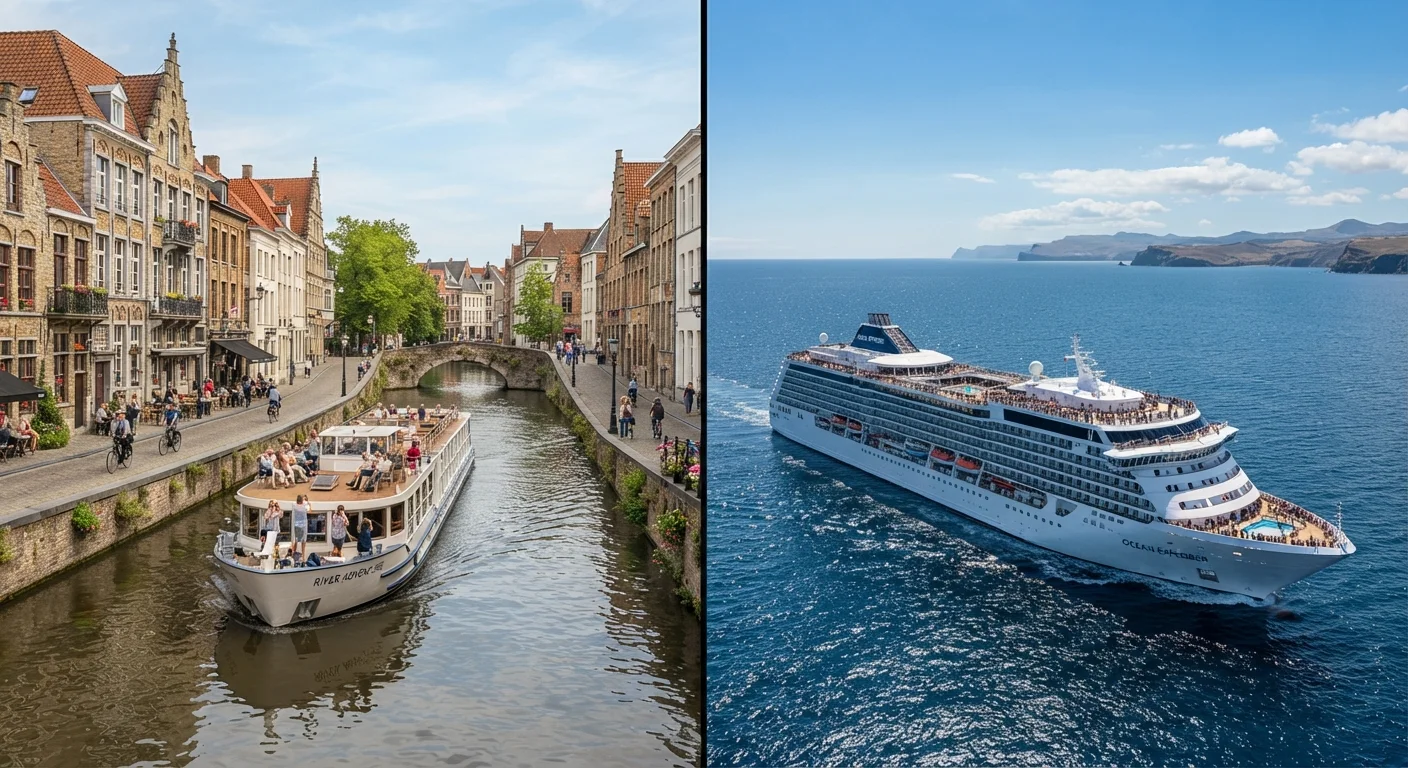
Key Takeaways
- River cruise ships carry far fewer passengers than ocean ships, producing a noticeably quieter atmosphere.
- Ocean cruises generally offer more onboard amenities, including pools, entertainment venues, and multiple dining outlets.
- River itineraries dock in town centers far more consistently than large ocean ships, which anchor offshore.
- Motion sickness is rarely a concern on rivers, while open-water crossings can produce significant swells.
- River cruises tend to cost more per night but often include more meals, excursions, and drinks in the base fare.
- Ocean cruises cover greater geographic range, making them practical for remote or island destinations unreachable by river.
Option A
River Cruises
The intimate, destination-dense option for travelers who want to go deep.
Best for: Travelers who prioritize frequent port stops, cultural immersion, and a relaxed, small-group atmosphere without rough-water concerns.
Option B
Ocean Cruises
The wide-ranging, amenity-rich option for travelers who want more variety.
Best for: Travelers who want onboard entertainment, a range of cabin choices, longer sea days, and access to far-flung international ports.
If you want to wake up in a different European city every morning
River Cruises
River itineraries dock overnight in port, so you can step ashore early or stay late without a tender or transfer.
If you are traveling with children or teenagers who need onboard activities
Ocean Cruises
Large ocean ships have dedicated kids clubs, pools, water slides, and entertainment schedules that river vessels simply do not carry.
If motion sickness is a serious concern for you
River Cruises
Rivers have calm, confined water, so vessel movement is minimal compared to open-ocean crossings even in mild weather.
If you want to reach places like Alaska, the Caribbean, or the Norwegian fjords
Ocean Cruises
Those destinations have no navigable rivers suitable for cruise ships, so an ocean vessel is the only cruise option.
If you prefer a quieter, more socially intimate travel environment
River Cruises
With 100 to 200 passengers on most river ships, the crowd dynamic is closer to a small group tour than a floating resort.
Ship size and passenger experience
The physical difference between the two formats shapes almost every aspect of the trip. Most river cruise ships carry between 100 and 200 passengers and are designed to fit within the lock dimensions of European waterways. Ocean cruise ships range widely, from small expedition vessels around 200 passengers to large resort ships carrying 4,000 or more.
That gap in scale has direct effects. On a river ship, you will likely recognize fellow passengers within the first day, staff ratios are higher relative to guest count, and dining is typically served in a single room at relaxed hours. On a large ocean ship, anonymity is easy to maintain, crowd management at popular venues can be noticeable, and the social atmosphere feels closer to a resort than a neighborhood gathering.
Cabins also differ significantly by format. River staterooms are compact, and many standard cabins have a french balcony (a floor-to-ceiling glass door that opens inward rather than onto a full outdoor deck). Ocean ships carry a much wider range of cabin types. For a detailed look at what each category actually provides, see Cruise Cabin Categories Decoded.
Itinerary structure and port access
River cruises are built around the ports. A typical week-long European river itinerary visits six to eight towns, docking directly in the city center or within easy walking distance of it. Disembarkation is straightforward: you walk off the gangway onto a cobblestone street. This matters practically because it means less time in transit and more time ashore.
Ocean ships dock at commercial cruise terminals, which are sometimes several miles from a city center. Ports that cannot accommodate large ships require tendering, where passengers ride small boats from the anchored ship to the pier, which adds time and can be cancelled in rough conditions. Port Day Planning: Getting the Most from Limited Time Ashore covers how to use port time efficiently regardless of format.
Ocean itineraries, however, cover geography that rivers cannot reach. A Caribbean island-hopping route, an Alaska Inside Passage voyage, or a crossing to the Norwegian fjords has no river equivalent. The trade-off is longer sea days between ports, which suits travelers who find onboard time enjoyable rather than idle.
| Criterion | River Cruises | Ocean Cruises |
|---|---|---|
| Typical passenger count | 100 to 200 | 200 to 4,000+ |
| Port access | City center docking | Terminal or tender required |
| Ports per week | 6 to 8 | 3 to 6 |
| Motion sickness risk | Very low | Low to moderate |
| Onboard amenities | Limited, lounge and dining | Extensive, resort-style |
| Fare inclusions | Meals, excursions, often drinks | Cabin and meals; extras add up |
| Geographic range | Inland waterways only | Global, including remote ports |
| Cabin size | Compact, limited categories | Wide range of categories |
Onboard amenities and included costs
River cruise fares typically bundle a large share of the trip cost upfront. Most lines include all meals, a daily guided excursion, and house wine or beer with dinner in their base price. Some include all beverages and gratuities. This makes budgeting straightforward, though the per-night rate looks high compared to an ocean cruise fare presented at its base level.
Ocean cruise pricing works differently. The headline fare covers the cabin and standard meals, but drinks packages, specialty dining, shore excursions, and gratuities are usually separate line items that accumulate quickly. Comparing sticker prices without accounting for those additions will understate what an ocean cruise actually costs.
Onboard amenities favor ocean ships by volume. A large ocean vessel may have a spa, multiple pools, a casino, live theater, a climbing wall, and a dozen restaurant options. A river ship will have one restaurant, a lounge, a sundeck, and often a small fitness area. Neither is better in absolute terms; the question is whether you want to use those facilities during the trip.
For a grounded look at what cruising actually involves day to day, The Truth Behind Common Cruise Myths addresses several assumptions travelers carry into the booking process.
Motion, comfort, and physical accessibility
Rivers do not produce swells. Passengers who are prone to seasickness on open water generally report no discomfort on river vessels. Ocean ships have stabilizers that reduce pitch and roll considerably, but rough conditions on transatlantic routes, the Drake Passage, or winter sailings in the North Atlantic can still produce noticeable movement for sensitive travelers.
Physical accessibility varies more by individual ship than by format, but the compact size of river vessels does create some constraints. River ships have narrower corridors and fewer elevators than large ocean ships. Embarkation sometimes requires crossing over a neighboring vessel when multiple ships dock side by side, which involves steps and uneven surfaces. Travelers with significant mobility limitations should verify the specific vessel's configuration directly with the cruise line before booking.
Ocean ships built in the last decade generally meet modern accessibility standards more consistently, with wider corridors, multiple lifts, and accessible cabin designs that go beyond what most river vessels provide.