

Key Takeaways
- Kittens use tail position, ear angle, and pupil size together to communicate emotional state.
- Biting and scratching during play is normal but can be redirected with consistent responses.
- The slow blink is a genuine signal of comfort and social trust between cats and humans.
- A kitten that hides frequently may be overwhelmed, not simply shy.
- Vocalizations vary by context: chirping, trilling, and meowing each mean something different.
- Early, positive handling shapes how comfortable a kitten is with humans for life.
Kitten behaviour
Kitten behaviour refers to the full range of actions, sounds, and postures young cats use to express their needs, emotions, and social intentions. Because kittens cannot speak, their communication relies on body language, vocalizations, and interaction patterns. Learning to read these signals helps owners respond appropriately and build a foundation of trust.
Feline behavioural researchers distinguish between intraspecific signals (cat-to-cat) and signals kittens adapt specifically for human communication, such as the adult meow, which cats rarely use with one another.
Reading your kitten's body language
A kitten's body is constantly broadcasting information. The tail, ears, eyes, and posture work together as a single system, and interpreting one in isolation leads to misreading.
Tail position is one of the clearest indicators. A tail held straight up signals confidence and a friendly approach. A tail tucked under the body indicates fear or submission. A puffed, bottle-brush tail means the kitten feels threatened. A tail held low and flicking side to side during play is a sign of rising excitement, not aggression, though it can precede a bite if stimulation continues.
Ears tell a similar story. Forward-facing ears show curiosity or alertness. Ears swiveled to the side or flattened against the head signal anxiety or irritation. Combined with dilated pupils in normal lighting, flattened ears almost always mean the kitten needs space.
Posture rounds out the picture. A kitten that rolls onto its back and exposes its belly is displaying trust, though this is not necessarily an invitation to touch that area. Many kittens will swat or bite if the belly is stroked, because that position is also a defensive stance that gives all four sets of claws access. Common myths about feline affection covers this and other frequently misread signals in more detail.
What different vocalizations mean
Adult cats meow almost exclusively at humans, a behavior that appears to develop as a way to extend kitten-to-mother communication into life with people. Young kittens use a wider, more varied vocal range.
Chirping or chattering, the rapid jaw movement cats make when watching birds through a window, is linked to predatory excitement. It is not distress. Trilling is a short, rising sound that mother cats use to call kittens, and many kittens carry this into their interactions with owners as a greeting. A long, drawn-out yowl is more urgent and can signal pain, disorientation, or intense frustration.
Purring is widely associated with contentment, and often it is. However, cats also purr when anxious or unwell. Context is the deciding factor. A purring kitten that is relaxed, has soft eyes, and is in a comfortable position is almost certainly content. A purring kitten at a vet clinic with tense posture is likely self-soothing.
Return the slow blink
When your kitten makes soft eye contact and slowly closes and reopens its eyes, try doing the same in return. This signal is associated with relaxed, affiliative states in cats. Responding in kind can reinforce the kitten's sense that you are a safe, predictable presence.
Play behaviour and what it reveals
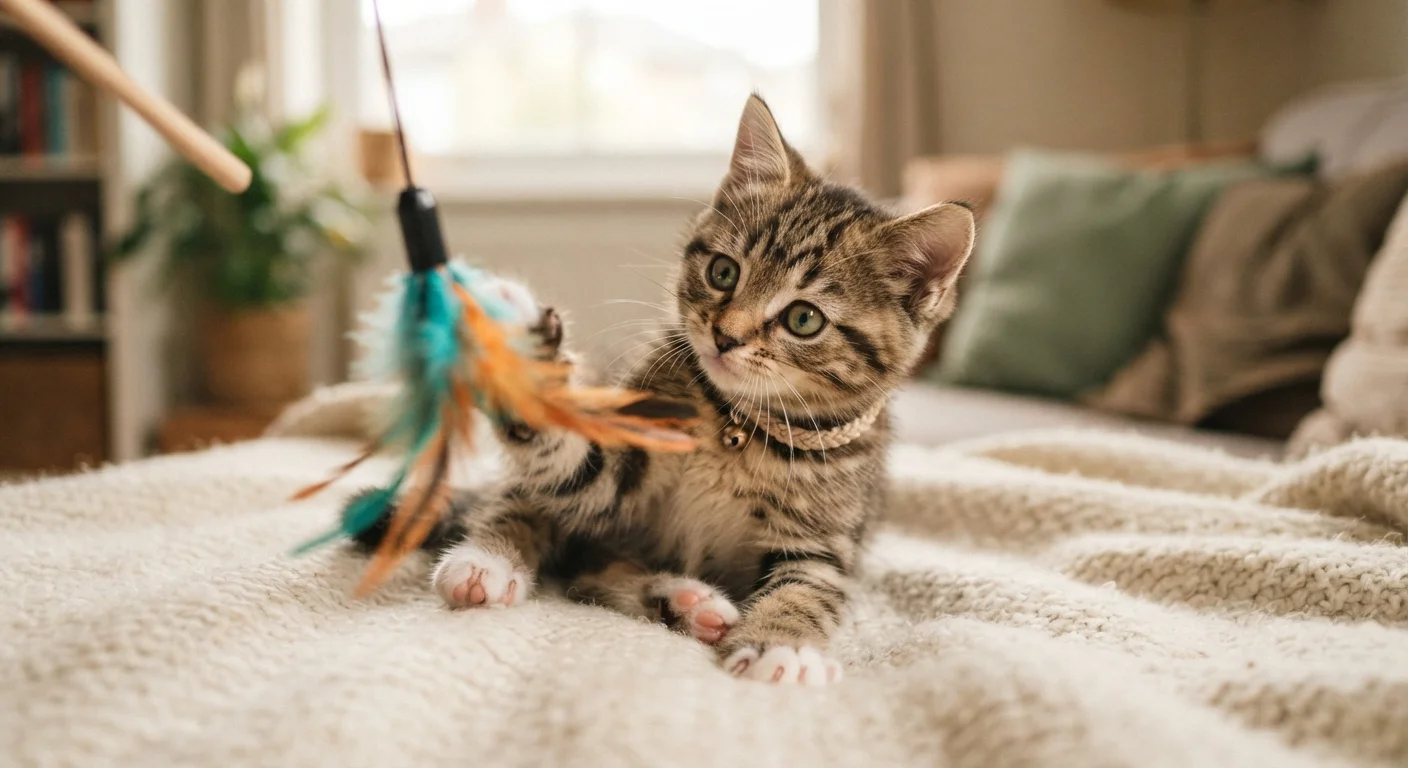
Play in kittens is not random activity. It rehearses the motor sequences used in hunting: stalking, pouncing, biting, and kicking. This means play that looks rough is usually neurologically normal, even when it targets your hands or feet.
The problem is not the behaviour itself but its direction. Kittens that are allowed to treat hands as prey objects tend to bite harder as they grow. Consistent redirection to appropriate toys, starting early, shapes this pattern. A kitten that ambushes ankles is not being aggressive; it has learned that ankles are an acceptable target because that lesson was never corrected.
Solo play, where a kitten chases shadows or attacks imaginary prey, is healthy. Kittens that play very little despite being awake and seemingly well may be under-stimulated or, less commonly, unwell. How play should evolve across a cat's life explains how to match the type and intensity of play to each life stage.
Hiding, clinging, and what each tells you
A kitten that hides frequently is not necessarily antisocial. Hiding is a coping strategy, and young cats use it when their environment feels unpredictable or overwhelming. The appropriate response is to let the kitten choose when to emerge, not to retrieve it from its hiding spot. Forcing contact when a kitten is already stressed increases fear rather than reducing it.
On the opposite end, a kitten that follows you constantly and cries when alone may be experiencing separation distress, which is more common in kittens weaned too early or in single-kitten households. Gradual, positive alone-time training, leaving the kitten with enrichment and returning before distress peaks, can reduce this over time.
The socialisation window in early kittenhood shapes how a cat responds to new people and environments for years. Kittens handled calmly and frequently between two and seven weeks of age tend to recover from stressful situations more quickly as adults.
This article is for general informational purposes only and is not a substitute for professional veterinary advice. If you have concerns about your kitten's health or behaviour, consult a licensed veterinarian or certified veterinary behaviourist.