

Key Takeaways
- Most minimum payments cover interest first, leaving the principal balance nearly unchanged each month.
- A $3,000 credit card balance at 20% APR can take over 14 years to pay off on minimums alone.
- The longer a balance sits, the more interest accumulates, increasing the total amount you repay.
- Adding even a small fixed amount above the minimum each month cuts repayment time significantly.
- Understanding how minimums are calculated helps you see exactly why the debt persists.
Minimum payment
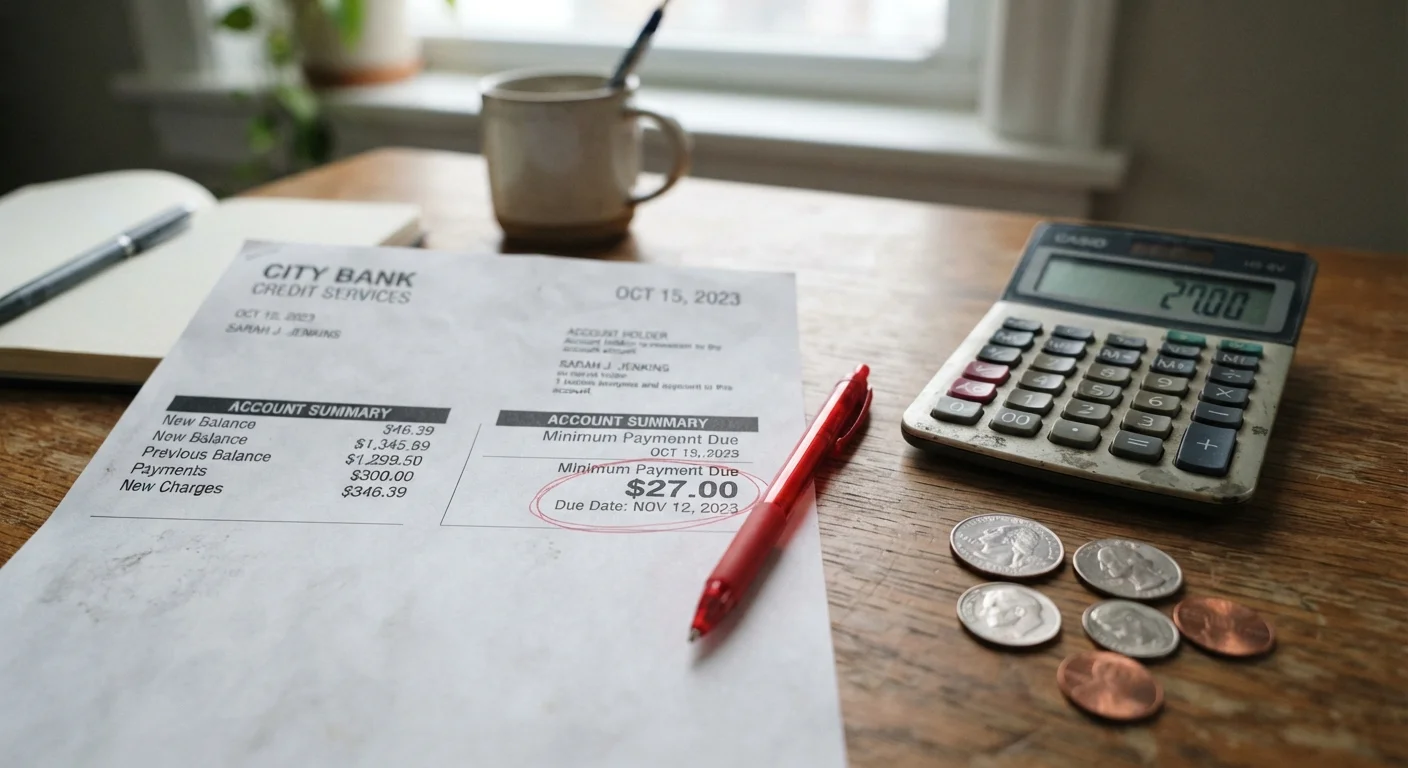
A minimum payment is the smallest amount a lender requires you to pay on a credit card or loan each billing cycle to keep the account in good standing. Paying only this amount does not eliminate the debt quickly. Most of the payment goes toward interest charges, leaving the principal balance largely untouched.
Minimum payments are typically calculated as either a flat dollar amount (often $25 or $35) or a small percentage of the outstanding balance (commonly 1% to 2%), whichever is greater.
How minimum payments are calculated
Credit card issuers generally use one of two methods to set your minimum payment. The first is a flat dollar amount, often between $25 and $35. The second is a percentage of your outstanding balance, typically 1% to 2% of what you owe, plus any interest and fees charged that month. You pay whichever figure is higher.
Early in repayment, when your balance is large, the percentage method produces a higher number, so that formula applies. As the balance shrinks, the minimum payment shrinks with it. This sounds like progress, but it is actually part of the problem. Smaller required payments mean more of your money sits in the account earning interest rather than reducing the debt.
To see how interest translates into real dollar amounts, the key is understanding that interest is calculated on the current balance before your payment is applied. On a $3,000 balance at 20% annual percentage rate (APR), roughly $50 in interest accrues in one month. If your minimum payment is $60, only $10 goes toward the balance.
The math behind a slow payoff
The Consumer Financial Protection Bureau (CFPB) requires card issuers to print a minimum-payment warning on every billing statement. That warning exists because the numbers are striking. A $3,000 balance at 20% APR, paid only at the minimum each month, takes approximately 14 years and 4 months to pay off. The total interest paid over that period would be roughly $3,400, meaning you pay more than double the original balance.
14+ years
Time to pay off $3,000 at 20% APR on minimums
Based on CFPB minimum-payment disclosure calculations for a $3,000 balance at 20% APR.
$3,400+
Interest paid on a $3,000 balance using only minimums
This figure represents the total interest cost over the full minimum-payment repayment period at 20% APR.
~3.5 years
Payoff time at a fixed $100 monthly payment
Paying a consistent $100 per month on the same $3,000 balance at 20% APR clears the debt in roughly 3.5 years.
The payoff slows over time for a structural reason. Because minimum payments are often set as a percentage of the remaining balance, they fall as the balance falls. You end up paying less each month but for longer. The debt shrinks, but slowly, and interest keeps accumulating on whatever remains.
Compare that to paying a fixed $100 per month on the same $3,000 balance at 20% APR. The debt clears in about 3 years and 6 months, and total interest paid drops to roughly $1,200. That is more than two hundred dollars a month less in interest, just from holding the payment steady.
Why the balance can grow even when you pay
There is a specific situation worth understanding: if the interest charged in a billing cycle exceeds the minimum payment due, the balance actually increases despite the payment. This can happen with very high interest rates or when a minimum payment floor is set too low relative to the balance.
This is sometimes called negative amortization (when a loan balance grows rather than shrinks over time). It is less common on standard credit cards because issuers are required to set minimums high enough to cover at least all interest and fees charged, but it can appear on certain deferred-interest or promotional financing products if the terms are not read carefully.
Even without negative amortization, the effect of compound interest on a stagnant balance is significant. The type of debt you carry also matters: unsecured credit card debt typically carries higher interest rates than secured debt, which is one reason credit card minimum payments are so costly relative to the balance.
Set a fixed payment amount, not a percentage
Instead of paying whatever the minimum says, pick a fixed dollar amount you can afford and pay that every month. This prevents your payment from shrinking as the balance does, which is what keeps minimum-only payers in debt for years. Even $50 or $75 above the stated minimum can make a large difference in the total time and interest.
What changes when you pay more than the minimum
Paying a fixed amount above the minimum each month redirects more money to the principal balance. Because interest is charged on the remaining balance, a lower balance means less interest accrues the following month. That creates a compounding effect in the opposite direction from the one that keeps minimum-only payers in debt for years.
A few concrete patterns are worth knowing. First, even a modest increase matters. Paying $25 extra per month on a $3,000 balance at 20% APR cuts the payoff period from over 14 years to roughly 4 years. Second, keeping your payment fixed rather than letting it drop with the balance is the mechanism that accelerates repayment. Third, any lump sum applied directly to principal can reset the interest calculation downward immediately.
For a structured approach, a debt repayment plan on paper can show exactly how each payment reduces the balance over time. And if you are weighing debt payoff against saving, the trade-off between saving and paying down debt depends on interest rates and your financial situation. Strategies that accelerate debt payoff range from fixed overpayments to balance consolidation, each with different practical requirements.
This article is for informational purposes only and is not personalized financial advice. Consult a licensed financial professional for guidance specific to your situation.