

Key Takeaways
- Listing every debt with its balance, interest rate, and minimum payment is the foundation of any workable plan.
- Choosing either the avalanche or snowball method determines which debt gets extra payments first.
- A written plan lets you track progress, spot problems early, and adjust when your income or expenses change.
- Maintaining a small emergency fund while repaying debt reduces the chance a surprise expense derails your progress.
- Even a modest extra payment each month shortens your payoff timeline meaningfully.
What you will need
Why putting the plan on paper matters
Most debt advice stops at the strategy level: "pay off the highest-interest debt first" or "build a snowball." That guidance is sound, but it leaves a gap between concept and action. A written plan closes that gap by giving you a concrete document to check against reality each month.
Abstract targets also tend to drift. When the numbers live only in your head, it is easy to underestimate what you owe, overestimate how much you are paying, or forget how long you have left. Putting the plan on paper forces accuracy from the start and makes deviations visible before they compound. For context on why letting payments slide can extend your timeline far longer than people expect, see how minimum payments affect total repayment time.
This article is for general informational and educational purposes only and is not personalized financial advice. Consult a licensed financial professional for guidance specific to your situation.
What you will need
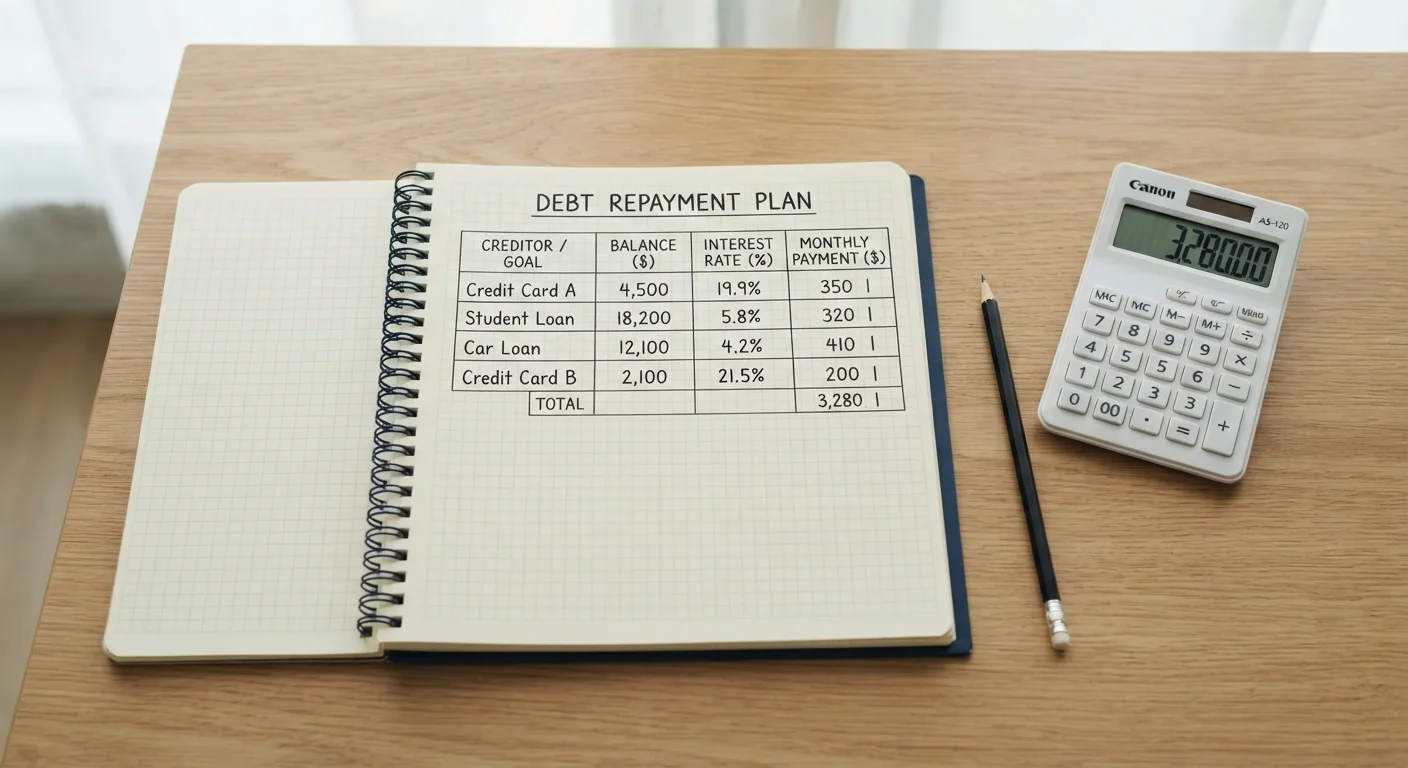
What a sample plan looks like
Suppose a household carries three debts:
- A credit card with a $4,200 balance at 22% APR and a $90 minimum payment
- A personal loan with a $7,500 balance at 11% APR and a $175 minimum payment
- A car loan with a $12,000 balance at 6% APR and a $240 minimum payment
The household can put $700 per month toward debt total. After covering all three minimums ($505 combined), $195 remains to direct as an extra payment.
On paper, the plan looks like this:
| Debt | Balance | APR | Minimum | Extra payment |
|---|---|---|---|---|
| Credit card | $4,200 | 22% | $90 | $195 |
| Personal loan | $7,500 | 11% | $175 | $0 |
| Car loan | $12,000 | 6% | $240 | $0 |
The extra $195 goes to the credit card because it carries the highest interest rate. This approach is commonly called the avalanche method. It minimizes total interest paid over time. An alternative, the snowball method, targets the smallest balance first regardless of rate, which can help if the psychological lift of a quick payoff matters more to you than the math. Neither choice is wrong; the one you will stick with is the right one.
Understanding how these debts differ in type can also shape your priorities. How secured and unsecured debts differ explains why the car loan and credit card carry different risks and lender behavior.
List every debt in one place
Write down each debt with three data points: current balance, annual interest rate (APR), and required minimum monthly payment. Pull these directly from your most recent statements, not from memory. Include credit cards, personal loans, auto loans, student loans, and any medical payment plans.
Set your monthly repayment budget
Add up all minimum payments to find the floor: the absolute minimum you must pay to stay current on every account. Then look at your monthly budget and determine how much above that floor you can consistently commit. This surplus is your extra payment. Be realistic: a number you can sustain for two years beats an aggressive target you abandon in three months.
Choose a payoff order
Rank your debts by either interest rate (highest to lowest, avalanche method) or balance (smallest to largest, snowball method). Apply your extra payment to the first debt on your list while paying minimums on all others. Do not split the extra payment across multiple debts; concentrating it speeds payoff significantly.
Write out the plan month by month
Create a simple table with columns for each debt showing the starting balance, monthly payment applied, interest charged that month, and the ending balance. You do not need precise amortization software to do this; a basic spreadsheet or even a paper table works. Calculating the first few rows manually helps you understand how interest accrues and why the extra payment shrinks the balance faster than the minimum alone would.
Review and update the plan monthly
At the end of each month, record actual payments made and updated balances. Note any changes to your budget that affect how much extra you can pay. When you pay off one debt, immediately redirect that freed-up payment to the next debt on your list. Document that redirect in your table so the logic is visible when you look back later.
Tracking progress and adjusting over time
A plan that never gets updated is just a snapshot. The useful version is a living document you revisit each month, even briefly.
After 12 months in the example above, the credit card balance would be paid off. At that point, the full $285 that had gone to the credit card (minimum plus extra) rolls into the next target debt, in this case the personal loan. This is what the debt avalanche looks like in practice: each eliminated balance frees up cash that accelerates the next one.
When your financial situation changes, the plan absorbs that change explicitly rather than silently. A pay increase means a higher extra payment. A car repair that drains savings means a temporary reduction. Writing down the adjustment keeps the plan honest and prevents the kind of "I'll make it up next month" thinking that rarely materializes.
Keeping a small emergency fund separate from your debt payoff budget also matters. Even $500 to $1,000 set aside reduces the chance that one unexpected bill forces you to pause payments or carry new credit card debt. For more habits that support a stable financial foundation, the everyday money tips hub covers practical approaches worth reading alongside a repayment plan.
Small windfalls belong in the plan
A tax refund, work bonus, or cash gift can cut months off your payoff timeline if you apply it directly to your target debt. Treat it the same way you would a regular extra payment and update your table to reflect the new lower balance. This also keeps the plan accurate for future projections.