

| Shape of a yield sign | Downward-pointing equilateral triangle (Federal Highway Administration (FHWA) Manual on Uniform Traffic Control Devices) |
| Color of warning signs | Yellow (standard); fluorescent yellow-green for pedestrian and school zones (MUTCD, current edition) |
| Advisory speed sign color | Yellow with black text (MUTCD, current edition) |
| No-passing zone sign shape | Pennant (right-pointing triangle), left side of road only (MUTCD, current edition) |
| "Begin right turn lane" vs. merge | White arrow signs indicate new lane added, not a mandatory merge (FHWA guidance on lane-use signs) |
| Stop vs. yield legal difference | Stop requires full halt; yield requires slowing and giving way if traffic is present (Uniform Vehicle Code and most state motor vehicle codes) |
Why some signs create consistent confusion
Road signs in the United States follow a standardized system set out in the Federal Highway Administration's Manual on Uniform Traffic Control Devices (MUTCD). Shape, color, and symbol each carry meaning, but several signs look similar enough to one another that drivers, even experienced ones, confuse them in the moment. That confusion can produce hesitation, sudden braking, or incorrect actions that raise crash risk.
The signs that generate the most errors tend to fall into three categories: signs that look similar to a different sign, signs whose meaning has changed over the years, and signs that are read correctly in isolation but misapplied when stacked with other signs on one post. Rural and urban roads each present their own sign-reading challenges because density, posting speed, and driver familiarity differ significantly between environments.
| Shape of a yield sign | Downward-pointing equilateral triangle (Federal Highway Administration (FHWA) Manual on Uniform Traffic Control Devices) |
| Color of warning signs | Yellow (standard); fluorescent yellow-green for pedestrian and school zones (MUTCD, current edition) |
| Advisory speed sign color | Yellow with black text (MUTCD, current edition) |
| No-passing zone sign shape | Pennant (right-pointing triangle), left side of road only (MUTCD, current edition) |
| "Begin right turn lane" vs. merge | White arrow signs indicate new lane added, not a mandatory merge (FHWA guidance on lane-use signs) |
| Stop vs. yield legal difference | Stop requires full halt; yield requires slowing and giving way if traffic is present (Uniform Vehicle Code and most state motor vehicle codes) |
Regulatory signs drivers get wrong
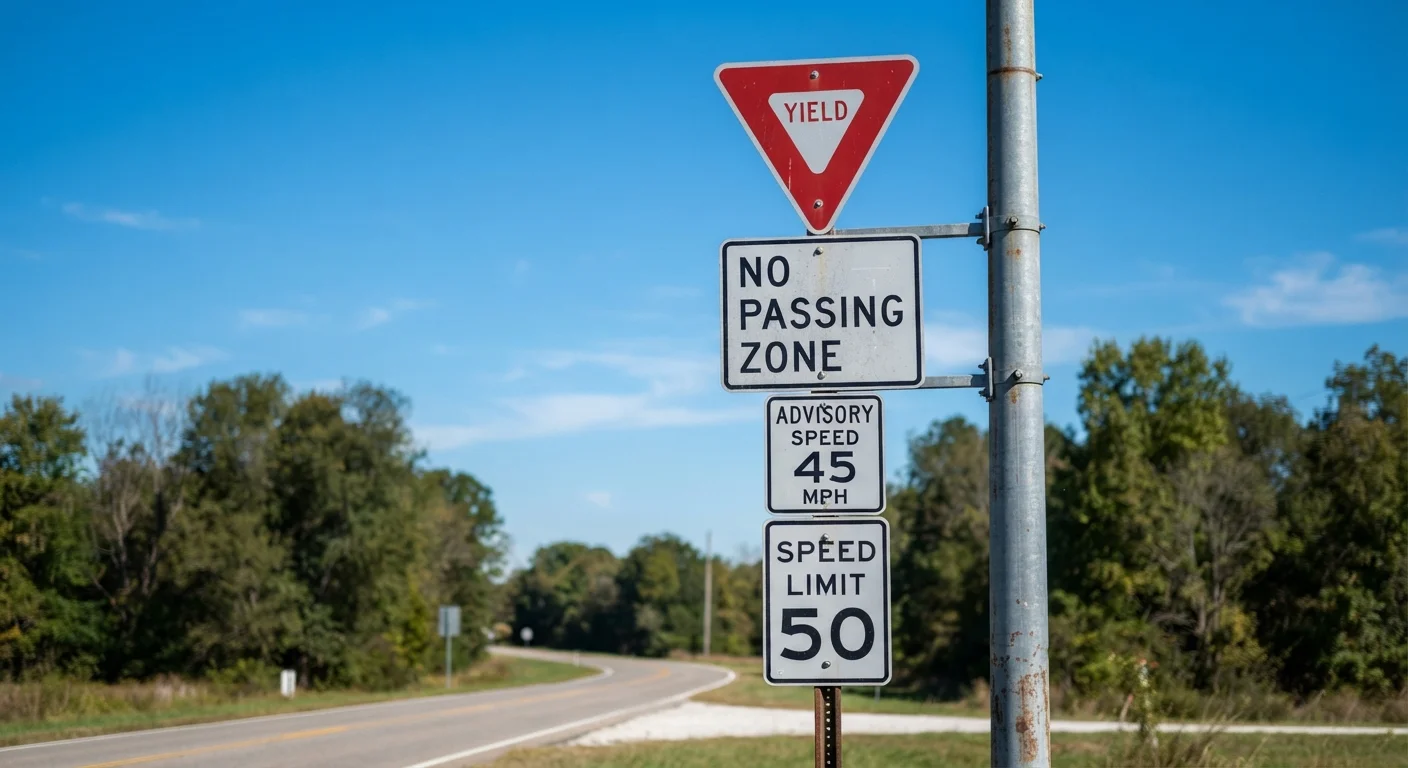
Yield vs. stop. Both signs require giving way to cross traffic, but they impose different legal obligations. A stop sign requires a complete halt before the stop line regardless of whether other vehicles are present. A yield sign requires slowing and giving way only when conflicting traffic is actually present. Many drivers treat yield signs as optional slow-downs and stop signs as yield signs, which is incorrect in both directions.
No-passing zone pennant. The pennant-shaped yellow sign appears on the left side of the road at the start of a no-passing zone. Drivers who are unfamiliar with it sometimes read it as a general warning rather than a legal prohibition on overtaking. Its shape is unique in US traffic control, which helps once a driver knows what to look for.
Speed limit vs. advisory speed. A speed limit sign is white with black numerals and sets a legal maximum. An advisory speed placard is yellow with black numerals and appears beneath a warning sign, such as a curve or exit ramp sign. It recommends a safe speed for that condition, not a legal limit. Treating an advisory speed as a legal minimum or maximum is a frequent misreading. Unfamiliar roads multiply this confusion because drivers have no prior experience with local posting patterns.
Warning signs that are commonly misread
Diamond-shaped yellow signs alert drivers to a condition ahead. The specific symbol inside the diamond determines the correct response, and several symbols are confused with one another.
- Divided highway begins vs. divided highway ends. The "begins" sign shows two arrows splitting apart; the "ends" sign shows two arrows merging. Misreading the ends sign causes some drivers to move toward the center lane rather than prepare for oncoming traffic in the opposite lane.
- Merge vs. added lane. A merge sign shows two lanes narrowing into one, meaning at least one driver must yield. An added-lane sign shows a new lane appearing without any narrowing. Drivers who treat an added-lane situation as a merge may brake unnecessarily and create a rear-end hazard.
- Pedestrian vs. school zone signs. Both use a fluorescent yellow-green background and a walking-figure symbol. The school zone version includes a pennant or "school" text and has specific time-of-day restrictions. Ignoring the distinction can mean applying school-zone caution when it is not required, or missing it when it is.
For a broader look at how sign misreading intersects with junction errors, roundabout sign and marking myths cover a specific type of intersection where multiple signs appear at once.
Signals and markings that function like signs
The flashing yellow arrow is among the most misunderstood traffic control indications in the US. It replaced the older permissive green ball at left-turn lanes in many states. A flashing yellow arrow means a left turn is permitted but drivers must yield to oncoming vehicles and pedestrians before turning. It does not mean stop, and it does not grant the right of way. FHWA research found that a substantial share of drivers initially interpreted it as either a stop indication or a protected turn, neither of which is correct.
Pavement markings also carry regulatory meaning that some drivers overlook. A solid white edge line is not simply decorative: crossing it is generally prohibited except when entering or exiting the roadway. A double solid yellow center line prohibits passing in both directions. A solid yellow line on one side paired with a dashed yellow on the other means only the driver facing the dashed line may pass.
Night driving compounds sign-reading errors because retroreflective surfaces vary in brightness and symbols are harder to process quickly. Night driving strategies address how experienced drivers adjust their approach to compensate for reduced processing time at speed.
Regulatory sign
A sign that imposes a legal requirement on drivers, such as a speed limit or a stop sign. Violating a regulatory sign can result in a citation.
Warning sign
A sign that alerts drivers to a hazard or change in road conditions ahead. Warning signs in the US are typically diamond-shaped and yellow.
Advisory speed
A recommended speed for a specific condition, such as a curve or ramp, shown on a smaller yellow placard beneath a warning sign. It is not a legal speed limit.
No-passing zone
A stretch of road where overtaking another vehicle is prohibited, indicated by a pennant-shaped yellow sign on the left side of the road or by a solid yellow center line.
Guide sign
A green or brown sign that provides directional, distance, or destination information. Guide signs do not impose legal requirements.
Flashing yellow arrow
A traffic signal indication that permits a left turn while yielding to oncoming traffic and pedestrians. It replaced the older permissive green ball indication at many US intersections.