

Key Takeaways
- Urban roads concentrate hazards close together: pedestrians, cyclists, signals, and stop-and-go traffic require constant short-range attention.
- Rural roads shift risk toward high speed, limited sight lines, wildlife crossings, and delayed emergency response times.
- Fatal crash rates per mile traveled are higher on rural roads than urban ones, largely due to speed and distance from trauma care.
- Switching between environments calls for deliberate recalibration of speed judgment and scanning habits.
- Vehicle maintenance needs differ by environment: city driving strains brakes and tires differently than sustained highway-speed rural travel.
Our Verdict
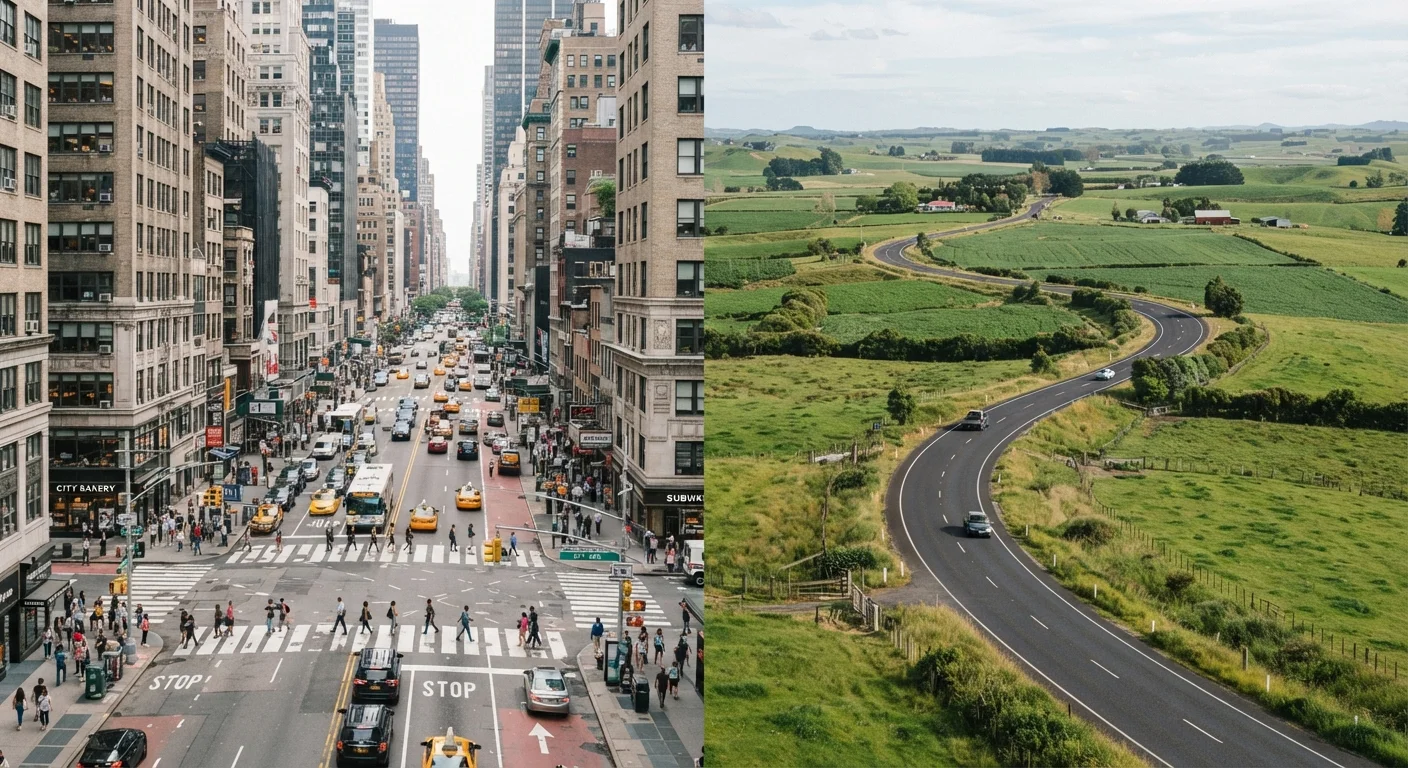
Neither road type is uniformly safer. Urban roads impose high-frequency, low-speed hazards that demand split-second attention in tight spaces. Rural roads carry lower traffic density but higher crash severity, with speed and isolation amplifying every mistake. Drivers who recognize which environment they are in and adjust their habits accordingly reduce risk in both settings.
| Best for | Recommended |
|---|---|
| Drivers who want to reduce close-proximity collision risk | Urban driving strategies: short following distances, constant pedestrian scanning, early signal reading |
| Drivers covering long rural distances | Rural driving strategies: expanded sight-line scanning, strict speed discipline, wildlife awareness |
| Drivers who regularly switch between city and country roads | Environment recalibration habits: consciously reset speed perception and scan range at each transition |
Why the environment changes what driving demands
Most drivers learn in one setting and gradually become comfortable there. That comfort can work against them when the road type changes. Urban and rural environments do not just look different; they place competing demands on attention, speed judgment, and hazard anticipation. Understanding those differences is one of the habits that separate lower-risk drivers from the rest.
The Federal Highway Administration's data consistently shows that rural roads account for a disproportionate share of traffic fatalities relative to vehicle miles traveled, even though urban roads carry far more daily traffic volume. That gap traces back to crash speed, roadway design, and how long it takes emergency services to reach the scene. Neither environment is simply dangerous or safe; each has its own risk profile.
Urban road hazards: density and distraction
City driving compresses hazards into short distances. A driver navigating a dense urban grid encounters traffic signals, crosswalks, cyclists in dedicated lanes, delivery vehicles stopped mid-block, and pedestrians stepping off curbs in quick succession. The primary skill demand is near-field scanning: tracking many objects at close range and anticipating their movements a second or two ahead.
Speed is lower, which reduces crash severity, but the sheer frequency of potential conflict points means small lapses matter. A momentary distraction near a crosswalk or a failure to check a blind spot before a lane change can have immediate consequences. Stop-and-go traffic also accelerates brake wear and increases fuel consumption, which connects to broader vehicle maintenance considerations for city-based drivers.
Urban intersections generate the highest share of angle and turning collisions. Reading signal phases early, leaving adequate gaps before entering an intersection, and treating green lights as conditional rather than guaranteed are all habits that reduce exposure.
| Urban roads | Rural roads | |
|---|---|---|
| Typical speed range | 15 to 45 mph | 45 to 70 mph |
| Primary hazard type | Pedestrians, cyclists, intersections | High speed, wildlife, limited sight lines |
| Crash frequency | Higher (more conflict points) | Lower (less traffic volume) |
| Crash severity | Generally lower | Generally higher |
| Emergency response time | Typically faster | Typically slower |
| Key scanning range | Close range, high frequency | Extended range, horizon-focused |
| Brake and tire wear | High (frequent stops) | Lower (sustained speeds) |
Rural road hazards: speed, isolation, and limited margin for error
Rural roads remove the density problem but introduce a different set of risks. Speed limits are higher, often 55 mph or above on two-lane state routes, and actual travel speeds frequently exceed those limits. At higher speeds, stopping distances lengthen considerably: a vehicle traveling at 65 mph needs roughly twice the stopping distance of one at 45 mph. Sight lines may be blocked by hills, curves, or vegetation, and oncoming traffic in the opposite lane leaves little lateral margin if a driver drifts.
Wildlife crossings are a genuine hazard on rural roads, particularly at dawn and dusk. Deer, elk, and other animals can appear with no warning. High beams help extend detection range on unlit roads, though oncoming traffic requires switching back to low beams promptly. Drivers on unfamiliar rural routes face added risk because they cannot anticipate where curves, intersections, or unmarked driveways appear.
Emergency response times in rural areas average significantly longer than in urban settings. That gap means a serious crash is more likely to become a fatal one before help arrives, which raises the cost of any mistake. Tire condition, fuel level, and phone charge all carry more weight on a long rural drive than they would in a city.
Speed perception and the transition problem
One of the least-discussed risks in road safety is the transition between environments. A driver who has spent an hour on a rural highway at 65 mph and then enters a 35 mph town often perceives 45 mph as slow. This speed adaptation effect is well-documented: the brain recalibrates its sense of normal speed based on recent experience, and that recalibration takes time.
The practical fix is deliberate: check the speedometer at the moment of transition rather than relying on feel. The same logic applies in reverse. A driver leaving a city after stop-and-go traffic may feel hesitant on an open rural road and unconsciously travel below the speed of surrounding traffic, creating a different kind of hazard.
Smooth acceleration and gradual braking suit both environments, but the distances over which those inputs play out differ substantially. In a city block, smooth braking means starting to slow 50 to 75 feet from a light. On a rural road, the same principle might apply over several hundred feet.
Scanning habits that fit each environment
Experienced drivers shift their visual scanning range based on conditions, and environment is one of the clearest cues for doing so. Urban scanning concentrates on the zone immediately ahead and to the sides: doorways, crosswalks, driveways, and gaps between parked vehicles. Rural scanning pushes that range further out, reading curves, crests, and field edges for animals or slow-moving farm equipment.
Road signs contribute to both tasks, and some of the signs that matter most differ by environment. Urban drivers encounter more regulatory signage governing turns, parking, and pedestrian zones. Rural drivers encounter more warning signs for curves, grades, and animal crossings. Signs that drivers most often misread include several that appear more frequently in one environment than the other, making familiarity with both sign sets worthwhile.
Night driving adds another layer to both settings. Urban glare from streetlights and other vehicles can mask pedestrians dressed in dark clothing. Rural darkness removes ambient light entirely, compressing effective visibility even with high beams. The distinct challenges of night driving compound the underlying risks of whichever road type a driver is on.