

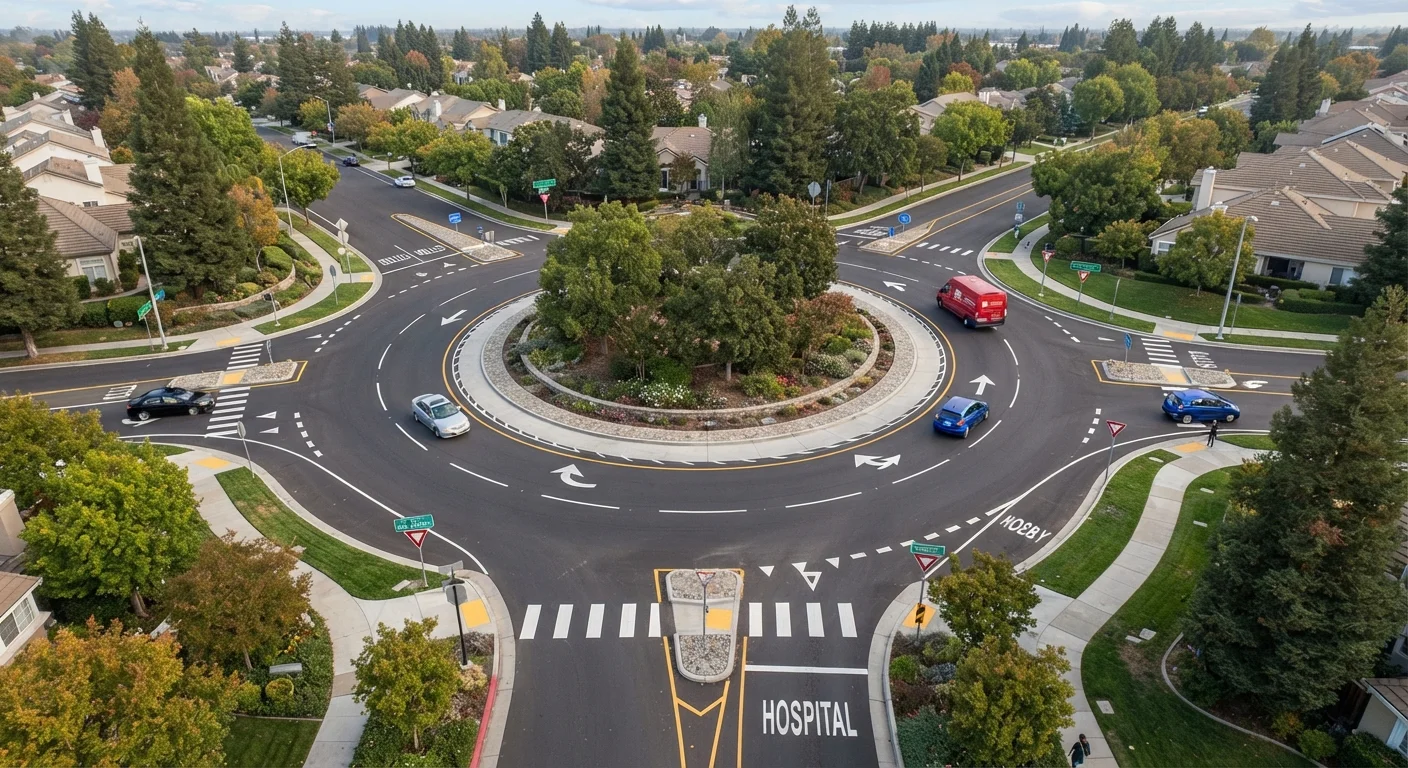
Key Takeaways
- Traffic already in a roundabout always has the right of way over entering vehicles.
- Lane choice at a multi-lane roundabout depends on your exit, not personal preference.
- Roundabouts consistently reduce serious injury crashes compared with traditional stop-and-signal intersections.
- You do not need to stop at a roundabout unless traffic inside prevents safe entry.
- Signaling when exiting a roundabout helps pedestrians and other drivers anticipate your move.
Why roundabout rules confuse so many drivers
Most US drivers learned to handle intersections governed by stop signs, traffic lights, or four-way-stop rules. Roundabouts use a different priority system, and the physical layout does not map directly onto anything most people practiced during driver's education. That mismatch produces persistent errors, even among drivers with decades of experience on other junction types.
The confusion is not a character flaw. It reflects a genuine gap in how roundabouts are taught and signed. Understanding the actual rules, not the assumed ones, removes most of the uncertainty that makes these junctions feel risky. If navigating any unfamiliar junction type raises anxiety, adjusting your approach on unfamiliar roads covers the broader habit of staying calm and deliberate when the road does not match your expectations.
Myth
The vehicle entering the roundabout has the right of way because it arrives at the intersection.
Fact
Vehicles already circulating inside the roundabout always have priority. Entering drivers must yield.
This is the most consequential roundabout error US drivers make, and it stems from habits built at four-way stops, where arrival order determines priority. At a roundabout, the yield line is at the entry point, not inside the circle. Every US state that has adopted roundabout design follows this rule: you wait at the entry until a safe gap in circulating traffic allows you to merge. Treating the roundabout like a four-way stop and pulling straight in is a leading cause of angle crashes at these junctions.
Myth
You must come to a complete stop before entering a roundabout.
Fact
Roundabouts use yield control, not stop control. You slow and check for gaps, but a full stop is only required when traffic inside prevents safe entry.
A yield sign at a roundabout entry means the same thing it means anywhere else: slow, look, and proceed when it is safe. If the roundabout is clear, you can enter without stopping. The yield design is deliberate: it keeps traffic flowing at low speeds rather than creating queues at a stop sign or waiting on a signal cycle. Drivers who stop unnecessarily at empty roundabouts disrupt the flow that makes these junctions efficient and frustrate drivers behind them.
Myth
Lane choice inside a roundabout is flexible; just pick the lane you prefer.
Fact
At multi-lane roundabouts, the correct lane depends on which exit you intend to use, and the rules follow the same logic as any other multi-lane road.
The general principle used across US roundabout guidance is: use the right lane for exits in the first half of the circle (roughly the first one or two exits), and the left lane for exits further around, including exits that require passing the entry point. Some roundabouts have signed lane assignments that override the general rule, so checking pavement markings and overhead signs before entering is important. Changing lanes inside the roundabout is allowed where lane markings permit it, but it carries a high collision risk because sight lines are limited. The safest approach is to choose the correct lane before you enter.
See our guide to road signs drivers misread most often for help interpreting the pavement markings and entry signs that accompany multi-lane roundabouts.
Myth
Roundabouts are more dangerous than regular intersections because drivers find them confusing.
Fact
Research by the Insurance Institute for Highway Safety found that roundabouts reduce fatal and injury crashes significantly compared with traditional stop-controlled and signal-controlled intersections.
Confusion during a learning period is real, but it does not translate into worse long-term safety outcomes. The geometry of a roundabout removes the high-speed right-angle and head-on conflict points that produce the most lethal crashes at conventional intersections. All traffic moves in one direction at low speed, so even when collisions occur, they tend to be low-severity sideswipes rather than T-bone impacts. The Insurance Institute for Highway Safety has documented injury crash reductions of roughly 75 percent when signals or stop signs are replaced by roundabouts.
Myth
Trucks and large vehicles cannot use roundabouts, so a roundabout must be the wrong junction type for that road.
Fact
Roundabouts are designed with a raised central apron (called a truck apron) that allows long wheelbase vehicles to mount it when turning.
A standard modern roundabout includes a low, mountable truck apron around the central island. Semi-trucks, buses, and other large vehicles can track over this apron to complete the turn without cutting across the circulating lanes. The apron is typically paved with a different surface texture or color to discourage ordinary passenger vehicles from using it, while still accommodating the off-tracking of long vehicles. Roads with heavy freight traffic can and do use roundabouts; the design just requires engineering the apron to match the expected vehicle mix.
Myth
You do not need to signal at a roundabout because everyone can see where you are going.
Fact
Signaling when you exit a roundabout tells pedestrians crossing at the exit and drivers waiting to enter that you are leaving the circle.
Pedestrians at a crosswalk on the exit leg cannot rely on watching your path through the circle to know whether you will exit at their crossing. A right-turn signal as you pass the exit before yours, or at minimum as you approach your exit, gives them and waiting drivers a clear indication of your intent. Some driver guidance also recommends signaling left (or not signaling) while passing exits you do not intend to use, to signal that you are continuing around. Practice varies, but signaling on exit is widely recommended and in some states is required by the same general signaling statutes that apply to any turn.
What actually happens in a multi-lane roundabout
Single-lane roundabouts are relatively forgiving because there is only one path through the circle. Multi-lane roundabouts add lane-choice decisions that must be made before entry, and errors there can lead to collisions inside the circle where correcting course is difficult.
~75%
Reduction in injury crashes
The Insurance Institute for Highway Safety reports roughly a 75 percent reduction in injury crashes when conventional intersections are converted to roundabouts.
~90%
Reduction in fatal crashes
IIHS data indicates fatal crash rates drop by approximately 90 percent at intersections converted from signals or stop signs to roundabouts.
The core discipline is reading the road before you reach the yield line. Pavement arrows, overhead signs, and the lane markings inside the circle all work together to direct traffic. Drivers who treat these markings the same way they would treat lane markings on any divided road make far fewer errors than drivers who try to improvise once inside.
Do not change lanes inside the roundabout
Lane changes inside the circle are legal where markings allow them, but the geometry makes it very difficult to see vehicles in adjacent lanes until they are close. Choose your lane before the yield line and hold it through your exit. If you miss your exit because you are in the wrong lane, go around again rather than cutting across lanes.
Pedestrian and cyclist crossings sit on the entry and exit legs, not inside the circle itself. Yielding to pedestrians at those crossings is a separate obligation from yielding to circulating traffic, and both apply.