

Key Takeaways
- Passenger conversations reduce the mental bandwidth available for monitoring traffic and road conditions.
- New and teenage drivers face significantly greater impairment from passengers than experienced drivers do.
- Unlike phone callers, passengers can and often do adjust their behavior when road conditions become demanding.
- The content and emotional intensity of a conversation matter as much as whether a conversation is happening at all.
- Drivers can set clear expectations with passengers before and during trips to protect attention.
Passenger distraction
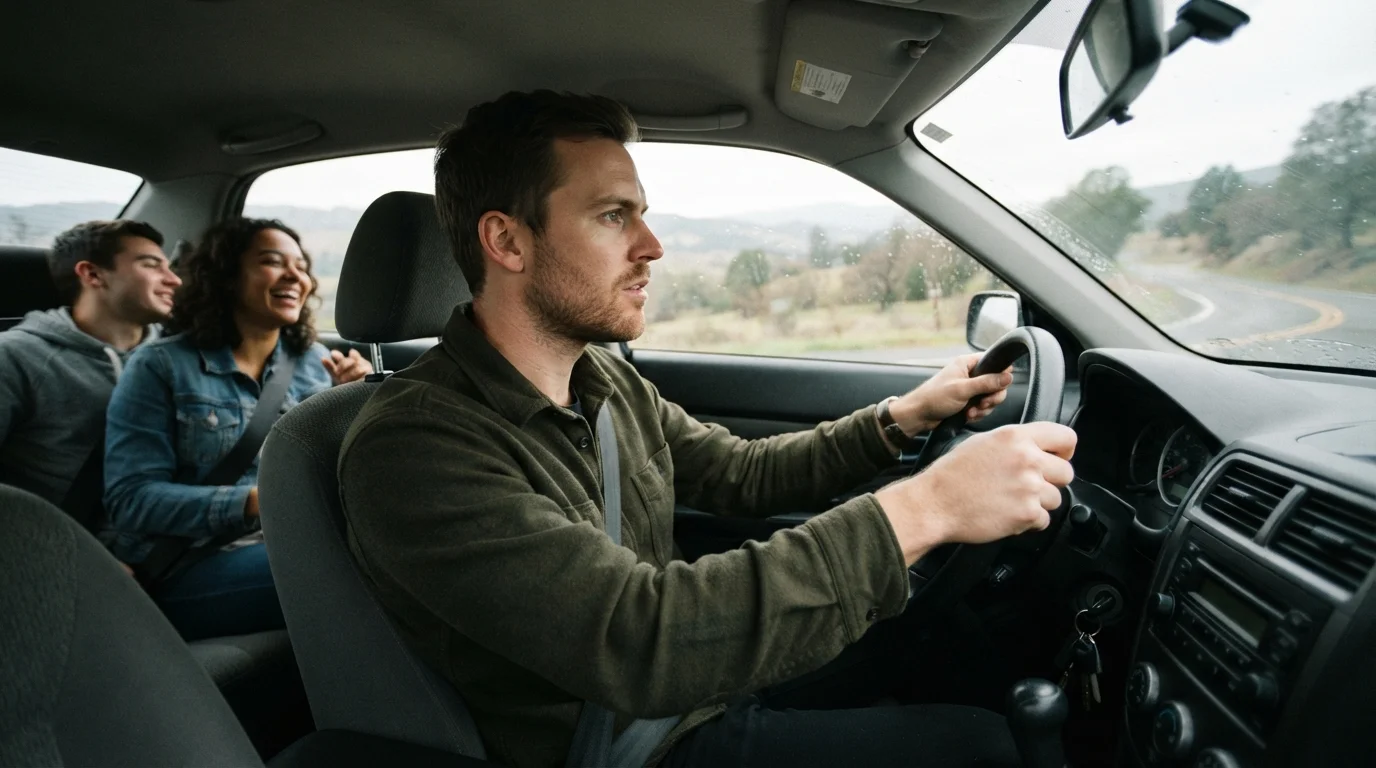
Passenger distraction is any reduction in a driver's attention caused by the presence or behavior of people riding in the vehicle. It can be verbal, such as holding a conversation, or physical, such as turning to look at a passenger. Unlike phone calls, passenger distraction is rarely recognized as a safety issue, yet research consistently places it among the leading causes of driver inattention.
Cognitive distraction, where the mind engages with content unrelated to driving, is distinct from visual or manual distraction, though all three can occur simultaneously during passenger interactions.
Why passengers are a distraction category of their own
Most drivers think of distraction as a phone problem. Passengers rarely make the mental list of hazards, partly because they have always been there, and partly because talking to the person next to you feels natural and low-stakes. That familiarity is what makes it worth examining.
The National Highway Traffic Safety Administration (NHTSA) has consistently identified passenger distraction as one of the most frequently reported contributing factors in distraction-related crashes. Unlike a dropped coffee cup or a navigation screen, a passenger generates continuous social demands: responses, eye contact, emotional engagement. Those demands do not disappear when traffic thickens or road conditions change.
What separates passenger distraction from other categories is its social dimension. Ignoring a ringing phone is straightforward. Ignoring a friend mid-sentence carries social friction, which means many drivers do not ignore it. The result is a distraction that self-replenishes.
The cognitive load behind a conversation
Driving depends on a processing system that handles far more than steering and braking. Scanning mirrors, reading road markings, anticipating other drivers, and adjusting speed all compete for mental bandwidth. Conversation adds to that load, not beside it.
The effect is well-documented in attention research. A driver following a demanding verbal exchange shows measurable reductions in peripheral vision, longer reaction times, and a tendency to fixate on a smaller portion of the road ahead, sometimes called the "tunnel vision" effect. The driver's eyes may still move, but information from those eye movements is less likely to be processed.
Content and emotional tone shape how much bandwidth a conversation consumes. A quick exchange about where to park draws little from the driver's cognitive reserves. A heated argument about money, or a conversation requiring the driver to recall detailed information, draws far more. Some of the most cognitively expensive conversations are the ones that feel most natural to have in a car, because the car feels like a private space for candid talk.
Set the tone before you pull out
A brief conversation at the start of a trip is easier than managing distraction mid-drive. Let passengers know you will ask for quiet on demanding roads or in heavy traffic. This removes the social awkwardness of interrupting mid-conversation and makes the request feel routine rather than rude.
See our guide to low-risk driving habits for a broader look at attention management behind the wheel.
The passenger advantage: situational awareness
There is one genuine difference between talking to a passenger and talking on a phone: the passenger can see the road. Research from the University of Utah and subsequent studies has shown that passengers naturally modulate their conversation in response to traffic demands. They pause mid-sentence when a car cuts in. They lower their voice when a driver brakes hard. This behavior is largely unconscious.
Phone callers have no such cue. They keep talking through a near-miss they cannot see. That distinction is why many traffic safety researchers treat hands-free phone calls as more consistently impairing than passenger conversation, even though both represent cognitive distraction.
The passenger advantage is not unlimited, however. It depends on the passenger noticing road conditions, which is less likely if they are looking at a phone, asleep, or absorbed in a book. It also disappears when the passenger is the source of conflict or emotional stress in the vehicle.
Teen drivers and the passenger multiplier
The relationship between passengers and crash risk is not uniform across driving experience. For teenage drivers, the data is particularly clear. The AAA Foundation for Traffic Safety and NHTSA data both show that crash risk for teen drivers rises with the number of peer passengers in the vehicle. The risk increase is not modest.
The reason involves the gap between skill and automaticity. Experienced drivers have automated large portions of vehicle control, freeing mental resources for hazard detection. Newer drivers have not reached that level. Every mental resource spent on conversation is one less available for the road. Add peer social pressure to that, and the dynamic worsens: teen passengers may actively increase stimulation through music, humor, or direct engagement at the worst moments.
Graduated driver licensing (GDL) programs in most US states restrict the number of teen passengers a new driver may carry precisely because of this effect. Those restrictions reflect real risk, not caution for its own sake. See also how fatigue compounds the same attention deficits for new and experienced drivers alike.
15%
Distraction-related crashes involving passengers
NHTSA data has identified passengers as a contributing distraction factor in roughly 15% of distraction-affected crashes, placing it consistently among the top distraction categories.
3x
Teen crash risk increase with multiple passengers
AAA Foundation for Traffic Safety research has found teen driver crash risk approximately triples when two or more peer passengers are present compared to driving alone.
40%
Reduction in useful visual processing during cognitive distraction
Attention research has documented that cognitive load from conversation can reduce the brain's effective processing of peripheral road information by around 40%, even when the driver's eyes are scanning.
Managing passenger distraction in practice
The goal is not to drive in silence. It is to match conversation intensity to road demands, and to make that possible by setting clear expectations.
Before a trip, it helps to tell passengers that you may need to stop talking at certain moments, particularly in heavy traffic, unfamiliar areas, or adverse weather. Most passengers respect this when told directly. Children benefit from having activities that occupy them without requiring driver response.
During the drive, a simple verbal signal works better than hoping a passenger will notice that traffic has thickened. Saying "give me a second" or "let me get through this stretch" is socially acceptable and effective. Drivers who feel uncomfortable asserting this may find it easier to frame the car as a zone where driving takes priority by habit, not by exception.
The same principles apply to night driving, where reduced visibility already increases the cognitive demands of the task. A conversation that is manageable in daylight on a familiar highway may become genuinely risky on an unfamiliar road at night.