

Key Takeaways
- Gulf Coast water averages warmer temperatures and stays calmer than the Atlantic for most of the year.
- The Atlantic Coast stretches across dramatically different climates, from subtropical Florida to cool Maine.
- Gulf Coast beaches along Florida and Alabama tend to have finer, whiter sand than most Atlantic beaches.
- Hurricane season affects both coasts, but the Gulf sees more direct landfalls in late summer and fall.
- The Atlantic offers a wider range of beach town cultures, from quiet barrier islands to dense resort cities.
- Your ideal coast depends on whether you prioritize water conditions, regional culture, or travel convenience.
Option A
Gulf Coast
The calm, warm-water alternative for families and waders.
Best for: Travelers who want flat, warm water, fine white sand, and a slower coastal pace.
Option B
Atlantic Coast
The classic East Coast shore with energy, variety, and surf.
Best for: Travelers who want wave action, lively boardwalks, and a range of beach town personalities.
If you want the calmest, warmest water for swimming with children
Gulf Coast
Gulf water is shallower and warmer through summer, and wave action is minimal, making it easier for young swimmers to stay safe and comfortable.
If you want surfing or bodyboarding
Atlantic Coast
The Atlantic generates consistent swells, especially from the Carolinas northward, giving wave riders far more to work with than the Gulf's typically flat surf.
If you want a lively boardwalk and beach town atmosphere
Atlantic Coast
Towns like Ocean City, Rehoboth Beach, and Asbury Park have dense concentrations of restaurants, rides, and nightlife that the Gulf's more spread-out coast generally lacks.
If you want pure sand quality and clarity of water
Gulf Coast
The quartz-based white sand and clear green-blue water along Florida's Panhandle and Alabama shores are widely considered among the finest on any US coast.
If you want to combine beach travel with Southern history and food
Gulf Coast
Gulf Coast states like Louisiana, Mississippi, and Alabama pair coastal access with a deep regional culture that rewards travelers who want more than a beach week. See our guide to the Deep South as a travel destination for context on the broader region.
Water conditions and what they mean for your trip
The Gulf of Mexico is a semi-enclosed body of water, which gives it fundamentally different behavior from the open Atlantic. Gulf water along Florida, Alabama, and Mississippi stays warmer longer into fall, often holding above 80 degrees Fahrenheit through September. Wave action is usually minimal because the fetch (the open water distance over which wind can build swells) is limited. That produces the calm, flat conditions most swimmers and waders prefer.
The Atlantic is open ocean. It responds to distant storms and prevailing winds with regular swells, and water temperatures vary sharply by latitude. Florida's Atlantic coast runs warmer than the Gulf in some months, but by the time you reach the Carolinas or Virginia, summer ocean temps drop noticeably, and north of New Jersey the water stays cold enough to deter most casual swimmers until July. Those swells that discourage waders are exactly what surfers and bodyboarders want.
| Criterion | Gulf Coast | Atlantic Coast |
|---|---|---|
| Average summer water temp | 82-86°F (Gulf of Mexico) | 65-80°F (varies by latitude) |
| Typical wave action | Calm, minimal swells | Moderate to strong swells |
| Sand character | Fine white quartz (Panhandle); darker further west | Varies widely by state and region |
| Hurricane exposure | High; storms intensify in enclosed gulf | Moderate; varies by latitude |
| Beach town density | Spread out, lower density | Dense clusters in Northeast and Mid-Atlantic |
| Surfing conditions | Generally flat, limited | Consistent swells, especially Carolinas north |
| Water clarity | Clear to very clear (Florida Panhandle) | Varies; clearer in South, murkier in North |
| Geographic range | Florida to Texas (approx. 1,630 miles) | Florida to Maine (approx. 2,069 miles) |
Sand, scenery, and what each coast looks like
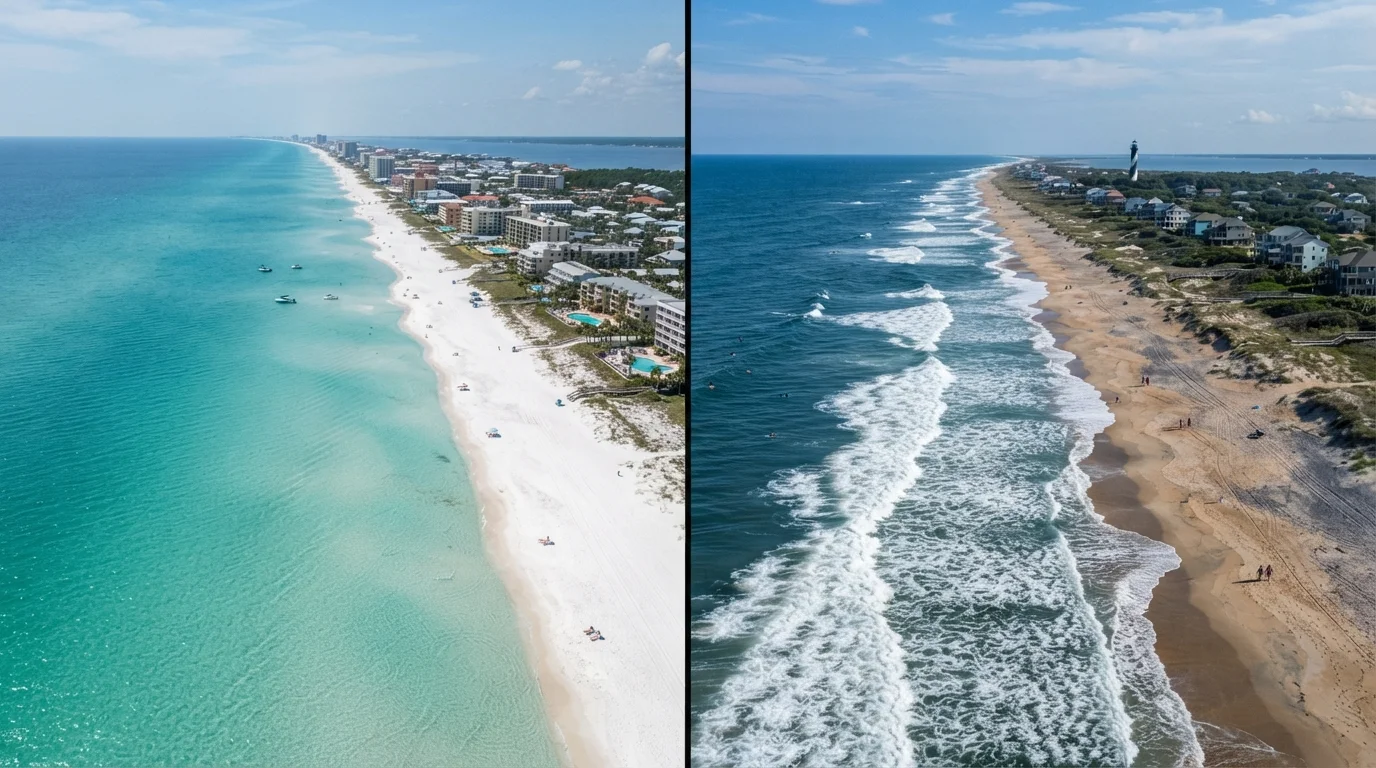
The Gulf Coast from Pensacola through Gulf Shores is made largely of quartz sand carried south from the Appalachian Mountains over millennia. That origin produces the powdery, bright-white beaches the Florida Panhandle is known for. The water there reads as clear turquoise in photos that are not retouched. Further west toward Louisiana and Texas, the sand darkens and the water carries more sediment from river outflows, particularly the Mississippi delta.
Atlantic beaches vary as much as the states that line them. The Outer Banks of North Carolina have wide, wild stretches with wind-shaped dunes. Cape Cod has a mix of bay-side flats and ocean-facing bluffs. Miami Beach is flat, fine, and subtropical. There is no single Atlantic sand color or character. Travelers who want variety within one coast will find more range on the Atlantic; travelers who want consistent quality in one specific stretch often point to the Panhandle.
Climate, seasons, and when to go
Both coasts share a hurricane season that runs formally from June through November, with peak activity in August and September. The Gulf of Mexico's enclosed geography means that storms which enter it often intensify quickly before landfall, which is why Gulf Coast states see some of the most damaging landfalls on record. That does not make the Atlantic coast safe during hurricane season, but the risk profile differs by location and year.
Shoulder seasons reward careful planning on both coasts. April through early June and October on the Gulf Coast bring lower humidity, smaller crowds, and comfortable air temperatures. The Atlantic's longer north-south range means shoulder timing shifts considerably by destination. Maine beaches peak in July and August; the Florida Atlantic coast (including Miami) stays warm enough for beach travel well into winter. If timing your trip around seasonal patterns interests you, our article on planning travel around seasonal patterns lays out a framework that applies domestically as well.
Beach town culture and travel character
The Atlantic Coast has a higher concentration of historic resort towns, partly because the Northeast and Mid-Atlantic states developed beach tourism earlier than Gulf states. Boardwalks in New Jersey, Delaware, and Maryland have operated for well over a century. College-town party scenes, quiet family resorts, LGBTQ+-welcoming communities, and fishing villages all appear within a few hours of each other along the mid-Atlantic stretch.
Gulf Coast beach towns are generally more spread out and lower density. Destin and Panama City Beach in Florida attract large summer crowds, but most Gulf towns feel less packed than their Atlantic equivalents at comparable times. The cultural context around Gulf beaches skews Southern in a way that Atlantic beach culture does not, which can add regional texture to a trip. For travelers who want to combine coastal relaxation with regional history, food, and landscape, the Deep South travel guide covers adjacent territory in more depth.
Travelers weighing a completely different type of American outdoor destination can also look at our comparison of the Mountain West and Pacific Northwest for a sense of how dramatically US regions can diverge.