

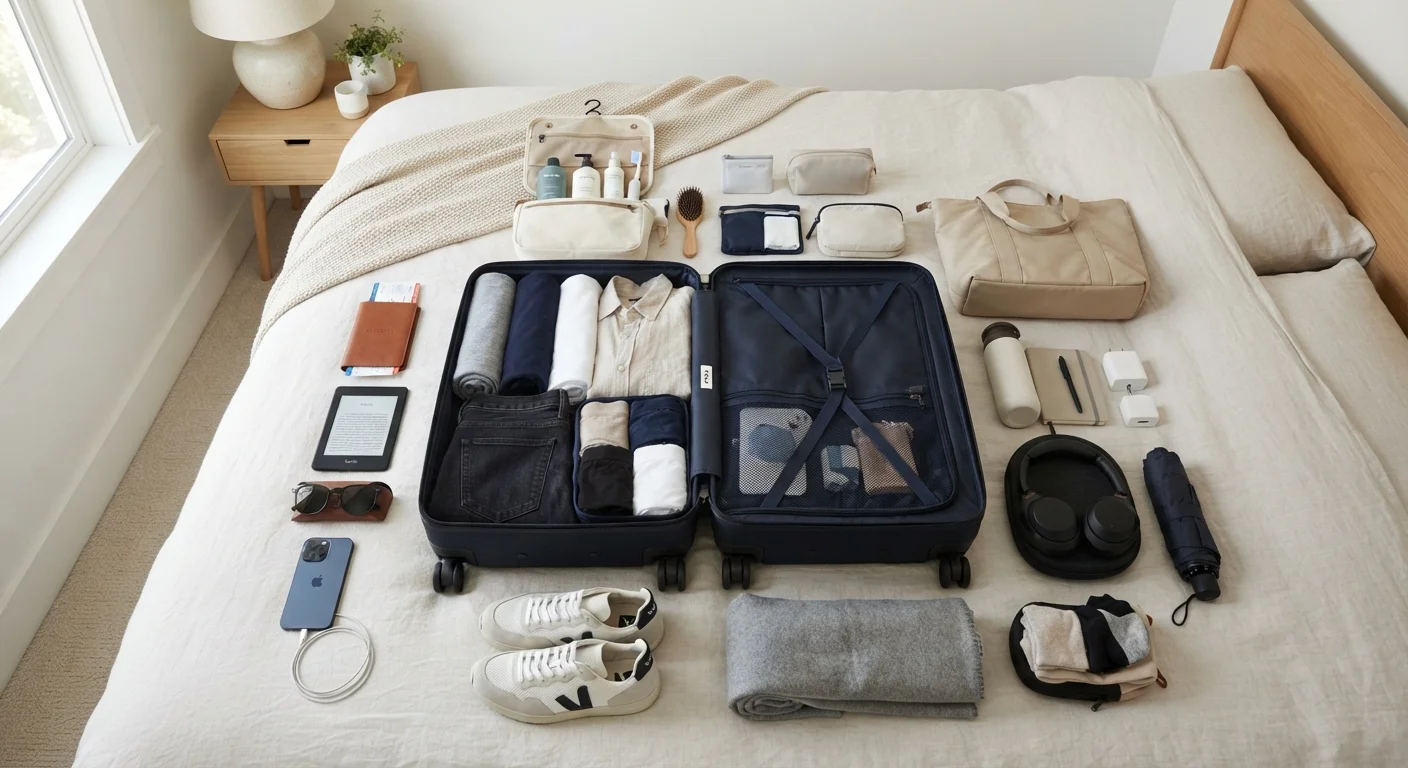
Key Takeaways
- Choosing the right luggage format before you pack determines how freely you move on arrival.
- Most travellers overpack clothing; a mix-and-match capsule wardrobe covers more days with fewer items.
- Climate variability across a single trip requires layering logic, not extra bulk.
- Carry-on placement of critical items protects you if checked luggage is delayed or lost.
- Liquid and battery rules vary by airline and country; verify before you pack, not at the gate.
Start with luggage, not a packing list
The container shapes what goes in it. Before adding a single item, decide whether your trip calls for a hard-shell checked bag, a soft-sided rolling carry-on, or a travel backpack. That decision depends on three things: how many cities you are moving through, the terrain you will cover on arrival, and your airline's baggage policy.
Travelers who move between multiple cities, especially using trains or buses between stops, generally find a 40- to 46-liter backpack or a compact carry-on easier to manage than a large checked bag. Standing in baggage claim in a foreign airport adds time and creates a single point of failure if the bag is delayed. A pre-departure checklist should include confirming your airline's carry-on dimensions, because these differ across carriers, and a bag that fits on a US domestic flight may not fit on a partner airline abroad.
If your trip is two weeks or longer, or involves formal occasions or specialized gear such as hiking boots, a checked bag becomes more practical. The goal is not to minimize luggage at all costs; it is to choose the format that matches how you will actually move.
Building a wardrobe that works across climates
Most overpacking happens in the clothing category. The solution is not to pack fewer clothes randomly; it is to pack clothes that combine with each other. A group of seven tops, four bottoms, and two outer layers will produce far more outfit combinations than a bag of unrelated pieces in the same count.
For trips covering multiple climates, layering is more efficient than packing separate wardrobes for each zone. A lightweight merino wool base layer, a mid-weight zip-up, and a packable wind- or rain-resistant shell handle a range of temperatures and can compress into a small corner of a bag. Merino wool in particular resists odor well enough that one item can be worn two or three times before washing, which materially reduces how many pieces you need.
Footwear is where travelers most often overpack. Two pairs cover most international trips: one for walking significant distances and one that is acceptable in a restaurant or casual indoor setting. A third pair for a specific activity such as hiking or beach use may be justified, but three pairs is a practical ceiling unless the trip has genuinely separate activity segments.
Before finalizing clothing choices, check the weather range for every destination on the itinerary. A well-structured itinerary makes this easier because the destinations and dates are already mapped out, so you can cross-reference expected temperatures and precipitation rather than packing for a vague worst case.
What belongs in your carry-on regardless of bag size
Checked luggage is delayed or misdirected often enough that every long-haul traveler should treat the carry-on as insurance. Certain items must travel with you in the cabin regardless of how you distribute everything else.
At minimum, keep one full change of clothes, any prescription medications, your travel documents, charging cables, and a day's worth of toiletries in the cabin bag. If your checked bag arrives two days late, this kit lets you function normally until it does. Travelers managing ongoing health needs should review international travel with health conditions for guidance on medication documentation and storage requirements, since some medications cannot go in checked baggage at all.
Electronics present a separate constraint. Lithium batteries above certain watt-hour thresholds are restricted or banned from checked bags by most airlines; they must travel in the cabin. Check the specific limits for every airline on your itinerary, because connecting flights may involve different carriers with different rules.
Toiletries, adapters, and the rules that catch people off guard
The TSA 3-1-1 rule (liquids in containers of 3.4 ounces or less, in a single quart-sized bag) applies to US departure airports, but other countries have equivalent restrictions that may differ in detail. Checking the rules for every airport you will depart from is faster than repacking at a security lane.
Power adapters are frequently forgotten or purchased redundantly. Most modern electronics including laptops and phone chargers are dual-voltage (check the label for "100-240V"), meaning they only need a plug adapter, not a voltage converter. However, some older hair dryers, electric razors, and personal care devices are single-voltage and will be damaged or destroyed by foreign current without a converter. Confirm the voltage requirements of every device before packing it.
For international trips involving cruise segments, the packing calculus changes. Cruise cabins have specific power outlet configurations, storage constraints, and prohibited items such as irons or certain heating appliances. The items cruise passengers most often forget overlap only partly with general international travel needs, so a combined trip with a cruise leg warrants a separate review of that list.
For budgeting context, packing decisions also have a financial dimension. Checked baggage fees, overweight fees, and the cost of buying forgotten items abroad can add up. Reviewing those costs as part of a realistic international travel budget helps you decide whether paying for checked luggage upfront is cheaper than the alternatives.