
Travelling Internationally with Health Conditions: General Considerations to Plan Around

Key Takeaways
- Consult your doctor at least four to six weeks before departure to review your health needs for the specific destination.
- Carry medications in original, labelled packaging and bring enough supply for the full trip plus a buffer.
- A written letter from your physician documenting your conditions and medications can prevent issues at customs and border crossings.
- Destination-specific health risks, such as altitude, climate, or endemic diseases, should factor into your planning.
- Travel health insurance that covers pre-existing conditions is a separate category from standard travel insurance.
Why the standard travel checklist falls short
Most pre-departure checklists cover passports, visas, and packing. For travellers managing a chronic illness, a disability, or any ongoing health need, that list misses a significant portion of the actual preparation. The pre-departure checklist for international trips is a useful starting point, but health planning runs in parallel and starts earlier.
The core challenge is that health systems, medication availability, and emergency infrastructure vary considerably by country. What is straightforward to manage at home may require advance coordination abroad. That gap is what this article addresses.
This article provides general travel planning information and is not a substitute for medical advice. Always consult a qualified healthcare provider before travelling with a health condition.
Timing your medical appointments correctly
Book a pre-travel appointment with your doctor or a travel medicine clinic at least four to six weeks before departure. This window matters because some vaccinations require multiple doses spaced weeks apart, and some destinations require proof of vaccination for entry. Your doctor also needs time to prepare documentation and adjust prescriptions if needed.
At that appointment, cover the specific destination rather than just a general health review. Altitude, humidity, heat, and endemic diseases (such as malaria or dengue fever) each affect different conditions differently. Bring your full medication list, including over-the-counter drugs and supplements, because some combinations have interactions and some countries restrict certain substances at the border.
Ask about in-flight management specifically
If you manage a condition that could shift during a long-haul flight, such as deep vein thrombosis risk, controlled diabetes, or a respiratory condition affected by cabin pressure, raise that scenario with your doctor as a separate topic from general clearance. Cabin altitude, limited mobility, meal timing, and hydration all interact with certain conditions in ways worth discussing before you board.
If you manage a condition that could deteriorate during long-haul flights, such as deep vein thrombosis risk or respiratory conditions worsened by cabin pressure, ask your doctor about in-flight management specifically. That conversation is different from general health clearance.
Medication logistics: what to carry and how to document it
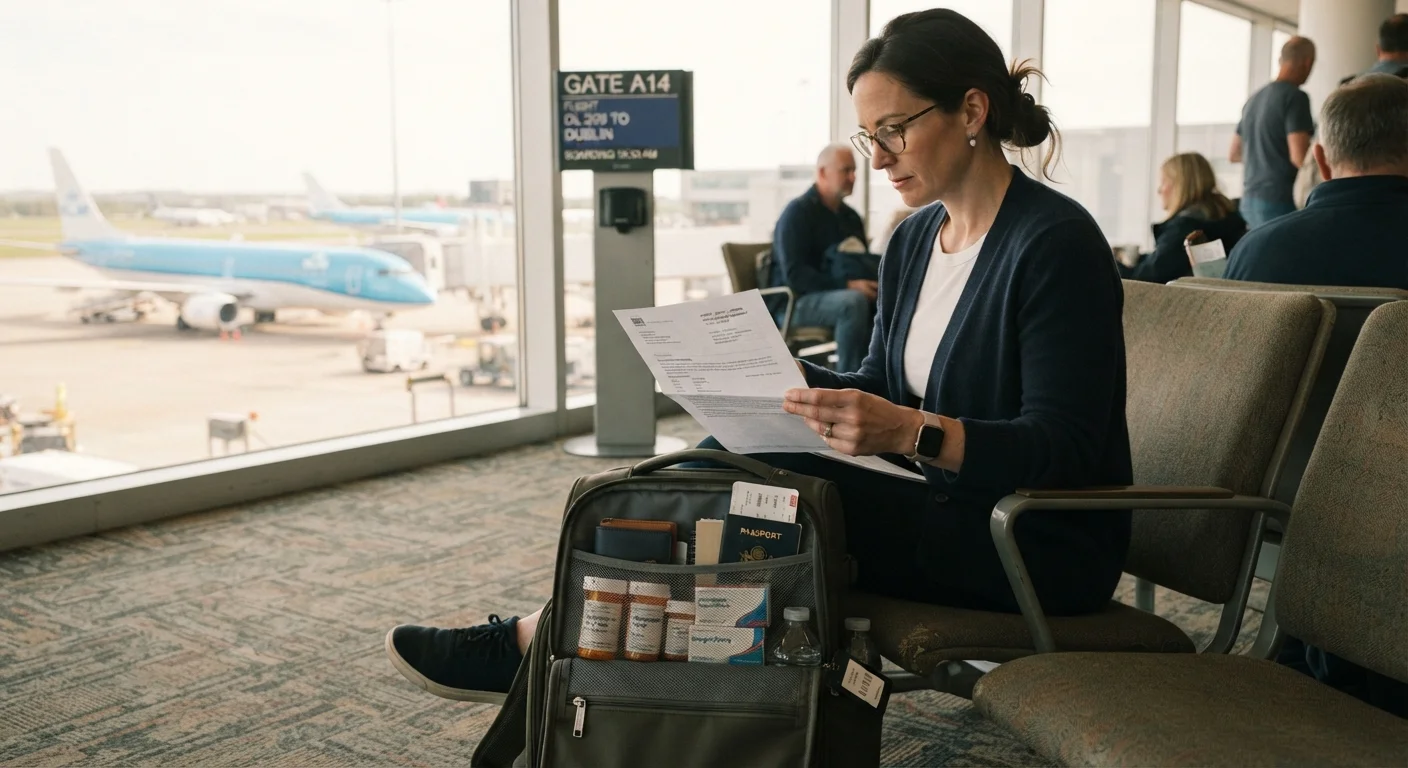
Carry all medications in their original, pharmacy-labelled containers. Pack them in your carry-on bag rather than checked luggage. Airlines lose and delay bags; medications cannot wait. Bring enough supply to cover your full trip plus at least five to seven extra days for unexpected delays or lost items.
For controlled substances or injectable medications, a physician's letter is not optional in practice. Border authorities in many countries will question undocumented medications, and in some cases, confiscate them. The letter should state your name, your diagnoses, the medications prescribed, dosages, and the duration of treatment. Ask your doctor to write it on official letterhead.
Check the legal status of your medications in each country on your itinerary. A drug that is legal and common in the United States may be a controlled substance or outright banned in your destination. The U.S. Embassy website for the destination country is one starting point; the country's own embassy in Washington can also confirm import rules. Verify directly with official sources before travel.
For a broader look at documentation travellers commonly need, the key concepts guide for international travellers covers several categories worth reviewing alongside health paperwork.
Travel insurance and pre-existing conditions
Standard travel insurance policies frequently exclude pre-existing conditions unless you purchase a specific upgrade or a policy designed to cover them. Read policy language carefully before buying. Terms like "stable" and "controlled" have defined meanings in insurance contracts that may not match how you or your doctor describe your condition.
Coverage to look for includes emergency medical treatment abroad, medical evacuation, and trip cancellation tied to a health event. The cost of medical evacuation from a remote or developing destination can reach tens of thousands of dollars without coverage.
This is general information about how travel insurance categories work, not personalised insurance advice. A licensed insurance professional or your state's insurance commissioner can help you evaluate specific policies for your situation.
If your trip includes a cruise, health-related planning has additional layers. The article on cruise preparation for travellers with chronic health conditions covers ship-specific considerations in more detail.
Destination-specific health factors
Some destinations introduce risks that compound existing health conditions. High-altitude destinations (generally above 8,000 feet) can affect cardiovascular and respiratory conditions and may require acclimatisation days that need to be built into your itinerary. Extreme heat affects hydration, blood pressure medications, and conditions like multiple sclerosis that are sensitive to temperature. Food safety standards vary and matter considerably for travellers who are immunocompromised or managing gastrointestinal conditions.
Seasonal patterns affect more than just weather. Peak travel seasons bring crowded transportation and accommodation, which can affect rest and stress levels. The article on planning an international trip around seasonal patterns covers how to factor seasonal variables into destination timing.
Research healthcare availability at your destination before you go. Identify the nearest hospital or clinic that meets an appropriate standard for your needs and save contact information offline. Some travellers also register with the U.S. Embassy or Consulate at their destination through the State Department's STEP program, which allows the embassy to contact you in an emergency.
Schedule a travel medicine consultation at least four to six weeks before departure.
This gives time for vaccinations, prescription adjustments, and documentation preparation. Leaving it to the week before travel limits your options significantly.
Carry a written physician's letter that documents your diagnoses, medications, and treatment plan.
This letter functions as official documentation at customs, in emergencies abroad, and when seeking care from an unfamiliar provider. Without it, border agents may delay or confiscate medications they cannot verify.
Verify the legal status of each medication in every country on your itinerary.
Medication regulations differ by country, and carrying an unlisted controlled substance across a border can have serious legal consequences regardless of your medical need.
Purchase travel insurance that explicitly covers pre-existing conditions before finalising your trip.
Standard policies exclude pre-existing conditions by default. Medical evacuation costs and emergency hospitalisation abroad can be financially devastating without the right coverage.
Pack medications in carry-on luggage, with an extra supply buffer beyond your travel dates.
Checked baggage is lost or delayed with some regularity. Medications are time-sensitive and often cannot be replaced quickly or at all in an unfamiliar country.