

Key Takeaways
- The muster drill is mandatory and covers the specific evacuation procedures for your ship.
- Modern cruise ships carry lifeboats, life rafts, and automatic detection systems well beyond minimum regulatory requirements.
- Deck and pool areas carry real slip, fall, and drowning risks that passengers can reduce with basic awareness.
- The ship's medical center handles many emergencies, but its resources are limited compared to a land hospital.
- Reporting hazards, knowing your cabin's location, and reading posted safety notices are passenger responsibilities.
The muster drill: your first and most important safety task
Every passenger on every cruise ship must attend a muster drill before or shortly after the vessel leaves port. This requirement comes from the International Convention for the Safety of Life at Sea (SOLAS), the global framework that governs commercial maritime safety. Missing or skipping the drill is not an option: crew members track attendance by cabin, and passengers who do not participate may be located and brought to their muster station.
The drill teaches you three things. First, the location of your muster station, the designated assembly point where you would report during an emergency. Second, how to put on a life jacket correctly, including the over-the-head fit and chest clip. Third, the sequence of signals you would hear from the ship's alarm system. Most ships use the signal described in SOLAS: seven short blasts followed by one long blast on the horn or general alarm.
Since 2020, the industry has moved toward eMuster systems on many ships. Passengers watch a safety video on their cabin TV or via a mobile app before departure, then report briefly to their muster station for a physical check-in with crew. The content is the same; the format is less crowded. Pay attention regardless of format, because the station location and alarm signals are ship-specific.
Screenshot your muster station location and the deck map before leaving your cabin on embarkation day. In an actual emergency, you want to move without hesitation, not search for posted signs.
Stress narrows attention and slows information processing; having the route already in memory removes a decision step under pressure.
Pack a small flashlight or headlamp in your carry-on, not your checked luggage. Power disruptions during ship emergencies are uncommon but do occur, and cabin corridors can become very dark.
Battery-powered personal lighting is a low-cost item that covers a scenario the ship's emergency lighting system is designed for but where a personal backup provides added confidence.
How cruise ship safety systems work
Large cruise ships carry lifeboats that together can hold every person on board, typically at 125 percent of total capacity as required by SOLAS. In addition to davit-launched lifeboats, ships carry inflatable life rafts that deploy automatically if the vessel sinks. Crew members train regularly on launching procedures.
Fire detection is automatic throughout the ship. Smoke detectors, heat sensors, and sprinkler systems are installed in cabins, corridors, engine rooms, and public spaces. The bridge receives alerts in real time. Ships also carry inert gas and CO2 suppression systems for engine and fuel spaces where water cannot be used.
Navigation safety involves multiple redundant systems: GPS, radar, electronic chart displays, and lookout watches. A dedicated safety officer monitors bridge operations, and international rules require rest periods for officers to limit fatigue-related errors.
For context on what to pack that supports your personal safety plan, see what passengers commonly forget to pack, which covers items like motion sickness aids and practical deck footwear.
Deck and pool area precautions
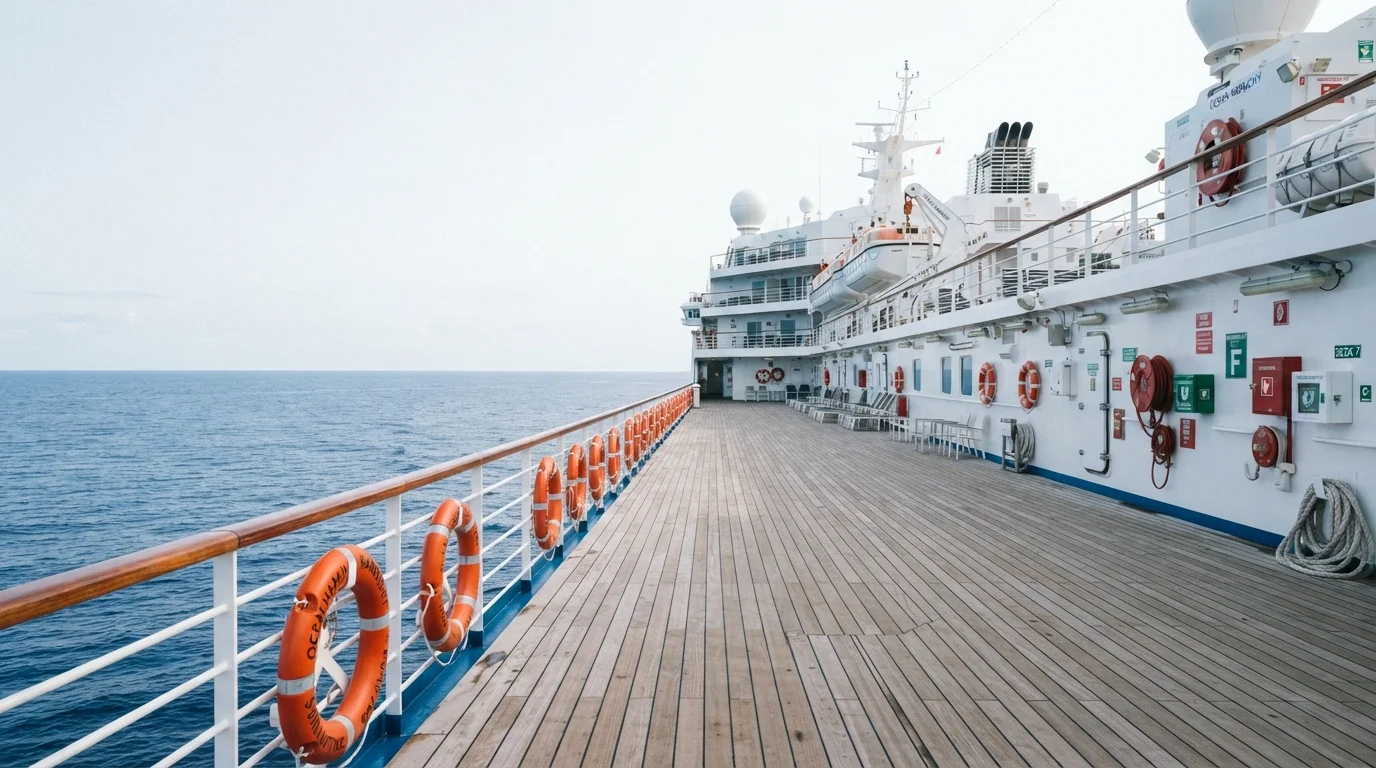
Slippery surfaces are the most frequent cause of passenger injuries on cruise ships. Wet pool surrounds, exterior deck planking during rain, and teak stairs with worn non-slip strips all present fall hazards. Wearing flat, closed-toe shoes with rubber soles on exterior decks and around pools is the straightforward fix.
Pool areas present a separate drowning risk, particularly for children. Most ship pools are not staffed with certified lifeguards during every operating hour; signage near the pool will tell you the supervision policy. Parents traveling with children should treat ship pools the same way they would an unsupervised backyard pool: constant visual contact is required.
Leaning over railings or sitting on them is prohibited on every ship and for good reason: falls overboard are rare but nearly always fatal. The same rule applies to throwing objects from balconies or decks. Balcony cabins present an additional consideration: balcony doors on most ships automatically latch, but passengers should ensure the door is fully closed when not in use, especially when traveling with children. See how balcony and suite categories differ for more on what these cabin types include.
Fire safety and what passengers should do
Cabins are the most common location for ship fires, and the cause is usually the same as at home: unattended candles, overloaded power strips, or items left near heat sources. Most cruise lines prohibit candles and incense outright; check your line's policy before packing them.
If you smell smoke or see fire in your cabin, leave immediately without stopping to collect belongings, close (do not lock) the cabin door behind you to slow the spread, and activate the nearest pull-station alarm if you have not already heard the ship's alarm. Move to your muster station using stairwells, never elevators.
In a corridor with visible smoke, stay low where the air is cleaner, keep one hand on the wall to navigate, and proceed toward an emergency exit marked with green running-man signs. These exit signs are illuminated by battery backup systems and remain lit even if the main power fails.
Never use elevators during a ship emergency
Elevators can lose power or trap passengers between decks during a fire or evacuation. Every ship posts instructions directing passengers to stairwells during emergencies. Make a habit of knowing where the nearest stairwell is from any space you spend time in, including restaurants and entertainment venues.
Medical emergencies at sea
Every large cruise ship is required to have a medical facility staffed with at least one physician and two nurses on sailings of more than 100 passengers. The facility can handle basic emergencies: lacerations, fractures, cardiac events, and IV medications. It is not a full hospital. Imaging is typically limited to X-ray, and surgical capability varies by vessel.
For serious emergencies, the ship can request a medical evacuation. Depending on the ship's location, this may involve a Coast Guard or air rescue helicopter, or a transfer to a local medical facility at the next port. Evacuation decisions rest with the ship's physician in consultation with the captain.
Travel insurance that includes medical evacuation coverage is worth understanding before you sail. Evacuation costs from remote ocean locations can reach tens of thousands of dollars and are not covered by standard US health insurance or Medicare in international waters. For broader wellbeing guidance while at sea, staying healthy on a cruise ship covers practical day-to-day habits. If motion sickness is a concern, managing seasickness outlines evidence-based options.
This article provides general safety information and is not a substitute for professional medical advice. Consult a qualified healthcare provider about any personal health concerns before travel.
Practical habits that reduce everyday risk
Know your cabin number and its location relative to stairwells and muster station on your first day. Ship corridors are long and visually similar; passengers who know where they are relative to exits navigate faster in low-visibility conditions.
Read the safety card posted on the back of your cabin door. It shows your specific muster station assignment and the evacuation route from your deck. This takes about two minutes and covers information the muster drill assumes you will have reviewed.
Report any hazard you notice: a wet floor without a warning cone, a loose handrail, a smoke detector with a blinking fault light. Guest services or the nearest crew member can route the report to the right department. Passengers are not expected to fix anything; reporting is the contribution.
Alcohol consumption raises risk in pool, deck, and stairwell environments. This is a consistent pattern across shipboard injury data: impaired balance on a moving vessel with wet surfaces increases the likelihood of falls. Moderation on sea days and in pool areas is a straightforward way to reduce that risk.
For a fuller picture of preparing for a cruise, see the items most passengers forget to pack, which includes safety-adjacent items many travelers overlook.