
Edge Computing and Why Your Smart Devices No Longer Need the Cloud for Everything

Key Takeaways
- Edge computing processes data on or near the device, not in a distant data center.
- Faster response times result because data does not travel to a remote server and back.
- Less data leaving your home can improve privacy, though it does not eliminate all risk.
- Many modern smartphones and smart home devices already include edge computing chips.
- Cloud computing and edge computing work together rather than replacing each other.
Edge computing
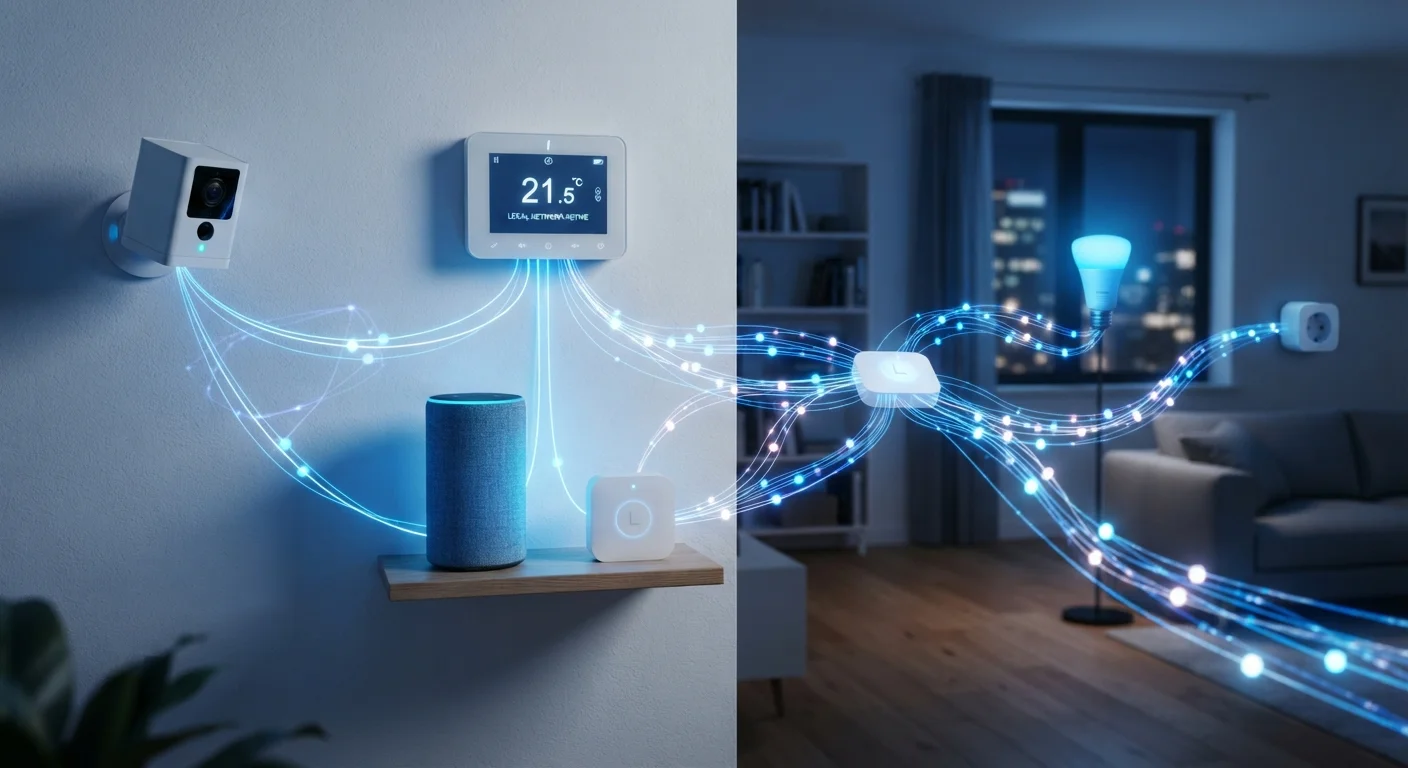
Edge computing is a way of processing data on or near the device that collects it, rather than sending that data to a distant server. When your smart speaker recognizes your voice without any internet delay, or your security camera flags motion before uploading a clip, edge computing is at work. The 'edge' refers to the outer boundary of a network, where devices like phones, cameras, and appliances sit.
In network architecture, 'the edge' contrasts with centralized cloud data centers. Processing at the edge typically involves on-device chips or a local gateway such as a home hub.
The cloud was never the only option
For most of the last decade, the assumption was simple: smart devices collect data, send it to the cloud, get an answer back, and act on it. That round trip works fine when the task can wait a few hundred milliseconds and when a stable internet connection is available. But two problems have pushed engineers toward a different model.
First, some tasks cannot wait. A car's collision-avoidance system needs to respond in milliseconds, not after a round trip to a server. Second, sending continuous streams of raw data, video, audio, health readings, across a network is expensive in bandwidth and raises legitimate privacy questions.
Edge computing addresses both problems by moving the processing step closer to where the data originates. The everyday devices in your home and pocket are now capable of handling far more computation than they were five years ago, and manufacturers have started taking advantage of that.
How the processing shift actually works
A traditional cloud setup has three stages: the device collects data, uploads it, and waits for the cloud to respond. An edge setup collapses those stages. The device (or a local hub connected to it) does the computation itself and only contacts a remote server when necessary.
Consider a smart security camera. A cloud-dependent version records video constantly and sends it to a server that checks each frame for motion or faces. An edge-capable version runs that analysis on a chip inside the camera. It only uploads a short clip when something worth flagging is detected. The raw, continuous video stream never leaves your home.
The same principle applies to voice assistants that detect a wake word locally before sending any audio to a server, and to fitness trackers that calculate heart rate and sleep stages on the device rather than uploading raw sensor data. For a closer look at the chips that make this possible, see what each component inside your smartphone actually does.
75%
Enterprise data processed outside traditional data centers by 2025
According to a projection by Gartner, published in their infrastructure research, the share of data processed at or near the edge was expected to grow substantially from under 10% in 2018.
Less than 1ms
Target latency for critical edge applications
Industry engineering standards for autonomous vehicles and real-time industrial systems set sub-millisecond latency as a benchmark, a threshold that cloud round trips cannot reliably meet.
Billions
Connected IoT devices generating edge data globally
Ericsson's annual mobility report has tracked the rapid expansion of connected devices, with billions of IoT endpoints now producing data that would overwhelm centralized networks if processed entirely in the cloud.
What this means for speed and reliability
Latency, the delay between an action and a response, drops when processing happens locally. A cloud request from a device in your home might travel hundreds of miles to a data center and back. An edge request travels a few feet, or nowhere at all.
Reliability improves as well. If your internet connection drops, a cloud-dependent device often becomes useless. A device with edge capabilities can continue operating for tasks it handles locally, though any feature that genuinely requires the internet will still be unavailable.
These gains matter most in situations where both speed and continuity are required: medical monitoring wearables, industrial sensors, autonomous vehicles, and real-time security systems. For home users, the practical benefit is that routines and automations continue working even during a brief outage, and responses feel more immediate.
Privacy: a clearer picture, not a simple one
Sending less data to remote servers reduces exposure to certain risks: interception in transit, storage on servers you do not control, and data being used in ways you did not anticipate. Those are real benefits.
But edge computing does not make a device inherently private. The manufacturer still controls what data the device sends, when it sends it, and how it is used. A camera with on-device processing might still upload metadata, usage patterns, or occasional samples for quality improvement. The privacy story depends on the specific device and the company behind it.
If privacy in your home network matters to you, securing your home network is a practical starting point regardless of whether your devices use edge processing or cloud processing. For a broader look at managing digital data at home, managing digital clutter at home covers both physical storage and data habits.
Check what your device actually sends
Most smart devices have a companion app with privacy or data settings. Look for options labeled 'local processing,' 'on-device,' or 'data sharing' before assuming a device is private by default. Adjusting these settings is often more effective than relying on marketing descriptions.
Cloud and edge as partners
The most accurate way to think about this is not cloud versus edge but cloud plus edge. Most modern systems split tasks by type: fast, local, or sensitive tasks happen at the edge; storage, large-scale analysis, and coordination happen in the cloud.
A fitness wearable might track your steps and heart rate entirely on-device throughout the day, then sync a summary to a cloud service each night for long-term trend analysis. A smart thermostat might learn your schedule locally but pull weather forecasts from a cloud service to refine its predictions.
This division is likely to deepen as chips become more capable. Manufacturers and developers interested in how these ideas extend to spatial environments can also explore spatial computing, which layers digital content onto physical space and depends heavily on low-latency local processing.