

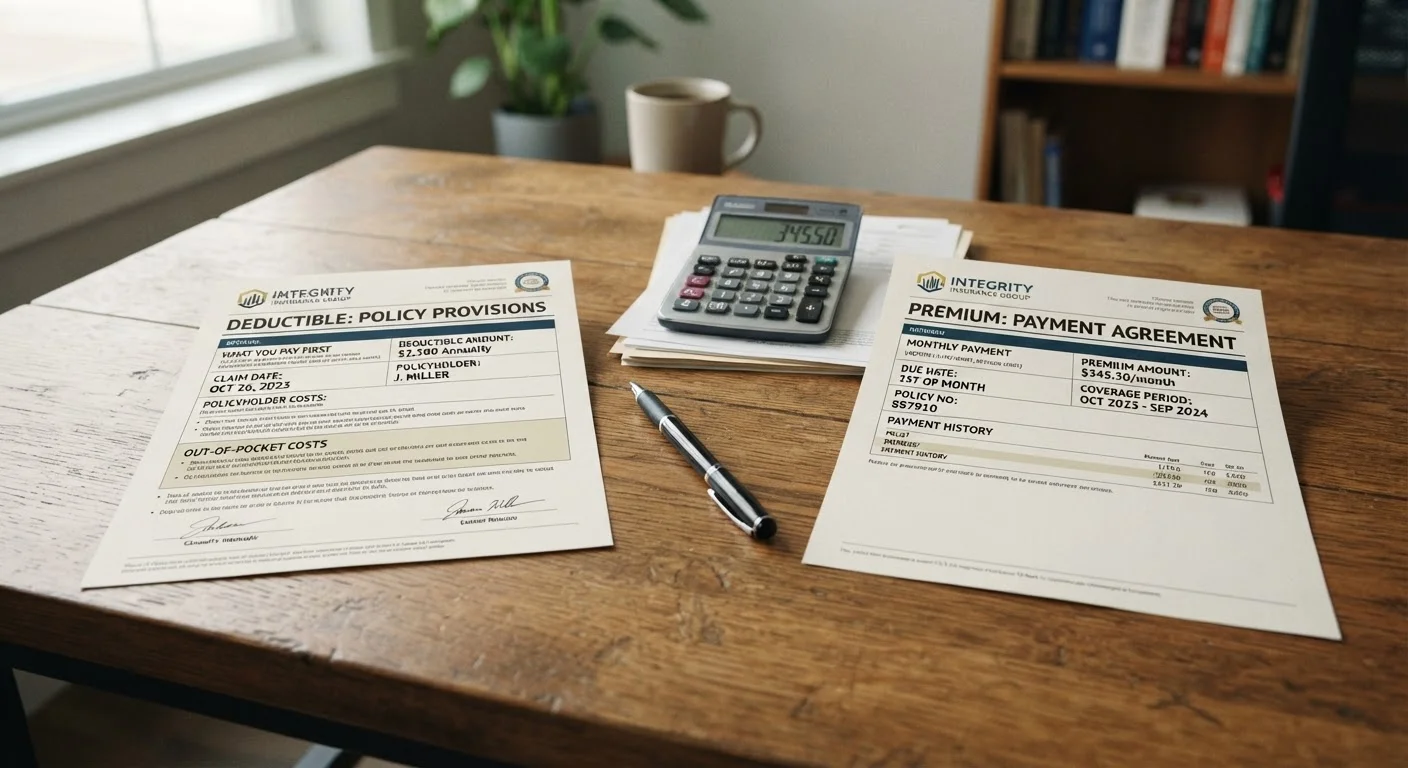
Key Takeaways
- A higher deductible generally lowers your monthly premium, but raises your cost when you file a claim.
- The right balance depends on your savings cushion, health needs, and how often you use insurance.
- Employer-sponsored plans and government programs may limit how much you can adjust this trade-off.
- Your out-of-pocket maximum caps total exposure, so the deductible is not your only risk number.
- Consult a licensed insurance adviser before choosing a plan based on this trade-off alone.
Option A
Deductible
The amount you pay out of pocket before insurance kicks in.
Best for: People who rarely file claims and want to keep monthly costs low.
Option B
Premium
The recurring cost you pay to maintain your insurance coverage.
Best for: People who want predictable, lower out-of-pocket costs when something goes wrong.
If you have strong emergency savings and rarely file claims
High deductible, low premium
You can absorb a large one-time cost if something happens, and you save money every month you don't need care.
If you have frequent medical needs or predictable annual claims
Low deductible, higher premium
Paying more each month becomes worthwhile when you know you will hit your deductible regularly.
If you have little to no emergency savings
Low deductible, higher premium
A large surprise deductible bill can cause serious financial strain if you have no savings buffer.
If you want to use a Health Savings Account (HSA)
High deductible, low premium
HSA eligibility requires a high-deductible health plan, and HSA contributions offer a tax advantage that offsets some of the deductible risk.
What each term actually means
A premium is what you pay to keep your insurance policy active, usually monthly or annually. You pay it whether or not you ever file a claim. Think of it as the base cost of being covered.
A deductible is the dollar amount you must pay yourself before your insurer starts paying for a covered loss. If your health plan has a $2,000 deductible, you pay the first $2,000 of covered medical costs each year. After that, the insurer begins sharing or covering the rest, depending on your plan's terms.
These two numbers move in opposite directions by design. Insurers charge lower premiums when policyholders agree to absorb more initial risk through a higher deductible. When the insurer takes on more of the early risk (lower deductible), it charges more each month to compensate.
For a fuller glossary of related terms, see Health Insurance Terminology Decoded, which covers copays, coinsurance, and out-of-pocket maximums in plain language.
The real trade-off: timing of cost, not total cost
Most people frame this as a math problem: which option is cheaper overall? That framing misses the point. The real question is when you pay, not just how much.
With a low-premium, high-deductible plan, your costs are back-loaded. You spend less each month, but face a larger bill the moment something happens. With a high-premium, low-deductible plan, costs are front-loaded. You pay more consistently, but you face a smaller bill when you actually need coverage.
This timing difference matters because of cash flow and financial resilience. A $3,000 deductible is manageable for someone with that amount sitting in savings. For someone without a savings buffer, the same deductible can mean debt, delayed care, or skipped treatment.
| Criterion | High deductible / low premium | Low deductible / high premium |
|---|---|---|
| Monthly cost | Lower | Higher |
| Cost when you file a claim | Higher out of pocket | Lower out of pocket |
| Best if you rarely use coverage | Yes | No |
| Best if you use coverage frequently | No | Yes |
| HSA eligibility (health plans) | Yes (if HDHP-qualified) | No |
| Risk if savings are low | High | Lower |
| Predictability of total cost | Less predictable | More predictable |
It is also worth separating premium from value. A lower premium does not mean better value if a high deductible forces you to delay care or borrow money to cover a claim. The right plan is the one your budget can actually handle at both ends: the monthly payment and the worst-case claim scenario.
Factors that should shape your decision
Three practical factors matter most when choosing where to land on the deductible-premium spectrum.
- Your savings cushion. Can you cover your full deductible from savings without disrupting rent, groceries, or other bills? If not, a lower deductible is worth the higher premium.
- Your expected usage. Someone managing a chronic condition who sees specialists regularly will likely hit a lower deductible every year. The math may favor paying more upfront in premiums to reduce per-claim costs. Someone who rarely uses coverage may never come close to a high deductible.
- HSA eligibility. High-deductible health plans (HDHPs) are the only plans that qualify for a Health Savings Account. HSA contributions are tax-deductible, grow tax-free, and can be withdrawn tax-free for qualified medical expenses. For eligible workers, this tax benefit can meaningfully offset the higher deductible risk.
Auto and homeowners insurance follow the same logic. Comprehensive vs. collision coverage is another example of how coverage decisions layer on top of this core deductible-premium trade-off.
If your premiums have been rising without a clear reason, Why Your Premium Went Up explains the factors that can push costs higher even when you have not filed a claim.
What the deductible does not tell you
The deductible is not your maximum exposure. Most plans also have an out-of-pocket maximum, which is the most you would pay in a plan year before the insurer covers 100% of remaining covered costs. In 2024, the IRS set out-of-pocket maximums for HDHPs, and the Affordable Care Act sets separate caps for marketplace plans. Knowing your out-of-pocket maximum gives you a clearer picture of actual worst-case cost, not just the deductible floor.
Some plans also have separate deductibles for different types of care: prescription drugs, mental health services, or out-of-network providers. A low headline deductible can mask higher actual costs if specific services you use fall under a separate, higher deductible.
Deductibles reset annually
Most insurance deductibles reset at the start of each plan year, not the calendar year. If you had a major claim in October, you may hit your deductible again just two or three months later. Check your plan's reset date, especially if you are timing elective procedures or large purchases against your deductible progress.
Before committing to any plan, ask the right questions before accepting a policy to make sure you understand every number that affects your total cost. And if you are starting to compare plans actively, shopping for insurance without getting overwhelmed offers a structured approach to the process.
This article is for general informational purposes only and is not personalized insurance, financial, or legal advice. Coverage terms, deductibles, premiums, and eligibility vary by plan, provider, and state. Consult a licensed insurance agent or financial adviser for guidance specific to your situation.