

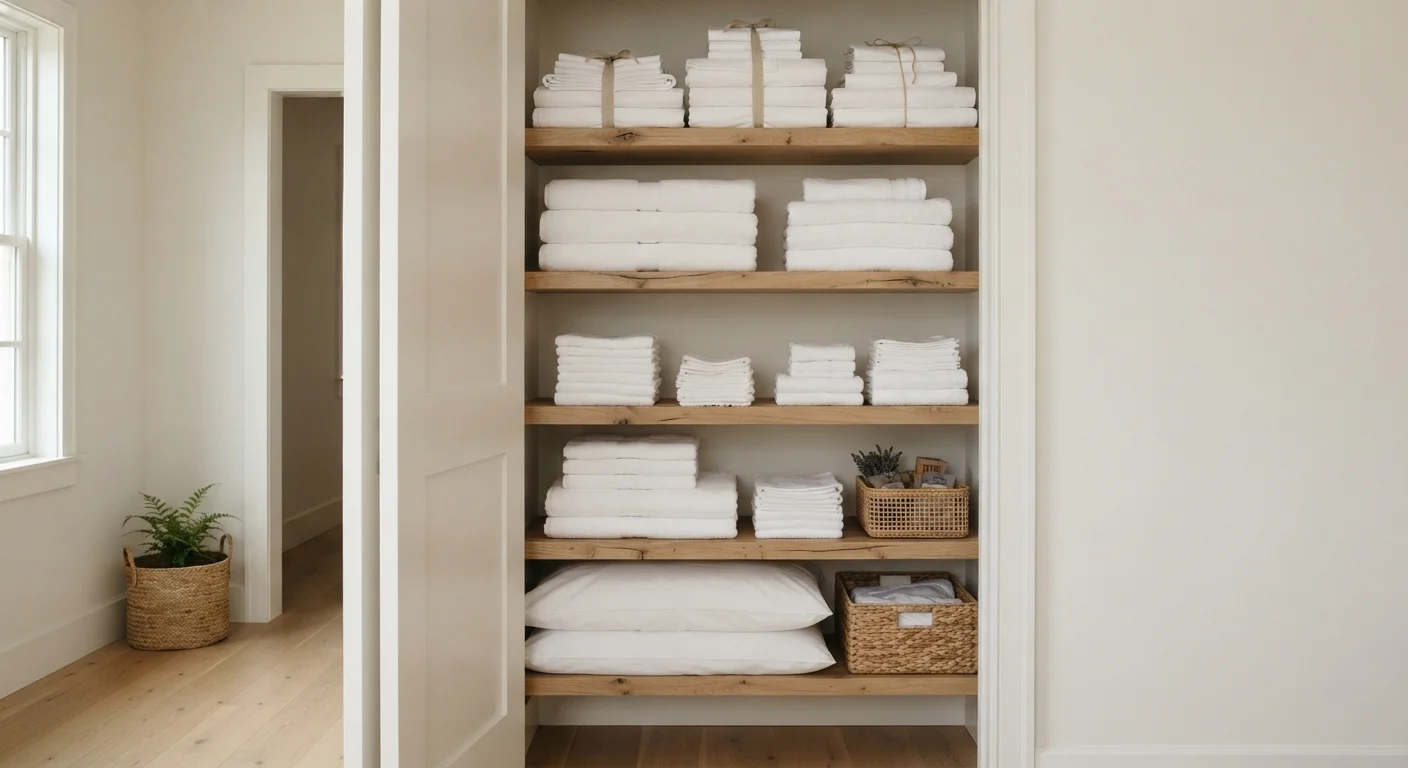
How to allocate shelves by use frequency
The most-used items should live at eye level, where you can grab them without bending or reaching overhead. For most households, that means bath towels and everyday bed sheets occupy the middle shelves. Spare pillowcases and hand towels sit just above or below.
Reserve the top shelf for infrequently used items: guest bedding, seasonal blankets, and extra pillow inserts. A folded duvet stored in a breathable cotton bag takes up less space and stays cleaner than one left loose. The bottom shelf works well for bulky items like mattress pads, tablecloths, and extra toilet paper or tissue stock, since these are easy to retrieve by crouching and do not topple as easily as folded stacks.
If your closet has deep shelves (12 inches or more), place like items front-to-back rather than side-to-side. Front slots hold your current rotation; the back holds backup stock. This prevents items from getting buried and forgotten.
For household members with different routines, a shared linen closet benefits from designated zones rather than a single communal pile. The guide to organizing shared living spaces covers how to build systems that multiple people will actually follow.
Folding methods that hold their shape on the shelf
Flat folds work for most towels and sheets because they stack evenly and do not require any special technique. Fold a bath towel in thirds lengthwise, then fold it in half twice. The result is a compact rectangle that stands upright or stacks without collapsing.
For fitted sheets, the common frustration comes from the elastic corners bunching out. Start by tucking one corner inside the other until all four corners nest together. Lay the sheet on a flat surface, fold the curved edge inward to create a rough rectangle, then fold in thirds. A fitted sheet stored this way stays almost as flat as a flat sheet.
The file-fold method, sometimes called the KonMari fold, works particularly well on shelves where you want to see every item at once. Instead of stacking linens, you fold each piece into a small rectangle and stand them upright side by side, like books on a shelf. This prevents the common problem of pulling one towel and toppling the stack. It also makes it immediately obvious when you are running low.
Washcloths fold quickly into thirds and store neatly in a small bin or basket on a shelf edge. Keeping washcloths together in one container avoids the sprawl that happens when small pieces mix with larger folded stacks.
What actually belongs in a linen closet
The term "linen closet" often becomes a catch-all, which is how closets lose their function. A useful rule: if you use it in a bedroom or bathroom and it is fabric or a personal care supply, it probably belongs here. If it migrated from the kitchen, garage, or medicine cabinet, it probably does not.
Core categories worth keeping in a linen closet:
- Bed linens (sheets, pillowcases, duvet covers) sorted by bed size
- Bath towels, hand towels, and washcloths
- Extra blankets and throws
- Spare toilet paper, tissue, and soap
- First aid basics, if your closet is near a bathroom and you have no dedicated medicine cabinet
Items that tend to drift in but work better elsewhere: cleaning supplies (which belong under the sink or in a utility area), expired medications (which should be disposed of safely), and miscellaneous hardware. If you find these during an organization session, the room-by-room decluttering framework provides a clear process for handling displaced items without just moving the problem to another shelf.
Store bed linens as sets. Tuck the pillowcases inside one of the folded flat sheets so the set stays together. This saves the time spent matching pieces every time you change a bed.
Labeling, containers, and maintaining the system
Labels work best when they identify categories rather than specific items. "Twin sheets", "bath towels", and "guest bedding" give enough information to put things back correctly without over-engineering the system. Simple paper labels in a label maker, or even handwritten tags on basket handles, are enough.
Baskets and bins serve a real purpose on deep or wide shelves where small items would otherwise scatter. Use them for washcloths, travel toiletries, or the first aid stock. Clear bins show contents at a glance; fabric bins look tidier but require labels to remain useful.
Shelf dividers prevent folded stacks from leaning and collapsing sideways. They are inexpensive and make a noticeable difference on shelves that hold towels or blankets without a wall on one side.
A linen closet stays organized when restocking is as easy as taking items out. That means leaving a small amount of open space on each shelf rather than filling every inch. One or two empty spots signal where the next item should go and remove the temptation to pile things on top of an existing stack.
Seasonal items like heavy blankets rotate in and out once or twice a year. When they come out for storage, this is a good moment to check for wear, thin towels, or sheet sets that no longer have matching pieces. The seasonal clothing rotation process follows similar logic and can be scheduled at the same time.