

Key Takeaways
- Freestanding shelving is the most flexible and budget-friendly option for most garages.
- Enclosed cabinets protect contents from dust and deter casual access, but cost more.
- Wall panel systems maximize floor space and adapt easily as needs change.
- The right system depends on what you store, how often you access it, and your budget.
- Combining two or three approaches often yields better results than committing to one.
Our Verdict
No single garage storage system outperforms the others in every situation. Freestanding shelves deliver quick, affordable organization for general storage. Wall panels work best when floor space is limited and the contents change frequently. Enclosed cabinets suit hazardous or valuable items that need protection and a tidier appearance.
| Best for | Recommended |
|---|---|
| Those working within strict budget or time constraints | Freestanding shelving |
| Garages with limited floor space or frequently changing storage needs | Wall panel systems |
| Households with children, pets, or a need for a polished look | Enclosed cabinets |
| Most real-world garages with mixed storage demands | A combination of all three |
Why garage storage deserves a structured approach
A garage collects what no other room will take: seasonal gear, tools, sports equipment, chemicals, and overflow from every other part of the house. Without a deliberate system, the space becomes hard to use and frustrating to navigate. Choosing a storage approach before buying anything prevents the common outcome of mismatched units that waste space.
The three main systems, freestanding shelving, wall panels, and enclosed cabinets, differ in cost, installation effort, flexibility, and what they protect. Understanding those differences lets you match the system to what you actually store. For a broader look at how vertical space affects every room in your home, see how to use vertical space effectively.
Freestanding shelving
Freestanding metal or wire shelving units require no wall attachment and can be repositioned whenever your storage needs shift. That flexibility makes them a practical first choice for renters or anyone uncertain about long-term layout.
Wire shelving allows air to circulate, which reduces moisture buildup on stored items. Solid-deck steel shelving can handle heavier loads and is easier to sweep clean. Most units assemble without tools in under an hour.
The main limitations are footprint and appearance. Each unit stands on its own legs, so it consumes floor area. In a smaller garage, several units lined up can crowd out vehicle space. Open shelves also collect dust and leave contents visible, which may not suit a workspace where appearance matters.
For typical weight capacities, a mid-range steel unit handles 200 to 2,000 pounds per shelf depending on gauge, so always check the manufacturer's rated load before storing heavy items like automotive fluids or power tools.
Wall panel systems
Wall panels, sometimes called slatwall or grid panels, mount directly to studs and use interchangeable hooks, bins, and brackets to hold tools, bikes, garden equipment, and more. Because storage moves off the floor and onto the wall, you recover square footage for parking or work.
The main advantage is reconfigurability. You can rearrange accessories in minutes without drilling new holes. That suits garages where storage demands change by season, such as swapping ski gear for bicycles in spring.
| Freestanding shelving | Wall panel systems | Enclosed cabinets | |
|---|---|---|---|
| Typical cost | Low to moderate | Moderate (panels + accessories) | Moderate to high |
| Installation effort | Very easy, no tools required | Moderate, requires stud finding | Moderate to difficult |
| Floor space used | High (each unit has a footprint) | Minimal | Low to moderate |
| Flexibility | High, move units freely | Very high, swap accessories easily | Low, fixed once installed |
| Dust and pest protection | Low, contents exposed | Low, contents exposed | High, doors seal contents |
| Good for heavy items | Yes, with correct gauge | Depends on wall framing | Yes, steel units |
| Renter-friendly | Yes | Sometimes | Rarely |
Installation requires locating wall studs and, for heavy loads, verifying that the wall framing can support the system's rated capacity. Drywall anchors alone are not sufficient for a loaded slatwall panel. If your garage has concrete or masonry walls, installation requires masonry anchors and a hammer drill, which adds time and cost.
Slatwall panels themselves are relatively affordable, but accessories accumulate cost quickly. A full set of hooks, bins, and bike mounts can double or triple the panel cost, so budget for accessories before committing.
Enclosed cabinets
Garage cabinets with solid doors keep contents out of sight, reduce dust accumulation, and can be locked, making them suitable for chemicals, power tools, or anything that should stay away from children. They also give a finished look if the garage doubles as a workshop or hobby space.
Steel cabinets handle moisture and temperature swings better than wood in most climates. Resin or high-density polyethylene cabinets resist rust and are lighter, but may flex under heavy loads. Wood cabinets look good but need sealing to hold up in an uninsulated garage where humidity fluctuates.
Cost is the main drawback. A wall-mounted steel cabinet system covering a two-car garage wall typically costs several times more than comparable shelving. Installation often involves bolting units to wall studs and, in some configurations, to each other for stability. Unless you are comfortable with basic carpentry and drilling into finished walls, hiring someone for the installation is worth considering.
Audit before you buy
Sort everything currently in the garage into categories before choosing a system. Knowing that you have 12 bins of seasonal items, a collection of long-handled tools, and one cabinet's worth of chemicals will tell you exactly which systems to prioritize. A quick inventory prevents buying shelving you don't need or missing the wall panel accessories that would have solved your actual problem.
If you are weighing whether the garage is the right long-term space for a major investment in cabinetry, reviewing garage conversion considerations first can clarify your plans.
Choosing or combining systems
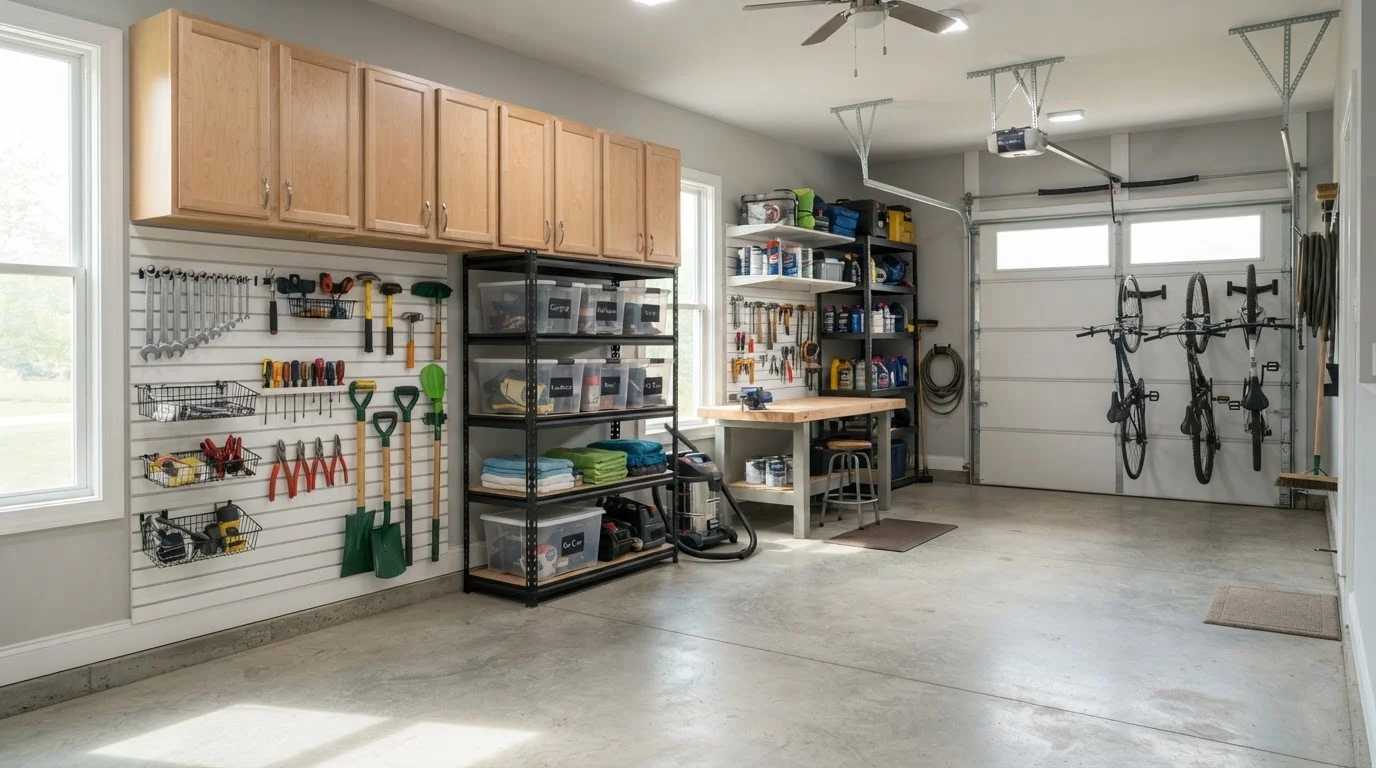
Most garages benefit from more than one approach. A common layout uses wall panels along one wall for frequently accessed tools and sports gear, freestanding shelving at the back for bulk items and bins, and one or two cabinets near the entry for chemicals or valuables.
Before purchasing anything, take stock of what you store, how often you need it, and how much wall versus floor space the garage has. Items used weekly should be easiest to reach. Seasonal items can sit on upper shelves or in overhead racks. Hazardous materials should always be locked away regardless of which system you choose.
Weight matters too. Concrete garage floors have no practical load limit for shelving, but walls do. Know your stud spacing and wall construction before mounting anything heavy.