

Key Takeaways
- A home maintenance log tracks repairs, inspections, and replacements in one place.
- Detailed records can strengthen insurance claims and support a smoother home sale.
- Renters benefit from logs too, particularly for documenting landlord-tenant responsibilities.
- A basic spreadsheet or notebook is enough to get started today.
What a home maintenance log actually is
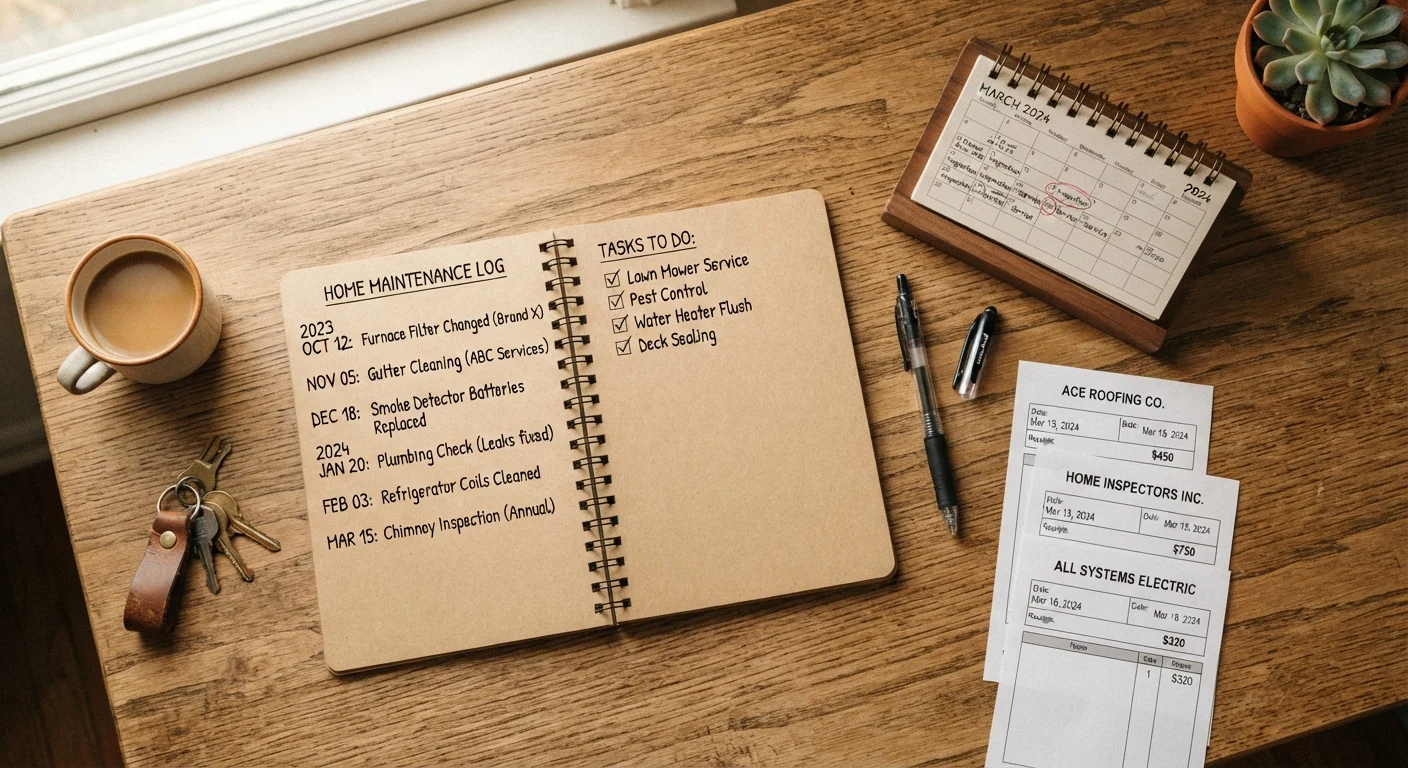
A home maintenance log is a running record of every significant repair, inspection, replacement, and upgrade done on a property. It captures the date work was completed, what was done, who did it (you or a contractor), how much it cost, and any warranty or permit details attached to the job.
The log does not need to be elaborate. A spiral notebook, a shared notes app, or a simple spreadsheet works. What matters is consistency: recording entries as work happens rather than trying to reconstruct years of history from memory or a pile of receipts.
For context, the same habit applies to vehicles. If you have ever kept a vehicle maintenance record, the principle transfers directly to your home, with a few additional fields worth tracking.
Why the record pays off
Homeowners who document repairs consistently have a clearer picture of what their property needs and when. Patterns become visible: a water heater that has needed two minor repairs in three years may be nearing the end of its useful life. Without a log, that pattern stays invisible until a failure forces the issue.
77%
Homeowners with no written maintenance records
A 2022 Porch survey found that most homeowners rely on memory rather than written records when tracking home repairs and maintenance history.
1%
Annual maintenance cost as share of home value
A widely cited rule of thumb in home-ownership planning holds that owners should budget roughly 1 percent of the home's value per year for ongoing maintenance and repairs.
Insurance claims are another area where documentation matters. If a pipe bursts or a storm damages the roof, an adjuster may ask about the age and maintenance history of affected systems. A log with dated entries and contractor invoices gives you concrete answers instead of estimates.
Selling a home is also easier with records. Buyers and their inspectors often ask when the roof was last replaced, when the HVAC was last serviced, or whether any permitted work was done. Written proof of diligent upkeep builds trust and can support the asking price.
Renters are not exempt from this practice. Tenant maintenance responsibilities can be more extensive than most people expect, and a log protects renters by documenting what they reported to a landlord and when.
What to record in each entry
Each log entry should answer a few basic questions: What was done? When? By whom? At what cost? Keep the entry brief but specific. "Fixed leaky kitchen faucet" is less useful than "replaced worn cartridge in kitchen faucet, self-completed, $14 in parts, 45 minutes."
Record every entry on the day work is completed.
Memory degrades quickly, and estimates made weeks later are less credible to insurers or buyers than dated contemporaneous notes. Same-day entries take less than five minutes and are far more reliable.
Photograph the work before and after, and store photos with the log entry.
Photos establish the condition of a system at a specific point in time. They can resolve disputes with contractors, landlords, or insurers by showing what existed before and after a job.
Note the age and expected lifespan of major systems when you first move in.
Knowing that a furnace is already 14 years old when you buy the home changes how you budget for the next few years. Without that baseline, the failure feels unexpected even when it was statistically predictable.
Keep a separate column or tag for warranty-covered items.
Appliances, roofing materials, and contractor labor often carry warranties that go unclaimed because the homeowner cannot locate or recall the terms. A tagged entry makes it easy to check coverage before paying out of pocket.
Log deferred maintenance as well as completed work.
Items you noticed but did not yet fix are still part of your property's condition history. Recording them helps you prioritize future work and shows good faith if a later issue is linked to the same area.
For contractor work, attach or scan the invoice and note the company name, license number if available, and any warranty terms. For permit-required work such as electrical panel upgrades or structural changes, note the permit number and inspection date. Work that required a permit is worth flagging clearly, since that documentation may be requested during a sale or insurance review.
Some repairs are straightforward DIY tasks, while others require a licensed professional. Either way, the log entry looks the same: date, description, cost, and outcome.
How to organize and maintain the log over time
Group entries by system or area: plumbing, HVAC, roof and exterior, electrical, appliances, and interior. This structure makes it fast to pull up the history of a specific system without scrolling through years of unrelated entries.
Set a recurring reminder, monthly or after any significant work, to update the log while details are fresh. Pair log reviews with the inspections covered in a seasonal maintenance walkthrough: the two habits reinforce each other.
Store at least one backup copy somewhere other than the property itself. A cloud folder, an email thread with yourself, or a copy at a family member's address all work. If a fire or flood damages your home, you want your records accessible from outside it.
Areas of the home that rarely get attention are often the ones that produce expensive surprises. Logging inspections of crawl spaces, attic ventilation, and exterior caulking, even when nothing is wrong, establishes a baseline that makes future changes easier to spot.