
Nutrient Density: Why 200 Calories From Almonds and 200 Calories From Crackers Are Not the Same

Key Takeaways
- Calories measure energy, not the vitamins, minerals, fiber, or protein a food delivers.
- Two foods with identical calorie counts can produce very different effects on hunger and health.
- Whole foods tend to be more nutrient-dense than processed foods with the same calorie content.
- Nutrient density matters for long-term satiety, not just short-term fullness.
- Building meals around nutrient-dense foods does not require expensive or exotic ingredients.
Nutrient density
Nutrient density describes how much nutritional value a food delivers relative to its calorie content. A nutrient-dense food packs vitamins, minerals, fiber, protein, and healthy fats into its calories, while a low-nutrient-dense food provides mostly calories with little else. Comparing foods by calories alone ignores this dimension entirely.
Researchers sometimes quantify nutrient density using scoring tools such as the Nutrient Rich Foods Index, which weights foods by their content of beneficial nutrients against nutrients to limit, such as added sugar and sodium.
Why the calorie label tells only part of the story
A calorie is a unit of energy, nothing more. When food manufacturers print a calorie count on a package, they are reporting how much energy that food will release when your body metabolizes it. What the number cannot tell you is what else arrives alongside that energy: whether the food carries fiber to slow digestion, magnesium to support muscle function, vitamin E to act as an antioxidant, or protein to trigger satiety signals. Two foods can share an identical calorie count while being nutritionally unrecognizable from each other.
This matters in practice because your body does not simply burn fuel and move on. It builds and repairs tissue, regulates hormones, manages immune responses, and transmits nerve signals, all of which depend on a continuous supply of specific nutrients. When meals are low in nutrient density, the body's energy needs may be met while its micronutrient needs go partially unmet.
Almonds versus crackers: a concrete comparison
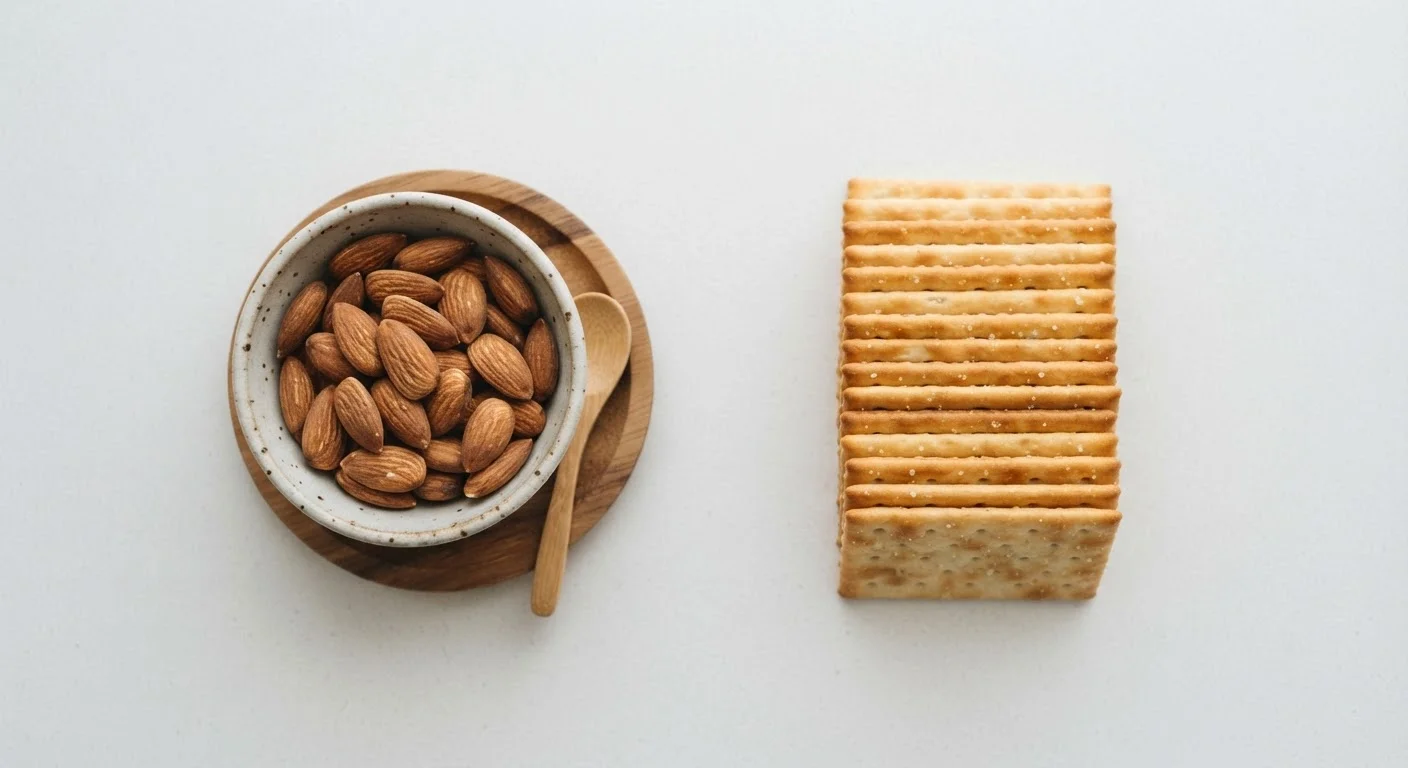
Consider 200 calories of plain salted crackers against 200 calories of whole almonds. The crackers are made primarily from refined wheat flour and added sodium. They provide quick-digesting carbohydrates, minimal fiber, little protein, and small amounts of a few minerals.
The almonds deliver roughly 6 grams of protein, around 3.5 grams of fiber, and meaningful amounts of vitamin E, magnesium, calcium, and potassium. The fat in almonds is predominantly monounsaturated, the same category found in olive oil. Because of the fiber and protein content, almonds also tend to digest more slowly, which can moderate the rise in blood glucose and extend the feeling of fullness.
Both snacks cost you 200 calories. The almonds return considerably more per calorie spent. That gap is what nutrient density measures.
~6g
Protein in 200 calories of almonds
A standard 200-calorie serving of whole almonds provides roughly 6 grams of protein, compared to approximately 3 grams in the same calorie count of plain refined crackers.
3.5g
Fiber in 200 calories of almonds
The same almond serving contains around 3.5 grams of dietary fiber, while an equivalent calorie serving of plain crackers typically provides less than 1 gram.
~20%
Daily magnesium from one almond serving
A 200-calorie serving of almonds supplies roughly 20% of the recommended daily intake of magnesium, a mineral involved in muscle and nerve function, according to USDA nutrient data.
What makes a food nutrient-dense
Nutrient density is not a fixed label but a relative measure. It depends on the ratio of beneficial components to total calories. Foods that tend to score well share a few common traits: minimal processing, intact fiber, and a meaningful supply of protein, healthy fats, or micronutrients.
Vegetables, legumes, whole grains, eggs, fish, nuts, and seeds generally land at the high end of the spectrum. Highly processed foods with added sugars, refined starches, and sodium tend to land at the low end, not because any ingredient is universally forbidden but because processing often removes fiber and micronutrients while concentrating calorie sources.
It is worth noting that nutrient density is not the same as being low in calories or low in fat. Sardines, walnuts, and lentils are all calorie-carrying foods with high nutrient density. The question is what the calories bring with them. For a closer look at how individual fats factor into this picture, see how saturated, unsaturated, and trans fats compare.
How nutrient density connects to satiety and eating patterns
Hunger is not simply a calorie deficit. It is also a signal shaped by protein intake, fiber content, blood glucose stability, and gut hormone responses. Foods with low nutrient density tend to lack the components, mainly fiber and protein, that engage those satiety pathways most effectively. This can lead to eating more total calories before hunger signals quiet down.
Research on dietary patterns consistently finds that people who eat more whole, minimally processed foods report better appetite regulation, independent of calorie intake. This aligns with the nutrient density framework: when each calorie carries useful cargo, the body's nutritional needs are met more efficiently. Eating patterns across whole diets tend to predict health outcomes better than any single food choice. Snack composition also matters here, and how between-meal eating affects overall nutrition depends heavily on what nutrients those snacks carry.
Applying nutrient density to everyday food choices
Shifting toward more nutrient-dense eating does not require overhauling every meal or buying specialty foods. Some practical starting points:
- When choosing a snack, compare the fiber and protein content on the nutrition label, not just the calorie count.
- Add a handful of leafy greens to meals that already contain protein; this adds micronutrients with minimal calorie cost.
- Swap refined grains for whole grains in meals where the texture difference is not significant to you.
- Opt for whole fruit over juice, which typically has less fiber for the same calorie load.
Many nutrient-dense staples are inexpensive. Canned beans, frozen spinach, oats, and eggs are all accessible options. Eating nutritiously on a limited budget is achievable with these kinds of choices. Be cautious of claims that frame single superfoods as the solution; fad diet narratives often distort nutrition science and nutrient density applies across whole eating habits, not single purchases.
This article is for informational purposes only and is not medical advice. Consult a qualified healthcare professional for guidance specific to your health needs and circumstances.