

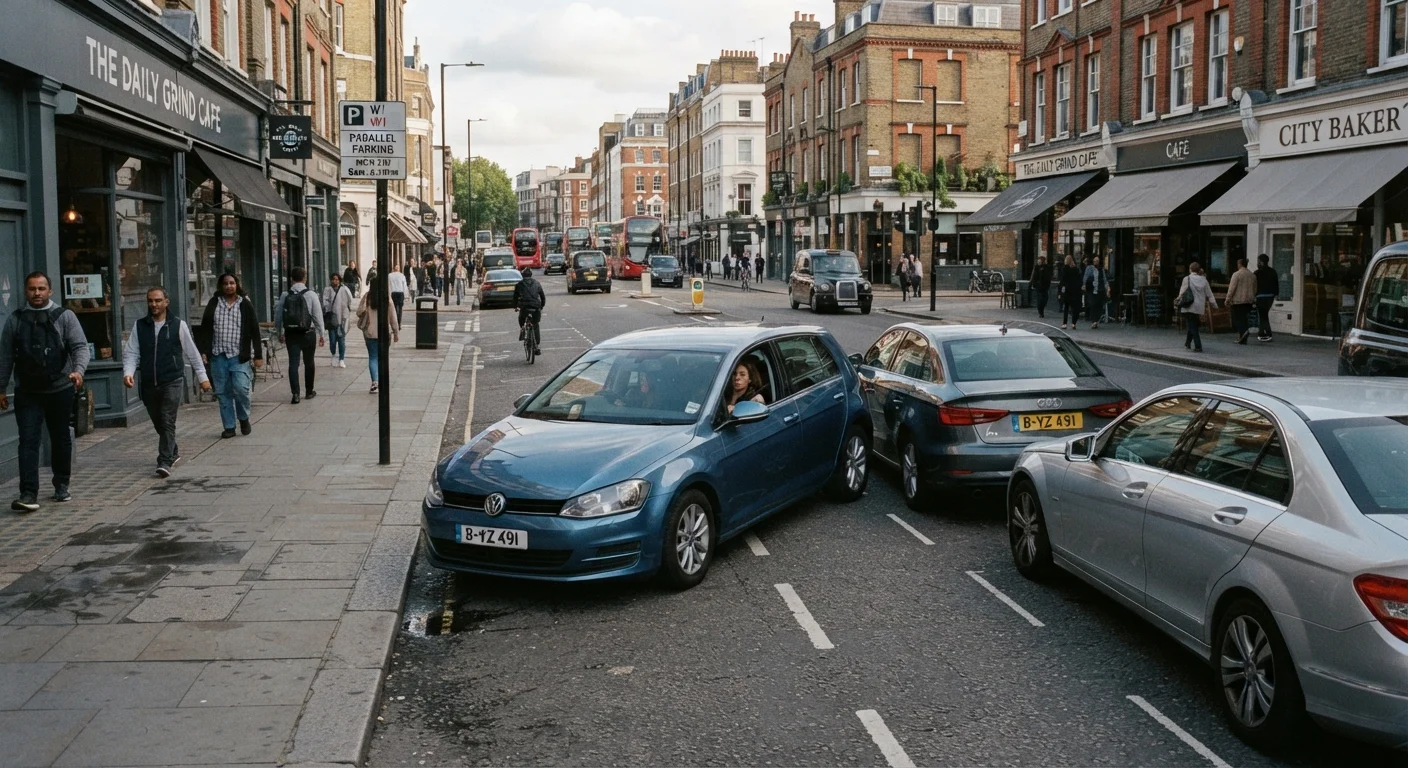
Key Takeaways
- Slow, controlled speed is the single biggest factor in successful tight-space manoeuvres.
- Reference points on your vehicle, not just mirrors, give more reliable positional feedback.
- Parallel parking and reverse bay parking follow repeatable geometric sequences.
- Checking blind spots on foot before reversing prevents most low-speed collisions.
- Reversing cameras and sensors assist but do not replace active observation.
What you will need
Why tight spaces feel harder than they are
Most drivers who struggle with parking are not making spatial errors; they are making speed errors. When a car moves too fast in a confined space, the brain cannot process feedback from mirrors and reference points quickly enough to make corrections. The result is overcorrection, clipping curbs, or stopping too far from the bay markings. Slowing to a near-crawl gives you time to think and steer precisely.
A second common problem is over-reliance on mirrors alone. Mirrors flatten depth and clip your peripheral view. Combining mirror checks with glances through rear windows and occasional physical checks outside the vehicle produces a much clearer picture of available space.
Drivers who feel anxious about tight manoeuvres may find it useful to read about managing driving apprehension, since low confidence often compounds physical technique errors. The habits that build overall safe driving, covered in detail in the article on low-risk driver habits, apply just as much at 2 mph in a car park as at 60 mph on the highway.
Before you start: preparation and observation
Before any reversing manoeuvre in a tight space, adjust your mirrors properly. The side mirrors should show a sliver of your vehicle's body at the inner edge, with the horizon roughly in the middle of the mirror frame. The centre mirror should give a full view through the rear window without tilting your head.
Walk the space if conditions allow. A 30-second check on foot shows you fixed obstacles that mirrors distort: low concrete posts, shopping trolleys, or a tight wall corner. This single habit eliminates the majority of low-speed scrapes.
What you will need
Identify two or three reference points on your own vehicle before you begin. For most cars, the point where the rear door handle aligns with a curb line, or the position of a wing mirror tip relative to a painted bay line, gives reliable positional data. These points stay consistent across all parking attempts in the same vehicle.
Step-by-step: parallel parking
Parallel parking into a street space is the manoeuvre most drivers find hardest. The steps below describe the standard right-side kerb approach used in the US, where you park on the right-hand side of the road.
Choose the right space
The target space should be at least 1.5 times the length of your vehicle. Anything shorter requires advanced spatial judgment and is not worth attempting in traffic. Pull up parallel to the car ahead, leaving roughly 2 to 3 feet of lateral clearance between your vehicles, with your rear bumpers approximately level.
Reverse slowly and apply first steering input
Select reverse and move back at a slow walking pace. When your rear axle is approximately even with the rear bumper of the car ahead, turn the steering wheel smoothly toward the curb. Use roughly three-quarters of a full turn initially. Keep watching the left side mirror to monitor the gap between your rear corner and the curb.
Straighten and apply counter-steer
When your car sits at roughly a 45-degree angle to the curb and your front door is approximately level with the rear bumper of the car ahead, begin turning the steering wheel away from the curb (counter-steering). This brings the front of the car into the space while keeping the rear on track toward the curb. Continue reversing slowly.
Straighten up and position the car
As the car approaches parallel to the curb, gradually return the steering wheel to the straight-ahead position. Stop when you are within 12 inches of the curb. If the gap is larger, pull forward slightly with a gentle steering adjustment toward the curb, then stop. The car should now be roughly centred in the space, leaving clearance to the vehicles fore and aft.
Apply the parking brake and confirm clearance
Apply the parking brake, shift to Park (or first gear on a manual), and check clearance front and rear by looking through the windows. Both adjacent vehicles should have at least 12 to 18 inches of space to exit the space without contact. If the space is too tight for either vehicle to leave easily, consider relocating to a different space.
Common problems and how to fix them
Finishing too far from the curb is almost always caused by beginning the first steering input too late. Move your reference point earlier: start turning when the rear of the vehicle ahead aligns with your B-pillar (the roof support between front and rear doors) rather than your rear bumper.
Clipping the rear corner of the vehicle ahead during a parallel park usually means the initial pull-forward position was too close. Aim to leave at least one full car length between the front of your car and the rear of the car ahead before you start reversing.
In a reverse bay park, finishing at an angle rather than straight is caused by uneven steering input during the approach arc. If the car consistently finishes angled to one side, begin straightening the wheel slightly earlier on that side.
Reversing cameras and parking sensors are useful cross-checks, but they have limits. Cameras distort distances near the edges of the frame. Sensors have dead zones. Neither replaces the full observation sequence described in these steps. For further practical guidance on adjusting to unfamiliar environments, see the article on driving on unfamiliar roads.