

Key Takeaways
- Drum brakes use friction shoes pressed outward against a rotating metal drum; disc brakes use pads clamped against an open rotor.
- Disc brakes dissipate heat faster, making them less prone to brake fade under repeated or heavy braking.
- Drum brakes remain common on rear axles of economy vehicles because they cost less to produce and integrate a parking brake more simply.
- Nearly all modern vehicles use disc brakes on the front axle, where the majority of stopping force is applied.
- Both systems rely on hydraulic brake fluid, so fluid condition affects the performance of either type.
Option A
Drum Brakes
The long-established hydraulic system still found on many rear axles.
Best for: Rear-axle duty on economy cars, light trucks, and vehicles where cost and integrated parking brake function matter.
Option B
Disc Brakes
The open-rotor design that dominates modern front axles and performance applications.
Best for: Front axles on virtually all modern passenger vehicles and any application requiring consistent, fade-resistant stopping power.
If you drive a budget-oriented commuter car and want to understand rear brake replacement costs
Drum Brakes
Many economy vehicles retain drum brakes at the rear specifically to keep manufacturing and service costs lower; brake shoes typically cost less than rear disc pads and rotors.
If consistent stopping power under repeated hard braking is a priority
Disc Brakes
The open rotor design sheds heat rapidly, keeping friction surfaces more consistent during extended or aggressive use compared to the enclosed drum.
If you are evaluating a used vehicle and want to assess brake system complexity
Disc Brakes
Disc systems are easier to visually inspect for rotor wear and pad thickness without disassembly, making routine condition checks more straightforward.
If you want to understand the braking setup on a light truck or van
Drum Brakes
Many light commercial and utility vehicles continue to use drum brakes at the rear because the self-energizing action of drum shoes suits moderate, sustained loads well.
How drum brakes work
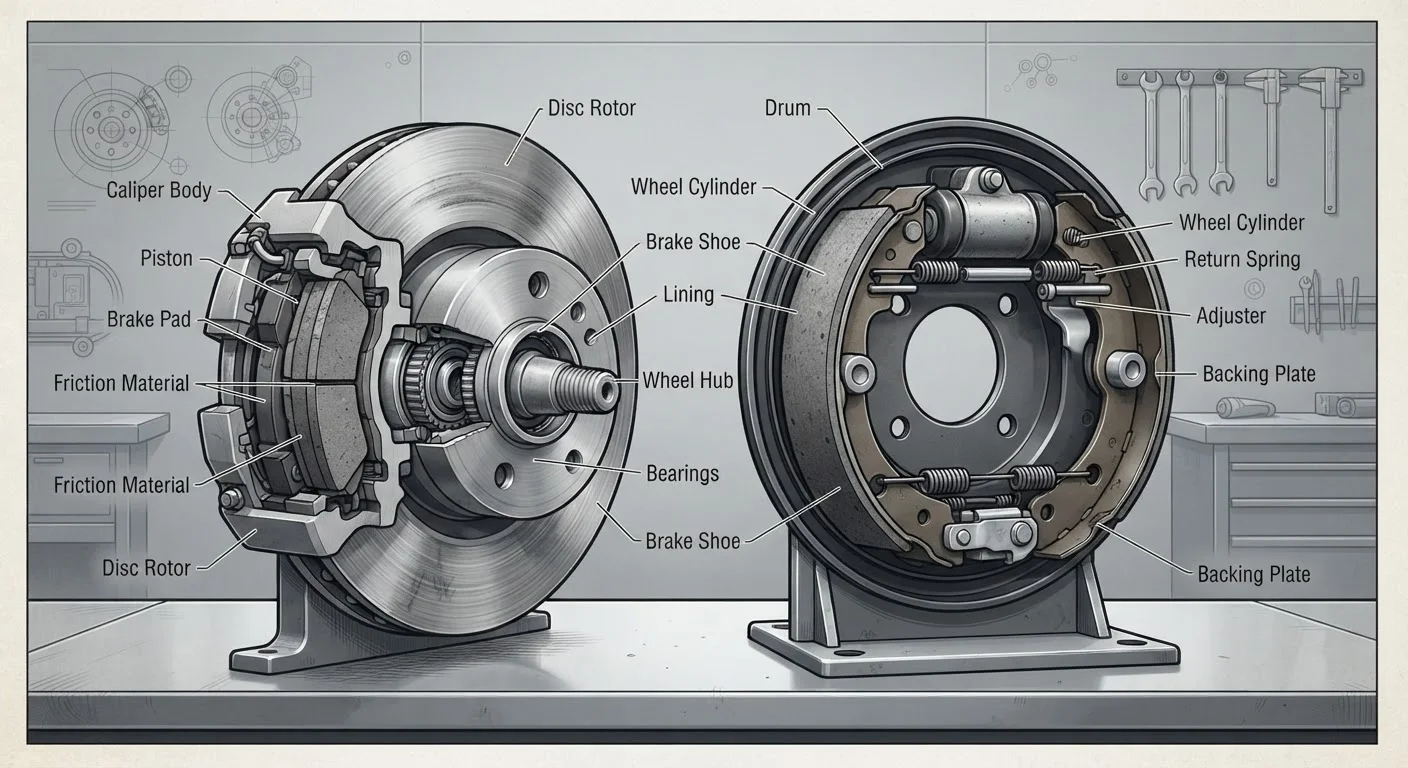
A drum brake assembly consists of a hollow metal drum that rotates with the wheel and a fixed backing plate inside it. Mounted to the backing plate are two curved friction shoes. When the driver presses the brake pedal, hydraulic pressure from the master cylinder pushes a wheel cylinder outward, forcing the shoes against the inside surface of the spinning drum. Friction between the shoe lining and the drum slows the wheel.
One property worth understanding is self-energization. As the leading shoe contacts the drum, rotational force pulls it tighter into the drum surface, increasing its own clamping force without additional hydraulic pressure. This makes drum brakes relatively efficient at generating stopping power with modest hydraulic input, which suited early vehicle design well and still suits rear-axle duty on lighter vehicles.
The enclosed design does create a heat-retention problem. Heat generated during braking is trapped inside the drum, and under repeated stops it builds up faster than the metal can dissipate it. This causes brake fade, where the friction material temporarily loses effectiveness. Water can also collect inside the drum, momentarily reducing braking until the shoes dry out against the drum surface.
How disc brakes work
A disc brake system replaces the drum with a flat, vented rotor that rotates openly with the wheel. A caliper straddles the rotor and holds brake pads on each side. Hydraulic pressure moves one or more pistons inside the caliper, squeezing the pads against both rotor faces simultaneously. The resulting friction slows rotation.
Because the rotor is exposed to airflow, heat leaves the system much more readily. Vented rotors, which have internal cooling channels between the two rotor faces, increase that surface area further. The result is that disc brakes resist fade far better under repeated hard stops, which is why they appear on the front axle of essentially every modern passenger car and on all four corners of performance, heavy, or safety-critical vehicles.
Disc systems are also easier to inspect. A technician can often gauge pad thickness and rotor condition visually or with a simple gauge, without removing the wheel assembly. For a deeper look at what worn pads actually look like and when to act on them, see our guide to assessing brake pad thickness.
| Criterion | Drum Brakes | Disc Brakes |
|---|---|---|
| Operating principle | Shoes press outward against drum interior | Pads clamp against open rotor faces |
| Heat dissipation | Enclosed; heat builds inside drum | Open rotor; heat disperses rapidly |
| Fade resistance | Lower under repeated hard stops | Higher; vented rotors help further |
| Typical placement | Rear axle on economy and light commercial vehicles | Front axle on all modern cars; all four on most newer vehicles |
| Parking brake integration | Simple mechanical integration via shoes | Requires separate mechanism or electronic actuator |
| Visual inspection ease | Requires partial disassembly | Often inspectable without wheel removal |
| Typical service cost | Lower parts cost; more labor complexity | Moderate parts cost; simpler labor |
Where each system is used on modern vehicles
The front axle carries roughly 60 to 70 percent of a vehicle's braking load because weight transfers forward under deceleration. For that reason, disc brakes have been standard at the front on new passenger cars for decades. Rear placement varies by vehicle segment.
Economy sedans and small hatchbacks frequently use drum brakes at the rear. The combination costs less to manufacture, and integrating the parking brake mechanism into a drum assembly is mechanically simple, typically a separate set of shoes or a small drum built into the rear rotor hat. Trucks, SUVs, and most vehicles produced after the early 2000s tend to use four-wheel disc setups, often with an electronic parking brake that removes the need for a mechanical rear drum.
Heavy commercial vehicles present a different calculation. Air-actuated drum brakes remain common on large trucks because they generate very high clamping force across wide, durable shoe surfaces and tolerate the sustained moderate braking typical of highway freight work. That said, disc systems are increasingly adopted in commercial applications as well, particularly where frequent city stop-and-go cycling is involved.
Whatever the system type, both rely entirely on hydraulic fluid to transmit pedal force. Degraded fluid compromises either system. Our article on what brake fluid neglect actually costs covers why fluid condition matters and how often it should be addressed.
Maintenance differences drivers should know
Brake shoes in a drum system typically last longer in mileage terms than disc brake pads, partly because of the larger friction area and partly because the rear axle does less braking work. However, when drum brakes do need service, the job involves more components: springs, adjusters, and wheel cylinders all require inspection. A qualified mechanic should handle drum brake work if you are not familiar with the spring tension and adjustment procedure, as incorrectly assembled hardware can affect parking brake function and braking balance.
Disc brake service is more straightforward in most cases. Pad replacement and rotor inspection are standard items at most shops. Rotors wear down over time and can develop scoring or thickness variation (called lateral runout) that causes a pulsing sensation through the brake pedal. Rotors must be replaced when they fall below the minimum thickness specification stamped on the rotor edge.
Both systems use the same brake fluid circuit. Moisture absorption into the fluid over time lowers its boiling point, which can worsen fade under hard braking regardless of whether drums or discs are fitted. Checking fluid condition during routine service applies equally to both configurations.