

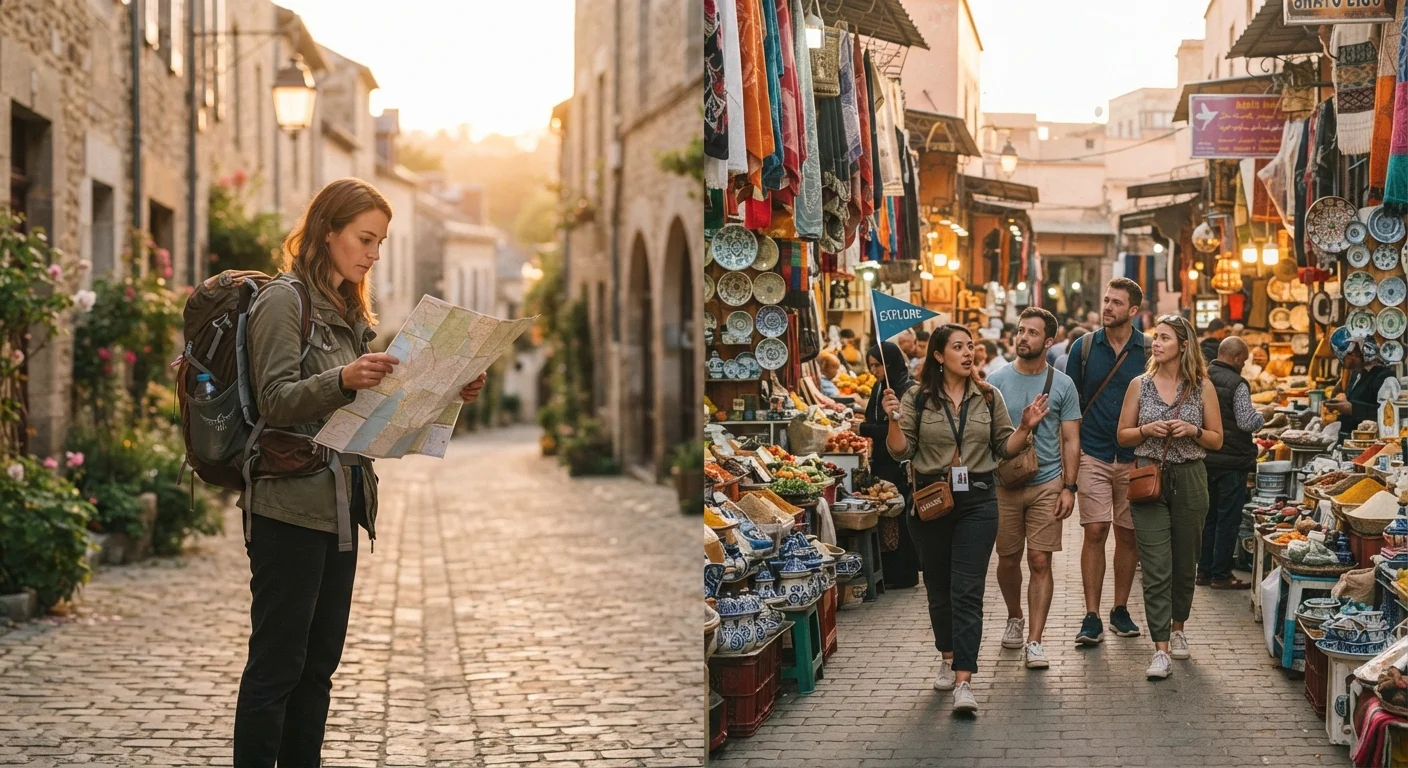
Key Takeaways
- Solo travel gives you full itinerary control but places all logistical responsibility on you.
- Group tours reduce planning burden and often include built-in safety buffers for unfamiliar destinations.
- Social experience differs sharply: solo travelers set the pace of human contact, group travelers get it by default.
- Neither option is universally safer; context, destination, and traveler experience all matter.
- Budget differences go beyond the ticket price and include time, flexibility, and unexpected costs.
Our Verdict
Solo international travel and group tours are not competing products so much as different experiences that suit different travelers and different trips. Solo travel works when you want autonomy, have some international experience, and can absorb logistical unpredictability. Group tours work when you want structure, local expertise, or a ready-made social context without the research overhead.
| Best for | Recommended |
|---|---|
| Travelers who want full schedule control and have prior international experience | Solo travel |
| First-time international travelers or those visiting regions with complex logistics | Group tour |
| Those who find meeting people while abroad a priority rather than a bonus | Group tour |
| Budget-focused travelers who plan well in advance and research thoroughly | Solo travel |
What you actually give up and gain on each path
Price is the first comparison most people make, but it is rarely the most consequential one. Solo international travel and organised group tours differ in how they allocate control, time, cognitive load, and social contact. Understanding those trade-offs makes the choice clearer than any per-night cost comparison.
When you travel solo, you own the itinerary completely. You can stay an extra day in a town you love, skip a site that does not interest you, or restructure your plans after a conversation with a local. That freedom has a real cost: you also absorb every logistical decision, every delay, and every unexpected problem. There is no tour manager to call when a train is cancelled or a hotel booking falls through.
Group tours transfer most of that operational weight to an organiser. Transport between sites, accommodation confirmations, and local permits are usually handled before you arrive. In exchange, you move on the group's schedule, not yours. Missing a departure point typically means missing the day's planned activity. For travelers visiting a destination for the first time, or one where language or infrastructure presents real challenges, that trade can be a good one.
See how to build a realistic international travel budget for a fuller picture of where costs actually land on each type of trip.
Safety: context matters more than format
A common assumption is that group tours are inherently safer than solo travel. The reality is more specific. Group tours add a layer of in-country support: guides who know local conditions, pre-vetted transport, and someone to escalate to if something goes wrong. For destinations where solo travelers face heightened risks due to infrastructure gaps, political instability, or language barriers, that support network is meaningful.
Solo travel is not inherently dangerous, however. Millions of people, including solo women travelers, navigate international destinations each year without incident. Risk depends far more on destination-specific conditions, traveler preparation, and situational awareness than on whether you are alone or in a group. Common myths about travelling to unfamiliar countries covers several of the misconceptions that cause travelers to overestimate or underestimate risk.
Before choosing either format, check your government's official travel advisories for your destination. Entry rules, vaccination requirements, and local laws change; verify current conditions with official sources rather than relying on travel content alone.
| Solo travel | Group tour | |
|---|---|---|
| Schedule flexibility | Full control, change plans anytime | Fixed itinerary, limited deviation |
| Planning burden | High: all research on the traveler | Low: organiser handles logistics |
| Social contact | Optional, self-directed | Built in, consistent throughout |
| In-country support | Self-reliant, personal contacts only | Guide and operator on hand |
| Cost transparency | Variable, many individual decisions | Mostly fixed upfront, fewer surprises |
| Pacing | Set by the traveler | Set by the group and guide |
Social experience: by design vs. by chance
Group tours build social contact into the structure. You will spend significant time with the same people across days or weeks. For many travelers, this is the draw: arriving at a destination without knowing anyone and leaving with genuine connections. The downside is that you cannot opt out if the group dynamic is difficult, and the pace of interaction is not yours to set.
Solo travel puts social contact under your control. You can seek it out through hostels, local events, or guided day trips, or you can spend a day entirely alone. That variability suits some travelers well and isolates others. There is no guarantee that solo travel produces rich social experiences; it depends on how actively you pursue them and on the destination's social infrastructure.
Travelers who are uncertain about extended solitude might consider a hybrid approach: solo travel with one or two booked group day tours at specific sites. This is a practical way to get local expertise at major attractions without committing to a full group itinerary. For a related decision about group vs. independent arrangements in a more contained context, shore excursions booked through the ship vs. independently arranged walks through similar trade-offs.
Logistics, timing, and the planning burden
A well-organised group tour compresses weeks of research into a single booking decision. Visas, vaccinations, and local logistics still require your personal attention, but accommodation sequencing, inter-city transport, and site access are handled. For travelers with limited time or limited appetite for research, this is a concrete advantage, not just a convenience.
Solo travel requires proportionally more upfront work. Destination research, accommodation vetting, transport booking, and contingency planning all sit with you. How much time that takes depends heavily on the destination. Western European cities with strong tourist infrastructure demand far less solo preparation than multi-country routes through Southeast Asia or sub-Saharan Africa. Planning around seasonal patterns is one area where solo travelers who research well can gain a real advantage: choosing travel windows that avoid peak-season crowds that group tours are often locked into.
Travelers considering a destination that is particularly remote or logistically complex, such as Alaska, face a version of this same calculation. Alaska travel involves logistical challenges that reward careful advance planning regardless of whether you go solo or with a structured tour.
Neither format is automatically right. The better question is which trade-offs you can work with given your destination, timeline, experience level, and what you actually want from the trip.