

Key Takeaways
- Checked bag fees, seat selection charges, and currency conversion costs can easily double a headline fare.
- Budget carriers often unbundle every service, so comparing base fares across airlines is misleading.
- Booking directly in the destination currency and using a no-foreign-transaction-fee card reduces unnecessary charges.
- Travel insurance costs vary widely and should be factored into the total trip budget before booking.
- Always price the full itinerary, including connecting airport transit costs, before committing to a ticket.
Why the headline price almost never holds
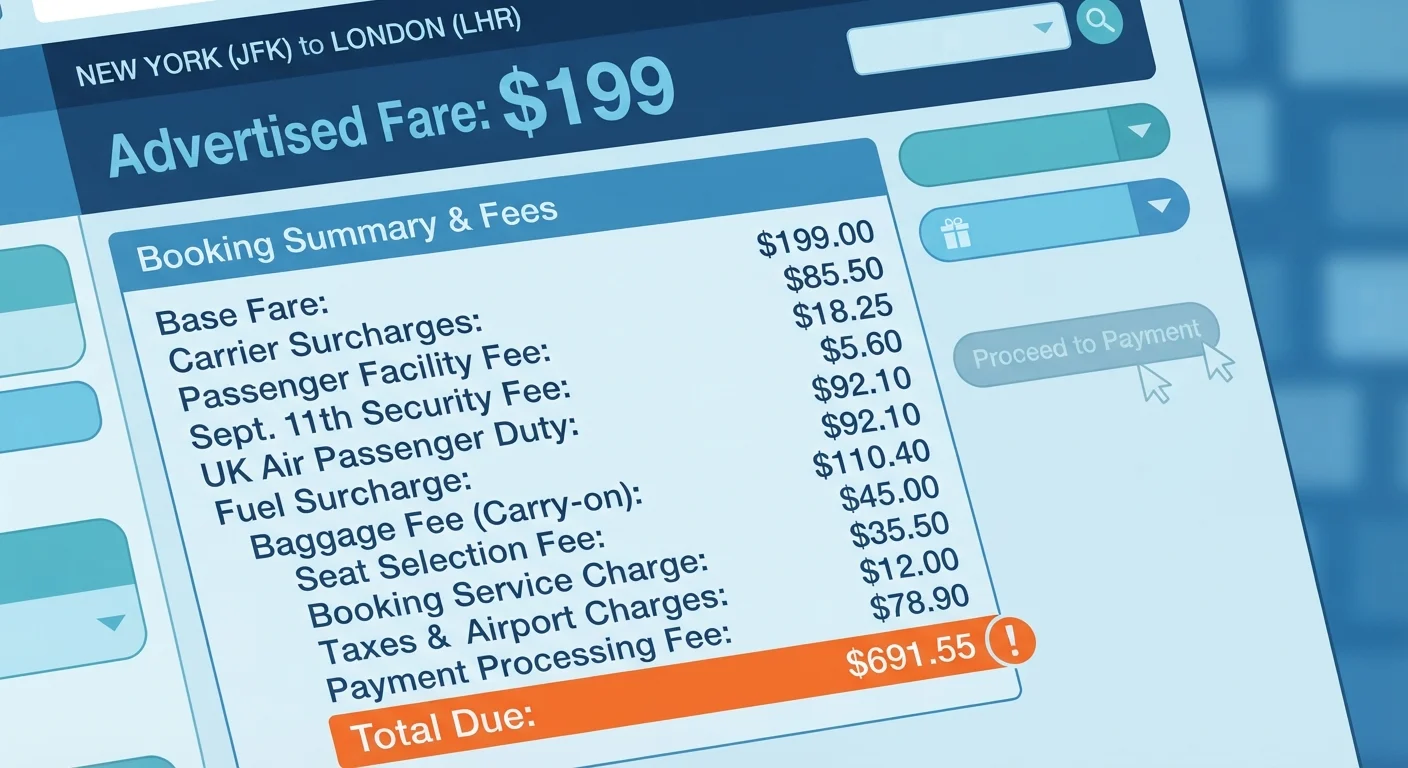
A $299 transatlantic fare looks attractive until checkout adds $65 in checked baggage, $34 for a seat that isn't a middle row at the back, and a $12 booking fee for paying with a card. The final total is closer to $410, and that's before any airport costs on either end. This pattern is common across both budget and legacy carriers, because airlines have learned to separate the base fare from the services most travelers consider standard.
The practice is called unbundling, and it has accelerated over the past decade. Airlines separate the seat from the luggage, the luggage from the meal, and the meal from the entertainment. Each piece carries its own price. For a domestic hop, unbundling might add $30 to a trip. For an international itinerary with a family of four, the same logic can add hundreds of dollars that never appeared in the search results.
Understanding which fees are avoidable and which are not lets you compare flights honestly and build a travel budget that holds through to departure day.
The most common mistakes travelers make
Below are the errors that most frequently inflate what travelers actually pay for international air travel, along with why each one happens and what to do instead.
Comparing only the base fare across airlines without accounting for bag fees.
Why it happens: Search aggregators often display the lowest possible fare, which excludes luggage costs that can vary by $50 to $100 or more per bag per direction.
Skipping seat selection to save money, then paying more at the airport.
Why it happens: Travelers assume they can choose a reasonable seat for free at check-in, but budget and many legacy carriers now charge for all seats except the least desirable ones.
Booking through a third-party site without reading its change and cancellation terms.
Why it happens: Third-party booking platforms sometimes layer their own fees on top of airline fees, meaning a 'free' cancellation offered by the airline may still cost a service fee through the platform.
Ignoring the cost of travel insurance until after tickets are purchased.
Why it happens: Insurance feels abstract before a trip is booked, so many travelers treat it as an afterthought or skip it entirely to save money.
Accepting the airline's currency conversion at checkout instead of paying in the local currency.
Why it happens: Airlines and booking sites present dynamic currency conversion as a convenience, but the exchange rate they apply is typically less favorable than what your bank or card issuer provides.
Overlooking the total transit cost for airports that are far from the city center.
Why it happens: A cheap fare into a secondary airport can look better on paper until you factor in the ground transfer, which at some European or Asian gateway airports can cost $40 to $80 each way.
Fees that tend to appear late in the booking process
$33B+
US airline baggage and change fees collected annually
The Bureau of Transportation Statistics has tracked ancillary fee revenue from US carriers, with baggage and reservation change fees consistently generating tens of billions of dollars each year.
2-3%
Typical foreign transaction fee on US credit cards
Many standard US-issued credit cards apply a foreign transaction fee of 2 to 3 percent on purchases billed in a non-US currency, including airline tickets priced in euros or other currencies.
Several charges appear only after a traveler has already invested time comparing options. Carrier-imposed surcharges, sometimes labeled 'YQ' or 'fuel surcharge', can add $100 or more to long-haul itineraries and are not always visible in aggregator search results. Some airlines charge separately for printing a boarding pass at the airport, for selecting emergency-exit rows, or for using a debit card instead of a credit card.
Foreign transaction fees are another late-stage surprise. Many US-issued credit cards charge 2-3% on purchases billed in a foreign currency. If an airline prices its tickets in euros and your card applies a conversion fee, that's an automatic markup on the ticket you thought you were comparing fairly. Using a card with no foreign transaction fee, or selecting to pay in the local billing currency rather than having the airline convert it to dollars, often results in a better rate.
These patterns mirror what happens in other big-ticket purchases. Just as first-time car buyers encounter costs that never came up during the sale, flight shoppers frequently meet fees only after committing emotionally to a departure time and route.
What to check before you book
Before finalizing any international ticket, run through this checklist:
- Look up the airline's checked and carry-on bag policy for international routes specifically. Policies differ by route, fare class, and even frequent-flyer status.
- Find out whether the fare class allows changes or cancellations. The cheapest fare tier on most carriers is completely non-refundable and non-changeable, which turns any schedule disruption into a full loss.
- Check whether your travel insurance covers flight cancellation and medical evacuation. The right insurance coverage is part of the real cost of international travel, not an optional extra.
- Price the transit costs at connecting airports. Some layover cities require an onward transit visa, and airport-to-city connections at certain hubs add taxi or train costs that belong in your budget.
- Total the itinerary cost for all travelers before comparing. A fare that looks cheaper per person may carry higher per-booking fees that close the gap when multiplied across a group.
If you are weighing independent booking against a group travel package, the comparison is rarely as simple as airfare alone. The logistics and pricing structure of solo travel versus organised tours differ in ways that affect whether a cheap ticket is actually the cheaper choice overall.