

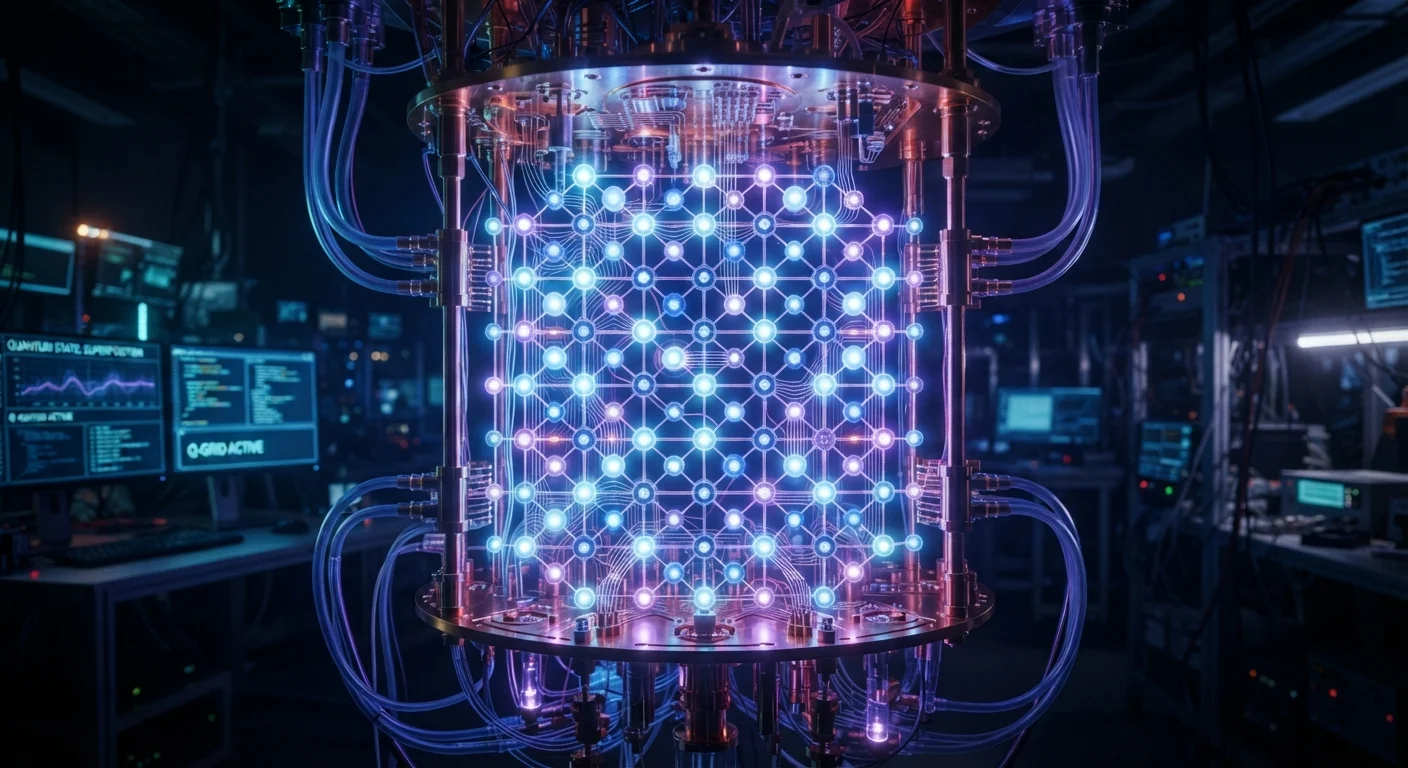
Key Takeaways
- Quantum computers are not universally faster than classical computers; they excel at specific problem types.
- Current quantum hardware is fragile, error-prone, and requires near absolute-zero temperatures to operate.
- No quantum computer has broken real-world encryption yet, though researchers are preparing defenses.
- Practical, general-purpose quantum computing for consumers remains years or decades away.
- Genuine progress is happening in chemistry simulation, optimization, and materials research.
Why quantum computing sounds more accessible than it is
Quantum computing appears regularly in tech headlines alongside words like 'breakthrough' and 'revolutionary.' The gap between those headlines and what the technology can actually do today is wide. Understanding that gap does not require a physics degree. It requires a clear look at what qubits actually are, what problems they solve well, and where the hardware genuinely stands right now.
Classical computers, including every smartphone and laptop in use today, work by processing binary information: every piece of data is ultimately a 0 or a 1. Quantum computers use qubits, which can represent 0, 1, or a superposition of both at the same time. A second property called entanglement allows qubits to be correlated in ways that have no classical equivalent. These properties let quantum machines explore many possible solutions simultaneously for certain classes of problems.
That 'certain classes' qualifier is the part headlines tend to drop. For a broader look at how processing shifts affect everyday devices, see this explainer on edge computing.
Myth
Quantum computers are just faster versions of regular computers, good at everything.
Fact
Quantum computers are faster only for specific mathematical problems. For most everyday tasks, a standard laptop outperforms them.
A classical computer processes bits, each either a 0 or a 1. A quantum computer uses qubits, which can exist in a combination of 0 and 1 simultaneously through a property called superposition. This is genuinely useful for problems involving enormous numbers of possible combinations, such as simulating molecular behavior or factoring very large numbers.
For tasks like browsing the web, editing documents, or streaming video, classical hardware is faster, cheaper, and far more practical. Quantum speedup is narrow and problem-specific.
Myth
Quantum computers already exist in usable, powerful form in research labs everywhere.
Fact
Operational quantum computers exist, but they are fragile, error-prone, and accessible to very few organizations.
Quantum hardware must operate near absolute zero, roughly -459 degrees Fahrenheit, to prevent qubits from losing their quantum state through a process called decoherence. The slightest vibration, heat, or electromagnetic interference corrupts calculations. Machines with hundreds or thousands of qubits exist, but qubit quality matters as much as count. A system with many noisy qubits can produce less reliable results than one with fewer, more stable qubits.
Access is typically through cloud platforms offered by a handful of major research institutions and technology companies. General laboratory access remains very limited.
Myth
Quantum computing will make current internet encryption obsolete almost immediately.
Fact
Cracking today's encryption would require millions of stable, error-corrected qubits. Current machines have hundreds to a few thousand noisy qubits.
A theoretical algorithm called Shor's algorithm could factor large numbers exponentially faster than classical methods, which would threaten RSA encryption. However, running Shor's algorithm on a cryptographically relevant problem would require fault-tolerant quantum hardware far beyond anything that exists today.
The U.S. National Institute of Standards and Technology (NIST) finalized its first set of post-quantum cryptography standards in 2024, giving organizations a clear path to upgrade their systems before capable machines arrive.
[important_callout]Myth
Quantum supremacy means quantum computers can now do everything better than classical ones.
Fact
Quantum supremacy refers to a single, narrow benchmark demonstration, not general superiority.
In 2019, Google's research team reported that their quantum processor completed a specific sampling calculation in about 200 seconds, a task they estimated would take a classical supercomputer roughly 10,000 years. IBM contested the timeline, but the broader point holds: the demonstration involved one artificial benchmark, not a commercially useful problem.
The term 'quantum advantage' is now preferred by many researchers, because it more accurately describes winning at a specific task rather than claiming across-the-board superiority.
Myth
Quantum computing is purely theoretical and has no real-world applications yet.
Fact
Researchers are already using quantum hardware for chemistry simulation, optimization problems, and materials science research.
Pharmaceutical and chemical companies are exploring quantum simulation to model how molecules interact at the atomic level, which could accelerate drug discovery. Optimization problems in logistics and financial modeling are also active research areas, though results are still early-stage and largely experimental.
These are genuine, if limited, applications. They do not yet replace classical methods, but they represent real scientific work rather than speculation.
Where genuine progress is happening
The most credible near-term applications are in quantum chemistry simulation. Calculating how electrons behave in complex molecules is computationally brutal for classical computers because the number of possible states grows exponentially with molecular size. Quantum hardware is naturally suited to this type of problem, and several research groups have demonstrated small-scale molecular simulations that would be impractical on classical machines.
Optimization is another active area. Problems like scheduling, routing, and portfolio balancing involve searching through a vast number of combinations for the best outcome. Quantum approaches may eventually offer advantages here, though practical demonstrations at commercially relevant scales have not yet materialized.
Error correction is arguably the central challenge. Raw qubits make mistakes constantly. Building logical qubits from many physical qubits to suppress errors requires enormous overhead, and most researchers consider fault-tolerant quantum computing to be at least a decade away. The technology shares something with other emerging fields: real scientific substance coexists with significant distance from consumer impact. For comparison, neural interface technology faces a similar gap between laboratory results and practical use.
2024
Year NIST finalized post-quantum cryptography standards
The U.S. National Institute of Standards and Technology published its first finalized post-quantum cryptographic algorithm standards to help organizations prepare for future quantum threats.
~1,000+
Qubits in leading research processors
IBM's Condor processor reached over 1,000 qubits in late 2023, though qubit count alone does not determine computational usefulness without error correction.
Millions
Stable qubits needed to crack RSA encryption
Academic estimates suggest breaking 2048-bit RSA encryption with Shor's algorithm would require millions of error-corrected logical qubits, far beyond current hardware.