

Key Takeaways
- AR overlays digital content on a camera view; MR anchors digital objects to physical space so they behave as if they belong there.
- AR works on everyday smartphones; MR typically requires specialized headsets with depth-sensing hardware.
- In MR, a virtual object can be blocked by a real one, which is not possible in standard AR.
- Both technologies sit on the Reality-Virtuality Continuum, with AR closer to pure reality and MR closer to the middle.
- The line between AR and MR is blurring as headset hardware becomes more capable and sensor arrays improve.
Option A
Augmented Reality (AR)
The digital layer added on top of the real world.
Best for: Casual, screen-based experiences where digital content sits over a live camera view without interacting with physical surroundings.
Option B
Mixed Reality (MR)
The blend where digital and physical objects coexist and respond to each other.
Best for: Immersive, hands-on applications where virtual objects need to anchor to real surfaces and react to the physical environment in real time.
If you want accessible digital overlays on a smartphone camera
Augmented Reality (AR)
AR runs on hardware most people already own and requires no specialized setup, making it the practical choice for everyday consumer use cases like navigation arrows or furniture previews.
If you need virtual objects to interact with real surfaces and real objects
Mixed Reality (MR)
MR's spatial mapping means a digital component diagram can sit on an actual machine and stay there as you walk around it, which AR's camera overlay cannot reliably do.
If you are evaluating technology for industrial training or surgical planning
Mixed Reality (MR)
MR's ability to register digital content precisely against physical geometry makes it far more useful for tasks where spatial accuracy matters.
If you are building a consumer-facing app with a broad audience
Augmented Reality (AR)
AR's compatibility with standard iOS and Android devices means your audience does not need to own or learn specialized hardware.
What the two terms actually mean
Both augmented reality and mixed reality place digital content in front of a real-world view. The difference is what that digital content can do once it is there.
AR adds a layer on top of reality without letting that layer interact with the physical scene. Think of the yellow first-down line broadcast during an American football game: it appears on your screen, but it has no relationship to the actual grass below it. Smartphone AR apps work the same way. A filter places cartoon ears on your head, or a shopping app drops a sofa into your living room view, but the sofa does not understand that the floor exists. Move the camera and the image floats rather than staying put.
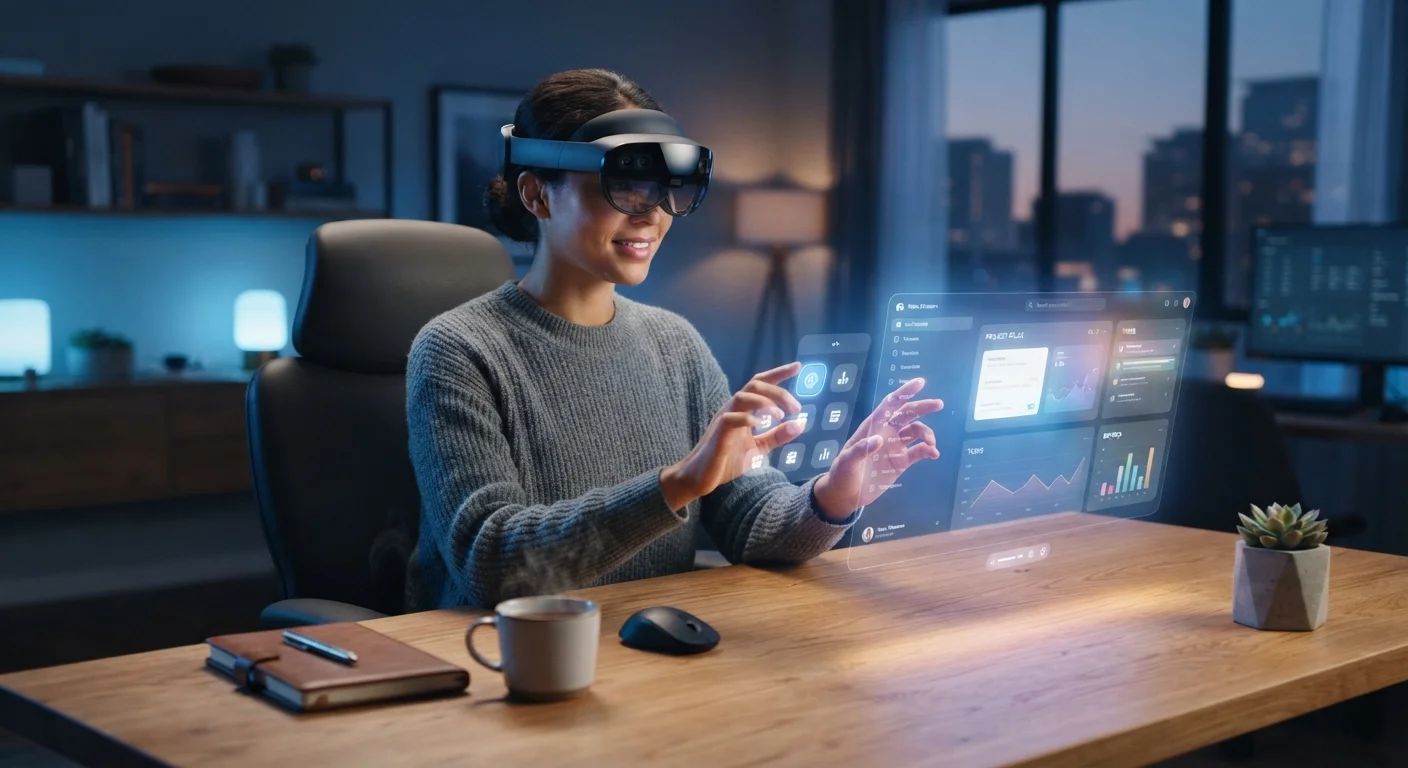
MR goes further. It maps the physical environment in three dimensions, then anchors digital objects to that map. A virtual coffee cup placed on your real desk in an MR headset stays on that desk as you move your head, because the system understands the desk is a flat surface at a specific position in space. More importantly, if you put a real book in front of that virtual cup, the cup can appear behind the book, because the headset knows the book is closer to you. That kind of spatial awareness, called occlusion, is the clearest dividing line between the two technologies.
For a broader look at how both fit into the wider technology ecosystem, see this plain-language explainer on spatial computing.
The hardware behind the difference
AR's most common platform is the smartphone camera, which captures a flat image and lets software paste graphics on top. No depth information is strictly required, although modern phones do use lidar or structured-light sensors to improve surface detection.
MR demands much more from its hardware. A dedicated headset typically carries multiple depth cameras, infrared projectors, and inertial sensors working together to build and continuously update a mesh of the surrounding room. Microsoft's HoloLens line and Meta's Quest Pro are examples of devices designed for this kind of spatial mapping, though MR capability exists on a spectrum rather than as a strict category.
| Criterion | Augmented Reality (AR) | Mixed Reality (MR) |
|---|---|---|
| Digital content placement | Overlaid on camera image | Anchored to physical space in 3D |
| Occlusion (real objects block virtual ones) | No | Yes |
| Typical hardware | Smartphone or tablet | Specialized headset with depth sensors |
| Room mapping | Basic surface detection at best | Full 3D mesh of environment |
| Cost to access | Low (existing devices) | Higher (dedicated hardware required) |
| Primary use today | Consumer apps, social media, retail | Industrial, medical, enterprise training |
| Content responds to physical objects | No | Yes |
The processing load for MR is significantly higher than for AR. Building a real-time 3D map of a room and correctly rendering occlusion requires dedicated chips that simply are not present in a standard phone. This is why MR remains more expensive and less widespread than AR, despite being the older concept in research terms.
Where each technology is used today
AR shows up in consumer life constantly, often without users labeling it as such. Face filters in social media apps, warehouse workers following digital pick-path overlays on tablets, and navigation apps that draw arrows over a live street view all use AR. The common thread is a camera feed with graphics placed on top of it.
MR is concentrated in professional and industrial settings where spatial precision matters. Surgeons have used MR headsets to overlay imaging data onto a patient during planning workflows. Aerospace technicians use spatial annotations anchored to physical aircraft parts to guide assembly. Architects walk through virtual building models placed inside real construction sites.
Consumer MR is growing but still limited. Gaming and entertainment applications have pushed the category toward general audiences, and several headsets now blur the boundary further by offering passthrough video that makes fully opaque displays behave similarly to transparent ones. Whether passthrough-based experiences count as MR or a very capable form of AR is a genuine debate in the industry, which tells you how much the terminology is still settling.
Why the distinction matters for everyday readers
If you are choosing a device or evaluating a technology claim, the AR vs. MR gap has practical consequences. An app that promises to let you "see how furniture fits in your room" is almost certainly AR: useful for rough sizing, but not a precise spatial simulation. An MR application running on a depth-sensing headset can produce measurements accurate enough to matter for installation.
Marketing language does not always respect this distinction. Products sometimes use "mixed reality" to sound more advanced while delivering standard AR experiences. A useful test: does the digital content stay locked to a specific point in real space when you move, and does real geometry block the digital image when it should? If yes to both, you are in MR territory. If the graphics drift or float without responding to physical objects, it is AR regardless of what the label says.
Understanding where one ends and the other begins helps you set realistic expectations, compare products accurately, and follow the technology as it develops in the years ahead.