

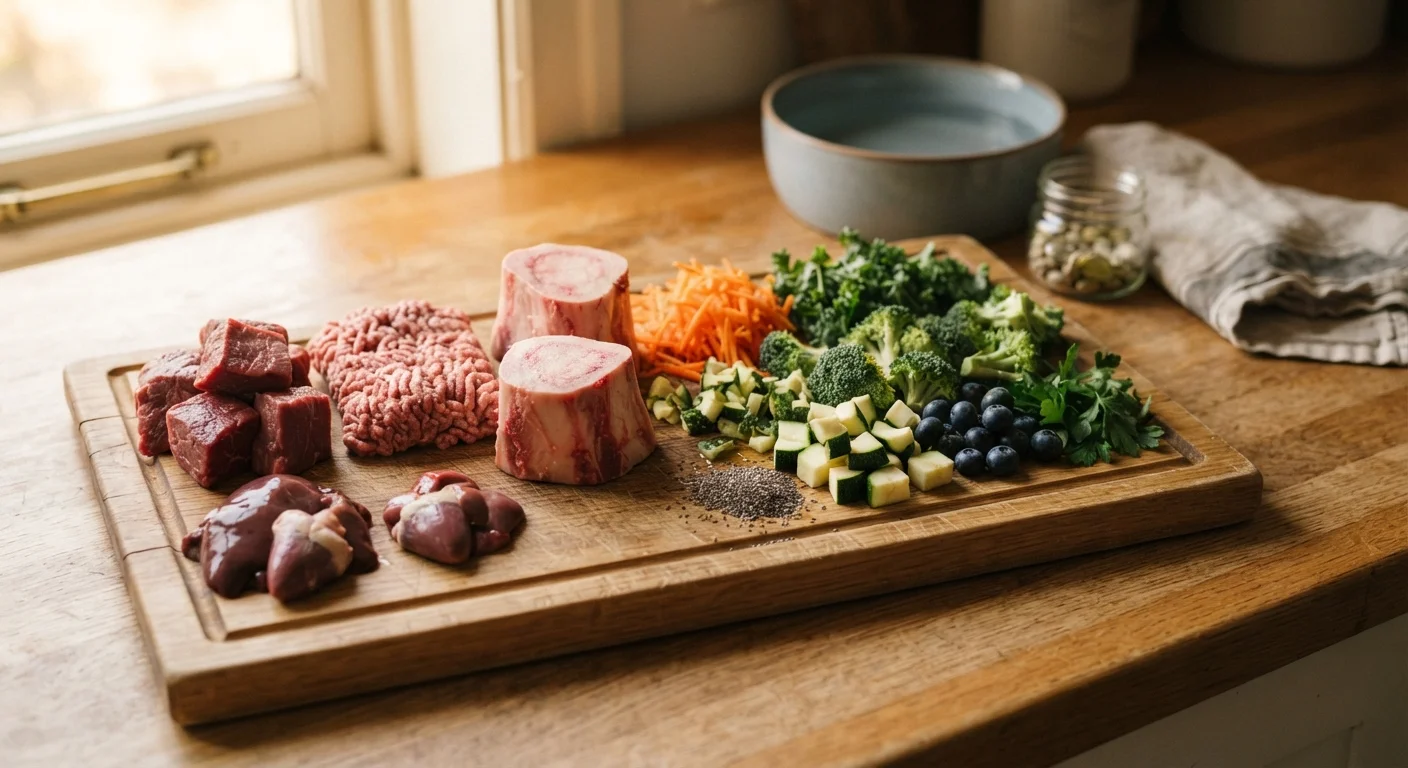
Key Takeaways
- A balanced raw diet must meet AAFCO or equivalent nutrient profiles, not just contain whole foods.
- Pathogen risk from raw meat is real and requires careful food handling to protect both pets and people.
- Puppies, seniors, and immunocompromised dogs face higher risk from nutritional imbalance in raw feeding.
- Veterinary guidance is recommended before switching any dog to a raw diet.
- Home-prepared raw diets frequently lack key minerals and vitamins without deliberate supplementation.
High moisture content supports daily hydration
Raw meat is largely water, which can contribute to overall fluid intake. Dogs who do not drink adequate water voluntarily may benefit from diet-sourced moisture.
Fewer ultra-processed ingredients
Raw diets contain no synthetic preservatives, artificial colorings, or high-temperature processing byproducts. For owners concerned about additive exposure, this is a meaningful difference.
Ingredient transparency when home-prepared
Home-prepared raw diets allow the owner to know exactly what is in each meal, which is useful when managing documented food sensitivities under veterinary supervision.
Whole bones can support dental hygiene
Raw meaty bones provide mechanical abrasion that may reduce tartar buildup. This applies only to appropriate raw bones; cooked bones splinter and are unsafe.
Pathogen risk to dogs and household members
Raw meat frequently carries Salmonella, Listeria, and Campylobacter. Both the FDA and AVMA have documented this risk in raw pet food and noted transmission to humans in the same household.
Nutritional imbalance is common in home recipes
Published analyses of home-prepared raw diets consistently find deficiencies in calcium, iodine, copper, and other micronutrients. Imbalance over time causes measurable harm, particularly in growing or senior dogs.
High cost and significant time commitment
Sourcing, storing, and preparing balanced raw meals is more expensive and time-consuming than feeding a commercially complete diet. Consistency is difficult to maintain across weeks and months.
Not appropriate for all dogs
Puppies, pregnant or nursing dogs, seniors, and dogs with compromised immune systems face greater risk from pathogen exposure and nutritional gaps. Veterinary clearance is needed before starting.
Bone hazards if incorrectly selected
Not all bones are safe. Weight-bearing bones from large animals can fracture teeth, and bones of any type pose choking or intestinal perforation risk without appropriate sizing and supervision.
Our Verdict
Raw feeding can be nutritionally complete when designed with veterinary or board-certified veterinary nutritionist input and strict food-safety practices. Without that oversight, the risk of nutritional imbalance and pathogen exposure is significant. The approach is not inherently superior to commercially balanced diets, and its suitability depends on the individual dog, household, and owner commitment.
Owners who can consistently follow food-safety protocols, consult a veterinary nutritionist, and commit to regular monitoring of their dog's health markers.
What 'balanced' actually means in a raw diet context
The word 'balanced' in pet nutrition refers to a specific standard: a diet must deliver all essential nutrients at levels supported by established research. In the United States, the Association of American Feed Control Officials (AAFCO) publishes nutrient profiles that set minimum and, where relevant, maximum levels for protein, fat, vitamins, and minerals. A commercially prepared food labeled 'complete and balanced' has either met those profiles through formulation or passed a feeding trial.
A raw diet assembled at home carries no automatic guarantee of meeting those profiles. Raw meat, organ, and bone combinations can provide many nutrients, but phosphorus-to-calcium ratios, zinc, iodine, and fat-soluble vitamins are frequently off without deliberate formulation. Owners considering raw feeding should review foundational pet nutrition concepts before making any changes, and consult a licensed veterinarian or a board-certified veterinary nutritionist to have a recipe formally evaluated.
What the research shows
Published studies on raw diets for dogs are limited in number and often small in scale, so firm conclusions remain difficult. Some research has found that raw-fed dogs show different gut microbiome profiles compared to kibble-fed dogs, though whether those differences produce meaningful health outcomes is not yet clear. A 2020 study published in PLOS ONE found higher microbial diversity in raw-fed dogs, but diversity alone does not confirm health benefit.
Concerns about pathogen contamination are more consistently documented. The U.S. Food and Drug Administration (FDA) and the American Veterinary Medical Association (AVMA) have both flagged raw meat diets as a source of Salmonella, Listeria, and Campylobacter, posing risk to dogs and to the people who handle the food or come into contact with the dog. Raw diets are not risk-free, and that risk does not disappear with high-quality sourcing alone.
74%
Home raw recipes deficient in one or more nutrients
A 2019 analysis in the Journal of Nutritional Science found that approximately 74% of home-prepared raw dog food recipes did not meet AAFCO minimum nutrient profiles.
7x
Higher Salmonella detection in raw vs. dry pet food
FDA sampling studies have consistently found Salmonella at significantly higher rates in raw pet food products compared to dry kibble tested in the same periods.
Nutritional imbalance is the other documented concern. A 2019 analysis published in the Journal of Nutritional Science examined home-prepared raw recipes and found the majority were deficient in at least one essential nutrient, with calcium, copper, and iodine among the most common gaps.
Advantages raw feeding proponents cite
Advocates for raw feeding point to a set of potential benefits, some of which have partial research support and some of which remain largely anecdotal. Understanding the distinction matters before drawing conclusions.
High moisture content supports daily hydration
Raw meat is largely water, which can contribute to overall fluid intake. Dogs who do not drink adequate water voluntarily may benefit from diet-sourced moisture.
Fewer ultra-processed ingredients
Raw diets contain no synthetic preservatives, artificial colorings, or high-temperature processing byproducts. For owners concerned about additive exposure, this is a meaningful difference.
Ingredient transparency when home-prepared
Home-prepared raw diets allow the owner to know exactly what is in each meal, which is useful when managing documented food sensitivities under veterinary supervision.
Whole bones can support dental hygiene
Raw meaty bones provide mechanical abrasion that may reduce tartar buildup. This applies only to appropriate raw bones; cooked bones splinter and are unsafe.
For dogs with documented sensitivities to certain processed-food ingredients, a carefully formulated raw diet can remove those triggers. However, an elimination approach requires veterinary guidance to confirm the actual allergen, since many perceived food reactions have other causes. Life stage also matters here: nutritional needs shift significantly from puppy to senior, and a raw diet designed for an adult dog is not appropriate for a growing puppy without adjustment.
Risks and practical challenges
The disadvantages of raw feeding are well documented and should be weighed carefully, not minimized.
Pathogen risk to dogs and household members
Raw meat frequently carries Salmonella, Listeria, and Campylobacter. Both the FDA and AVMA have documented this risk in raw pet food and noted transmission to humans in the same household.
Nutritional imbalance is common in home recipes
Published analyses of home-prepared raw diets consistently find deficiencies in calcium, iodine, copper, and other micronutrients. Imbalance over time causes measurable harm, particularly in growing or senior dogs.
High cost and significant time commitment
Sourcing, storing, and preparing balanced raw meals is more expensive and time-consuming than feeding a commercially complete diet. Consistency is difficult to maintain across weeks and months.
Not appropriate for all dogs
Puppies, pregnant or nursing dogs, seniors, and dogs with compromised immune systems face greater risk from pathogen exposure and nutritional gaps. Veterinary clearance is needed before starting.
Bone hazards if incorrectly selected
Not all bones are safe. Weight-bearing bones from large animals can fracture teeth, and bones of any type pose choking or intestinal perforation risk without appropriate sizing and supervision.
The comparison with other diet formats is worth making explicitly. Wet and dry commercial foods are held to regulatory standards at the point of manufacture, which raw home-prepared diets are not. Owners considering grain-free raw options should also read what the current evidence says about grain-free formulas before combining both approaches.
Food safety practices that cannot be skipped
Food safety is non-negotiable with raw diets
The CDC, FDA, and AVMA all advise that raw meat diets for pets require the same hygiene precautions used when preparing raw meat for human meals. This includes dedicated utensils, refrigeration at or below 40 degrees Fahrenheit, and careful handwashing after any contact with raw food or the dog. Households with young children, pregnant individuals, or immunocompromised family members should discuss these risks explicitly with both a veterinarian and a physician before proceeding.
If a raw diet is used, the FDA recommends treating raw pet food with the same handling protocols as raw meat for human consumption: separate cutting boards, thorough hand-washing, disinfecting surfaces, and keeping raw food frozen until use. Dogs fed raw diets can shed pathogens in their feces and saliva, so households with infants, elderly individuals, or immunocompromised people face additional exposure risk.
Sourcing from suppliers who follow HACCP (Hazard Analysis and Critical Control Points) practices reduces but does not eliminate pathogen risk. Freeze-drying and high-pressure processing (HPP) are methods some commercial raw producers use to lower bacterial load while preserving raw food characteristics, though their effect on all pathogens varies.
Owners who are evaluating options for older dogs should use a structured approach: this checklist for ageing pet diets outlines what to discuss with a veterinarian before any dietary change in a senior animal.
This article is for general informational purposes only and is not veterinary advice. Always consult a licensed veterinarian or board-certified veterinary nutritionist before making significant changes to your dog's diet.