

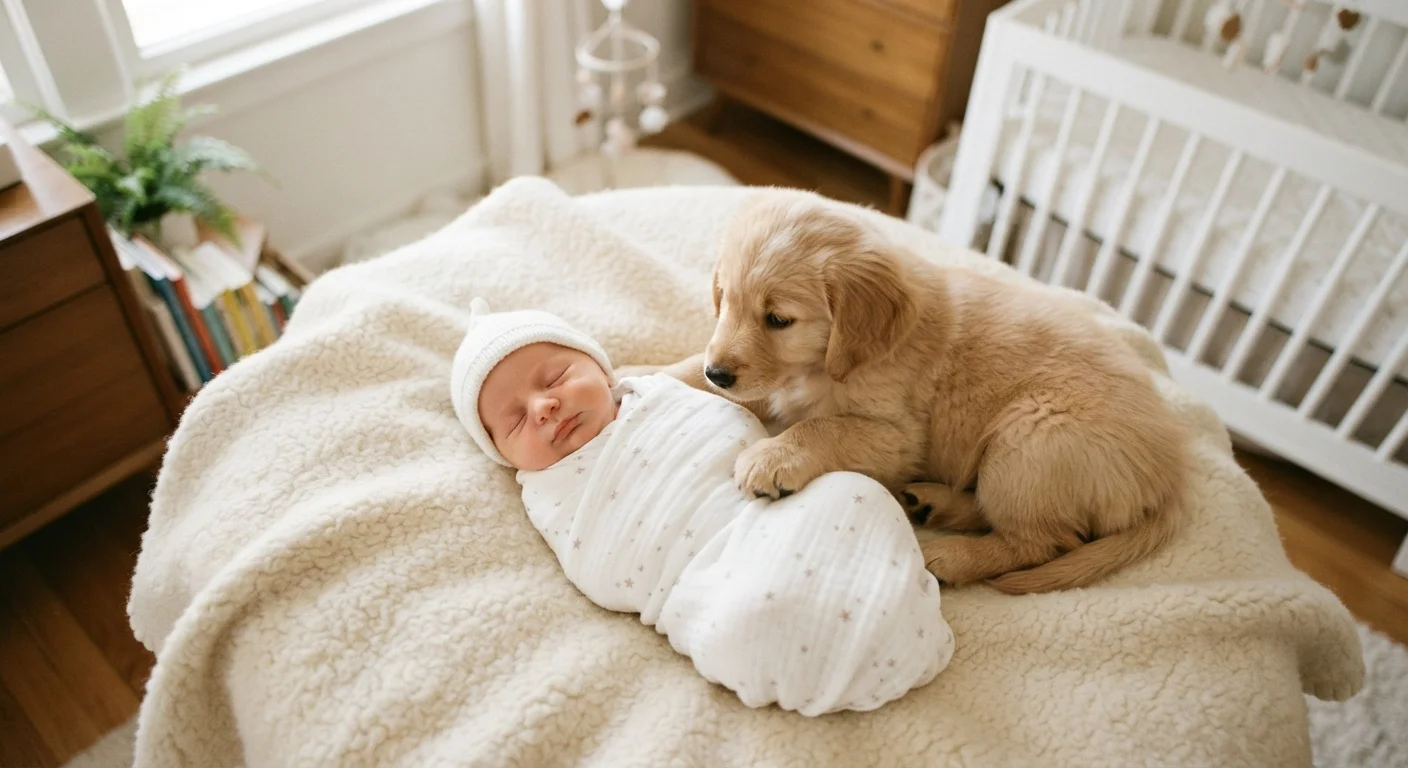
Key Takeaways
- Start puppy training and crate routines before the baby arrives whenever possible.
- Supervised introductions and a safe retreat space for the dog reduce stress for both animals.
- Consistent daily structure helps a puppy and a baby develop predictable sleep and feed rhythms.
- Babies and young puppies both require close supervision; never leave them unsupervised together.
- Early positive associations between the puppy and infant build a foundation for long-term friendship.
What you will need
Why timing and preparation matter
Few household challenges are as tiring as a sleepless newborn and a teething puppy arriving in the same season. Both depend entirely on the adults around them, both communicate through crying or whining, and both need structure before they can give much back. The good news is that the same qualities that make the overlap hard also make it manageable: puppies and babies are both in sensitive developmental windows, and habits formed now tend to stick.
Before the baby comes home, spend time on the basics. A puppy who already knows how to settle on a mat, walk on a loose lead, and accept being handled calmly is far easier to manage when your hands and attention are divided. See our guide to puppy socialisation versus obedience training for a clear breakdown of what to teach and when.
If the puppy arrives after the baby, the same principle applies: get the dog into a predictable routine as quickly as possible, because unpredictability raises stress for everyone in the house.
What you will need
Setting up your home for two new arrivals
Physical space management does most of the early safety work. A dog crate or a baby gate across a doorway gives the puppy a quiet retreat and gives you a reliable way to separate the two when you cannot watch them directly. This is not punishment; it protects the puppy from being startled and protects the baby from an enthusiastic jump or accidental scratch.
Keep the nursery off-limits until you are ready to introduce the puppy with your full attention. Some families allow the dog in the nursery during supervised visits only; others keep it permanently gated. Either works, as long as the rule is consistent from day one.
Use scent as your first bridge
Scent is a dog's primary sense, and a puppy that has already encountered the smell of a newborn in a calm context is less overwhelmed when they finally meet. Leave a worn baby item near the puppy's sleeping area for a few days before any face-to-face meeting. This small step reduces novelty and the excitable behaviour that comes with it.
Stock the puppy's own area with something that smells like the household before the baby arrives: a worn piece of clothing left in the crate helps the puppy associate new smells with safety rather than alarm. When the baby comes home, let the puppy sniff a used blanket or burp cloth from a distance before any face-to-face introduction.
For a broader overview of managing a new animal in an existing household, the research on animal introductions covers the principles that apply whether your second arrival has four legs or two.
Step-by-step introductions and daily routines
The first few weeks set the tone for months to come. Follow the steps below at a pace that fits your household; there is no fixed timeline, and a cautious approach is always better than a rushed one.
Introduce scent before sight
Before the baby and puppy are in the same room, let the puppy smell a cloth or item of clothing belonging to the baby. Place it near the puppy's crate or bed so the scent becomes familiar and neutral rather than exciting or alarming. Do this for two or three days before any face-to-face meeting.
First meeting on a lead, puppy calm
For the first in-person introduction, have one adult hold the baby and a second adult handle the puppy on a loose lead. Let the puppy approach at its own pace rather than pushing it toward the baby. Allow a brief sniff, then redirect the puppy's attention to a sit or a treat. Keep the session under two minutes.
Build a parallel routine
Map out a rough daily schedule that gives the puppy its exercise, feeding, and training windows around the baby's feed and nap times. Write it down and share it with anyone helping at home. A puppy that gets its needs met on a predictable schedule is less likely to compete for attention at the wrong moments.
Supervise all shared floor time
Once the baby begins spending time on a play mat, keep the puppy in view at all times during that period. Tether the puppy to a nearby anchor point or use a baby gate to keep it at a comfortable distance until it is reliably calm around the baby. Never leave the two alone together, regardless of how settled things seem.
Reward calm, settled behaviour
Whenever the puppy is relaxed near the baby, quietly praise it or offer a small treat. You want the puppy to associate the baby's presence with good things rather than with being corrected or excluded. Over time this pairing builds a genuinely positive relationship. Avoid loud celebrations that excite the puppy; calm praise is more effective here.
Once a routine is running, lean on it. Puppies and babies both regulate better with predictable feeding, nap, and play windows. A puppy who gets a walk at the same time each morning is less likely to be restless and demanding when the baby needs to nurse. For a fuller picture of how a dog's needs shift as months pass, our overview of a dog's life stages shows what to expect through adolescence and beyond.
Puppy adolescence, which typically lands between six and eighteen months, often coincides with a baby becoming mobile. A crawling infant and a dog in the middle of a hormonal phase is a combination that warrants extra vigilance. The adolescent dog behaviour guide explains what drives that phase and how to work through it without undoing earlier progress.
Health, hygiene, and when to call a professional
A young puppy and a young baby share one important vulnerability: their immune systems are still developing. Keep the puppy current on vaccinations and parasite control, wash hands after handling the dog or cleaning up after it, and keep dog feeding areas separate from baby floor-play areas. Our first-time pet owner health essentials covers the vaccination and parasite schedule in detail.
Never leave them alone together
No matter how gentle the puppy seems or how peacefully the pair have coexisted, a baby and a puppy must not be left unsupervised together. Puppies can become startled or overstimulated in seconds, and infants cannot move away or signal distress effectively. This rule applies throughout the puppy's first two years and whenever young children are involved.
If the puppy shows repeated signs of anxiety, resource guarding, or any growling around the baby, consult a qualified, force-free behaviourist promptly. These behaviours are manageable when addressed early and become harder to shift if left to worsen. Your veterinarian can refer you to an appropriate professional.
The Pet Health and Care hub has further guidance on recognising illness and keeping both young animals and young children in a safe shared environment.
This article is for general informational purposes only. It is not a substitute for professional veterinary, medical, or behavioural advice. Always consult a qualified professional for guidance specific to your household and the needs of your child or pet.