

Key Takeaways
- The brain is wired to favor immediate rewards over future ones, making saving feel unnatural by default.
- Loss aversion means the pain of giving up money to save can feel stronger than the pleasure of gaining that money later.
- Mental accounting causes people to treat money differently depending on where it came from or where it sits.
- Automation sidesteps willpower by moving money before you can spend it.
- Small structural changes to how you handle money tend to outlast motivation-based approaches.
Present bias
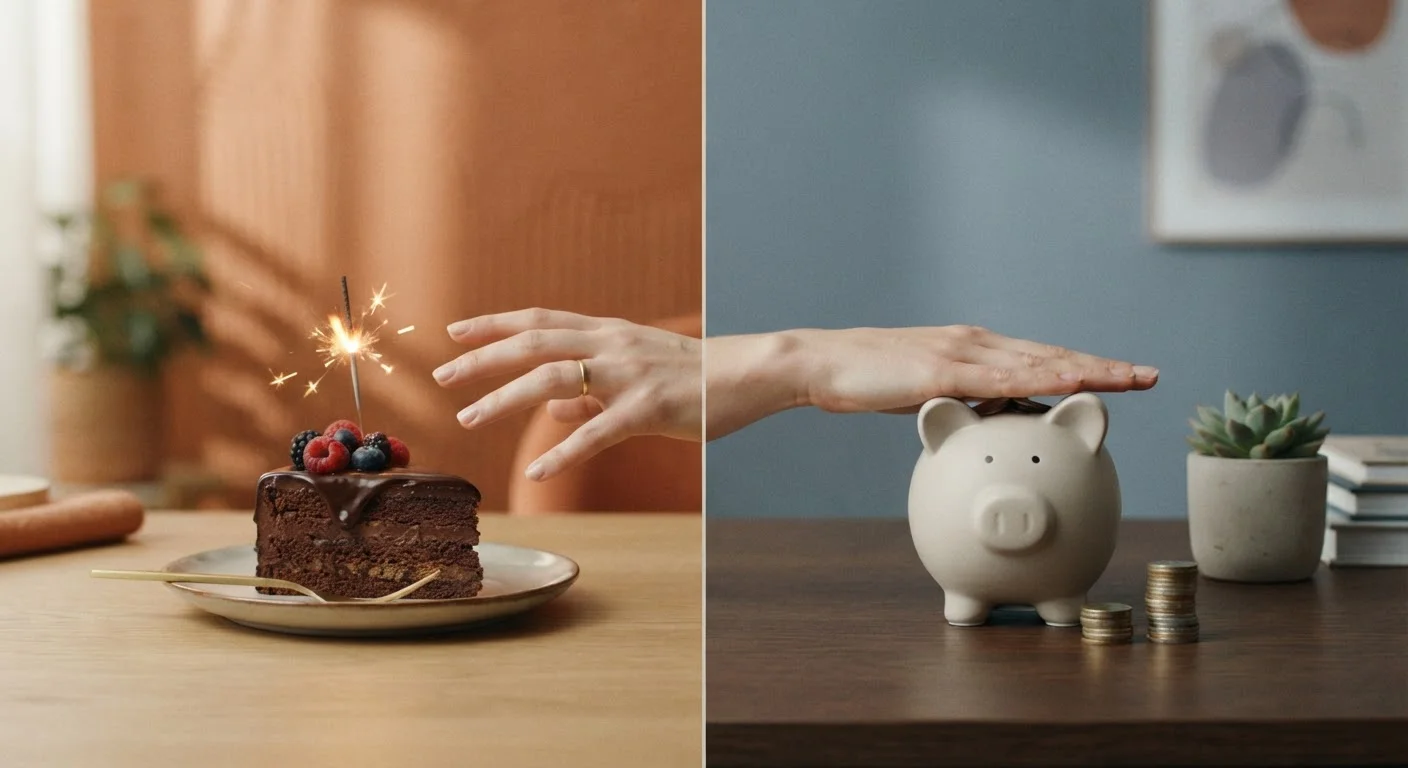
Present bias is the tendency to prefer a smaller reward right now over a larger reward later. It is a well-documented pattern in behavioral economics that explains why people consistently choose immediate gratification over long-term benefit, even when they know the trade-off is not in their favor. Saving money is hard partly because the brain treats future financial security as abstract, while today's purchase feels concrete and real.
Researchers measure present bias using discount rate experiments, finding that people disproportionately overvalue immediate payoffs relative to their stated long-term preferences.
Why the brain prefers spending now
Behavioral economists have documented a consistent gap between what people say they want (financial security) and what they actually do (spend). That gap is not a character flaw. It reflects how the brain processes time and reward.
When you spend money on something today, the brain's reward system responds quickly. The anticipation of a purchase, not just the purchase itself, releases dopamine. Saving, by contrast, offers no comparable immediate signal. The future benefit is real, but the brain treats it as vague and distant.
Present bias, defined above, sits at the center of this. Ask most people whether they would prefer $100 today or $115 in two weeks, and many choose the $100 even though the math clearly favors waiting. That same logic plays out whenever someone spends rather than saves, even on a small scale.
The everyday money habits that actually stick tend to work around this bias rather than fight it directly.
Loss aversion and the pain of saving
Psychologists Daniel Kahneman and Amos Tversky documented that people feel losses roughly twice as intensely as equivalent gains. This principle, known as loss aversion, shapes saving behavior in a specific way: when you transfer money to a savings account, the brain can frame that action as losing spending power, not gaining future security.
The framing matters more than most people expect. Someone who thinks of saving as 'giving up $200 this month' will find it harder than someone who thinks of it as 'protecting $200 for an emergency.' The dollars are identical. The psychological experience is not.
Reframe saving as keeping, not giving up
Instead of telling yourself you are setting money aside and losing access to it, try thinking of it as money you are keeping for a future version of yourself. That small shift in language can reduce the loss aversion response. It does not change the math, but it can change how the decision feels in the moment.
Loss aversion also helps explain why paying down debt can feel more motivating than building savings. Reducing a debt feels like eliminating a loss, which triggers a stronger emotional response than adding to a savings balance. Neither approach is wrong, but understanding the pull can help you make a deliberate choice rather than a reactive one. The decision between the two is worth thinking through carefully, and our piece on the saving versus debt trade-off offers a practical framework for that.
Mental accounting: not all money feels the same
People do not treat money as interchangeable, even when it is. This is called mental accounting. A $500 tax refund and $500 from a paycheck are the same $500, but many people spend the refund with less deliberation because it feels like a windfall rather than earned income.
The same pattern affects savings. Money sitting in a checking account feels available and spendable. The same amount in a labeled savings account or a separate institution feels less accessible, even though it legally belongs to the same person. That psychological distance turns out to be useful: it can reduce the impulse to dip into savings for everyday expenses.
Rounding up transactions to save the difference works partly because the amounts are small enough that the brain does not register them as a meaningful loss. It sidesteps the discomfort that comes with setting aside larger sums.
Working with your brain instead of against it
Knowing these patterns opens up practical options. The most durable ones reduce the number of decisions you have to make in the moment.
Automation is the most consistent example. Setting up an automatic transfer on payday means the money moves before you see it in your checking account. You never experience the psychological cost of choosing to save, because the choice is already made. Automating your savings does not require a complicated system; even a single recurring transfer is enough to shift the default.
Waiting periods work for spending decisions. Before buying something unplanned, a brief pause gives the brain's slower, more deliberate thinking a chance to catch up with its faster, reward-seeking response. The 24-hour rule is one structured version of this approach.
Small daily and weekly habits compound over time, not because they require discipline at every step, but because they change the environment so fewer tempting decisions arise.
This article is for general informational purposes only and does not constitute personalized financial advice. For decisions specific to your situation, consult a qualified financial professional.