

| Recommended daily iron (adult women 19-50) | 18 mg per day (National Institutes of Health, Office of Dietary Supplements) |
| Recommended daily iron (adult men 19+) | 8 mg per day (National Institutes of Health, Office of Dietary Supplements) |
| Recommended daily calcium (adults 19-50) | 1,000 mg per day (National Institutes of Health, Office of Dietary Supplements) |
| Recommended daily magnesium (adult women) | 310-320 mg per day (National Institutes of Health, Office of Dietary Supplements) |
| Recommended daily magnesium (adult men) | 400-420 mg per day (National Institutes of Health, Office of Dietary Supplements) |
| Most common nutritional deficiency worldwide | Iron deficiency (World Health Organization) |
Why these three minerals matter
Most nutrition conversations focus on macronutrients or vitamins, but three minerals quietly support some of the body's most fundamental functions: iron, calcium, and magnesium. National dietary surveys in the United States consistently identify all three as nutrients many adults consume below recommended levels. This is not a problem caused by exotic diets. It happens across ordinary eating patterns.
Iron carries oxygen through the blood. Calcium maintains bone structure and supports muscle contraction and nerve signaling. Magnesium is involved in more than 300 enzymatic reactions, including energy production and protein synthesis. None of these roles is optional. When intake falls short over time, the body compensates in ways that can gradually affect how you feel and function. This article is general nutrition information, not medical advice. If you have concerns about deficiency, a healthcare provider can order appropriate tests.
For context on how individual nutrients fit into the bigger picture, see how overall eating patterns compare to single-nutrient focus.
| Recommended daily iron (adult women 19-50) | 18 mg per day (National Institutes of Health, Office of Dietary Supplements) |
| Recommended daily iron (adult men 19+) | 8 mg per day (National Institutes of Health, Office of Dietary Supplements) |
| Recommended daily calcium (adults 19-50) | 1,000 mg per day (National Institutes of Health, Office of Dietary Supplements) |
| Recommended daily magnesium (adult women) | 310-320 mg per day (National Institutes of Health, Office of Dietary Supplements) |
| Recommended daily magnesium (adult men) | 400-420 mg per day (National Institutes of Health, Office of Dietary Supplements) |
| Most common nutritional deficiency worldwide | Iron deficiency (World Health Organization) |
Iron: function, sources, and absorption
Iron exists in two dietary forms. Heme iron, found in red meat, poultry, and fish, absorbs efficiently. Non-heme iron, found in legumes, tofu, fortified cereals, and dark leafy greens, absorbs less readily. The body absorbs roughly 15 to 35 percent of heme iron and 2 to 20 percent of non-heme iron, depending on other foods consumed at the same meal.
Vitamin C consumed alongside non-heme iron sources improves absorption. Combining spinach with tomatoes or lentils with bell pepper is a practical application of this. Conversely, calcium-rich foods and tannins in tea or coffee can reduce iron absorption when consumed at the same time, though this effect is modest for most people eating varied diets.
Adults with higher iron needs include women of reproductive age, pregnant individuals (who should consult a healthcare provider for personalized guidance), and people who follow plant-based diets. Iron-deficiency anemia is the most common nutritional deficiency worldwide, and its symptoms, including fatigue and difficulty concentrating, are often attributed to other causes.
Heme iron
A form of iron found in animal foods like meat, poultry, and fish. It is absorbed more efficiently by the body than non-heme iron.
Non-heme iron
The form of iron found in plant foods such as legumes, grains, and vegetables. Absorption varies and can be improved by pairing with vitamin C.
Bone density
A measure of how much mineral is packed into a segment of bone. Higher density generally means stronger bones less prone to fracture.
Enzymatic reaction
A chemical process in the body catalyzed by an enzyme. Magnesium acts as a cofactor in hundreds of these reactions, supporting energy production and other essential functions.
Bioavailability
The proportion of a nutrient that the body actually absorbs and uses after consumption. It varies by food source, preparation method, and what else is eaten at the same time.
Calcium: beyond bones
Calcium is the most abundant mineral in the human body, and roughly 99 percent of it is stored in bones and teeth. The remaining one percent circulates in blood and soft tissue, where it regulates muscle contractions, nerve transmission, and vascular function. When blood calcium drops even slightly, the body draws calcium from bone. This process, sustained over years of low intake, contributes to reduced bone density.
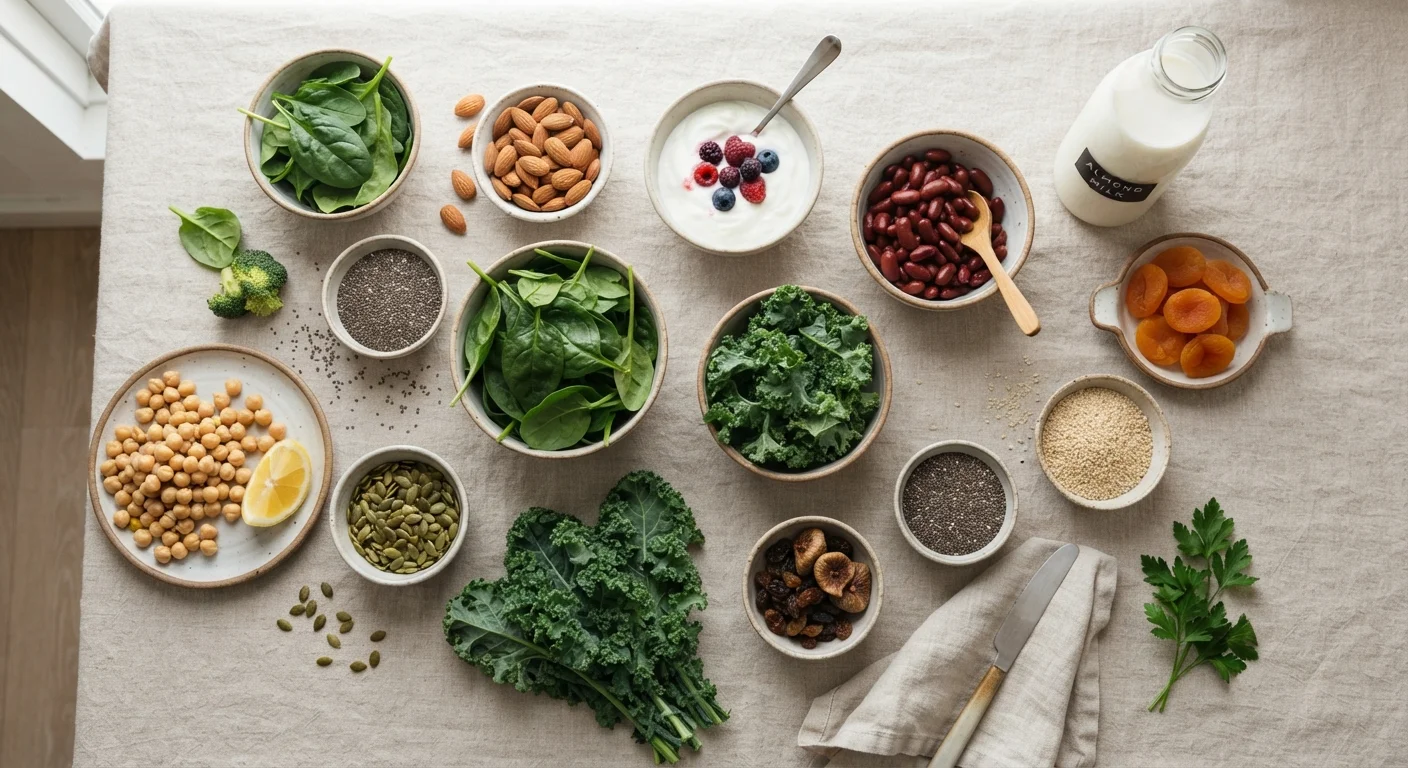
Dairy products are the most concentrated sources in the typical American diet, but they are not the only options. Fortified plant-based milks, canned salmon and sardines with bones, calcium-set tofu, bok choy, kale, and broccoli all provide meaningful amounts. Absorption depends partly on vitamin D, which the body produces through sun exposure and obtains from a limited number of foods including fatty fish and fortified products.
Adequate calcium intake throughout life, particularly in adolescence and early adulthood when bone is still accumulating, has long-term structural benefits. However, calcium supplements carry some nuance. If you are considering supplementation, discuss appropriate amounts with a healthcare provider rather than self-prescribing.
Magnesium: the overlooked mineral
Magnesium receives less public attention than iron or calcium, yet it is involved in muscle and nerve function, blood glucose regulation, blood pressure regulation, and the synthesis of DNA and protein. The body stores magnesium primarily in bone and soft tissue, making blood tests a limited reflection of total body status.
Good dietary sources include pumpkin seeds, chia seeds, almonds, black beans, edamame, whole grains, and dark chocolate. Leafy greens like spinach and Swiss chard also contribute significant amounts. Heavily processed diets tend to be lower in magnesium because refining grains removes much of the mineral content present in whole grain versions.
Magnesium deficiency is rarely severe in otherwise healthy adults, but chronically low intake has been associated in research with higher rates of several common conditions. Soil depletion and food processing have reduced magnesium in the food supply over recent decades, which may partly explain why intake data shows a consistent gap between actual and recommended consumption.
For a broader foundation in nutrition, this nutrition starter guide covers how to think about food choices without getting overwhelmed. And if you are curious about how what you eat affects gut bacteria, the relationship between diet and the microbiome is worth exploring, since magnesium-rich whole foods also support microbial diversity.
This article is for informational purposes only and is not medical advice. Consult a qualified healthcare professional before making changes to your diet or taking supplements, especially if you have an existing health condition.