
Staying Active Through Life's Disruptions: Travel, Illness, and Busy Seasons

Key Takeaways
- Maintaining any level of movement during disruptions is more beneficial than stopping entirely.
- Illness requires reducing or pausing activity, not pushing through, to support recovery.
- Short, flexible sessions replace full workouts when time or energy is limited.
- Bodyweight exercises and walking are reliable options requiring no equipment or location.
- A realistic, lower bar for activity during disruptions helps you return to routine faster.
Why consistency matters more than perfection
Most people lose fitness momentum not because of one missed workout but because a disruption stretches into weeks of inactivity. A work trip, a mild illness, or a demanding family season interrupts the routine, and without a plan for that gap, stopping becomes the default.
Research consistently shows that even reduced physical activity preserves much of the cardiovascular and muscular conditioning built during regular training. The goal during a disruption is maintenance, not progress. A shorter walk, a 15-minute bodyweight circuit, or a few stretches before bed counts. None of these need to match what you do on a normal week to be worth doing.
Understanding how rest fits into a fitness routine helps here: some reduction in output is not failure, it is a normal part of any sustainable approach to movement.
Staying active while traveling
Travel disrupts schedules, changes time zones, and removes access to familiar equipment. None of those obstacles make movement impossible.
Walking is the most accessible option. Choosing to walk between nearby attractions, using stairs, or getting off public transit a stop early can add meaningful movement without any planning. If you are building an itinerary, a well-structured travel plan can include movement-friendly choices from the start, such as walkable neighborhoods or morning free time before activities begin.
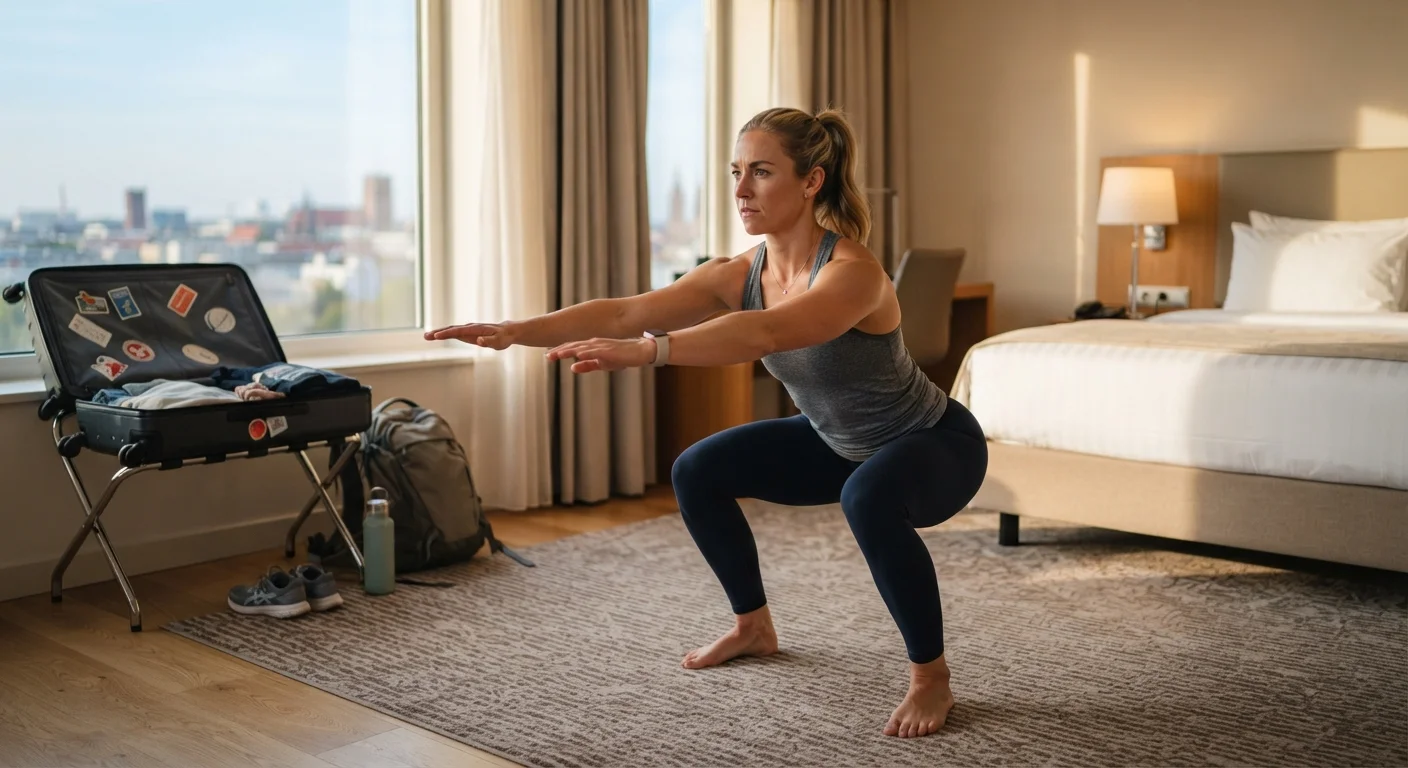
Hotel rooms have enough space for bodyweight exercises: squats, lunges, push-ups, and planks need only a few square feet. Resistance bands are light enough to pack and expand the range of exercises significantly. Many hotel properties have fitness facilities, and some have pools, both worth checking when booking.
Travelers managing ongoing health conditions should plan ahead. General considerations for traveling with health conditions covers documentation and logistics that can affect how much physical activity is realistic on a given trip.
Set a minimum viable session length before a disruption begins.
Having a pre-decided floor, such as 10 minutes of movement per day, removes the decision fatigue that leads to doing nothing. A specific, small commitment is easier to follow through on than a vague intention to stay active.
Pack movement into transitions and gaps rather than scheduling separate sessions.
During travel or hectic periods, carving out a dedicated workout block is often unrealistic. Using existing transitions, airport walks, morning time before meetings, or breaks between activities, distributes movement without requiring additional scheduling.
Use bodyweight exercises as your default fallback.
Bodyweight movements require no equipment, no gym, and very little space. They cover the major muscle groups and can be scaled to any fitness level, making them the most consistent option across all disruption types.
Lower your intensity benchmark when returning from illness.
Returning to full training volume immediately after illness increases the risk of relapse or injury. A gradual re-entry at 50 to 60 percent of normal effort for several days allows the body to adjust without additional stress.
Treat a disruption as a temporary context, not a reset.
Framing reduced activity as failure makes it harder to return to a routine after the disruption ends. Treating it as a planned adaptation preserves continuity of habit and reduces the psychological distance back to regular movement.
Movement during illness
Illness is the one disruption that sometimes calls for stopping activity entirely, not reducing it. The general guidance supported by sports medicine is sometimes called the neck rule: symptoms above the neck (a mild cold with no fever, minor congestion) may allow light activity such as easy walking. Symptoms below the neck (chest congestion, body aches, gastrointestinal illness) or any fever are signals to rest completely until resolved.
Pushing through fever or systemic illness can prolong recovery and, in some cases, carry real cardiovascular risk. The appropriate response is rest, hydration, and a gradual return to activity once symptoms clear.
When you do return, starting at a lower intensity than usual for several days is sensible. The signs of overtraining overlap with the fatigue that follows illness: if your body is not responding well to resumed exercise, that is a signal to slow down further, not push harder.
This article is for general informational purposes and does not constitute medical advice. Consult a qualified healthcare professional before resuming physical activity after any illness, particularly if you have an underlying health condition.
Adapting to busy seasons and hectic schedules
Busy seasons, whether a demanding work period, a holiday stretch, or a family caregiving situation, compress available time without eliminating it. The challenge is adjusting expectations while holding on to some movement.
Building a movement routine without a fixed schedule addresses this directly: structured routines are not the only way to stay active. Opportunistic movement, short walks, stretching between tasks, or a 10-minute session in the morning, accumulates across the week.
Flexibility and mobility work requires very little time and no equipment, and understanding the difference between flexibility, mobility, and stability helps you choose the right type of movement when energy is low. A short mobility routine before bed is easier to maintain during a hectic period than a full strength session.
The mood benefits of even brief movement are well established. Physical activity and its effect on mood are particularly relevant during stressful seasons, when the temptation to drop exercise is strongest and the return from even small amounts is high.