

Key Takeaways
- New cars lose roughly 15 to 25 percent of their value in the first year alone.
- Total depreciation over five years can reach 50 to 60 percent of the original purchase price.
- Mileage, condition, color, and vehicle segment all affect how fast a car loses value.
- Buying a used vehicle that has already absorbed heavy early depreciation lowers your ownership cost.
- Depreciation affects how much equity you hold if you need to sell, trade in, or refinance.
Car depreciation
Car depreciation is the decline in a vehicle's market value over time. It is the difference between what you paid for the car and what it would sell for at any later point. Depreciation is the single largest cost of vehicle ownership for most drivers, yet it rarely appears on any monthly bill.
Depreciation is calculated as the percentage drop from original purchase price to current resale or trade-in value. It is a non-cash expense, meaning no money leaves your account each month, but it reduces the vehicle's equity.
What depreciation actually means for your wallet
When you buy a car, you are not just paying for transportation. You are paying for an asset that loses value continuously. That loss is depreciation, and it is a real cost of ownership even though no invoice arrives for it each month.
Consider a vehicle purchased for $35,000. If it depreciates 20 percent in year one, the owner has absorbed a $7,000 loss in value before a single repair bill arrives. Over five years, total depreciation on that vehicle could reach $18,000 to $21,000. Spread across 60 months, that works out to $300 to $350 per month in lost value, a figure that often exceeds what drivers pay for fuel or insurance.
Because depreciation is invisible on a monthly basis, it is easy to undercount when calculating the true cost of ownership. Understanding it changes how you compare vehicles and financing options. For a broader view of how financing costs interact with ownership math, see common car loan misconceptions that affect what drivers ultimately pay.
Factor depreciation into your total cost estimate
When comparing two vehicles at different price points, calculate the estimated five-year depreciation for each, not just the monthly payment. A cheaper vehicle with faster depreciation can cost more in total than a pricier one with stronger resale retention. Published resale value guides can help you estimate these figures before you buy.
The depreciation curve: how value drops over time
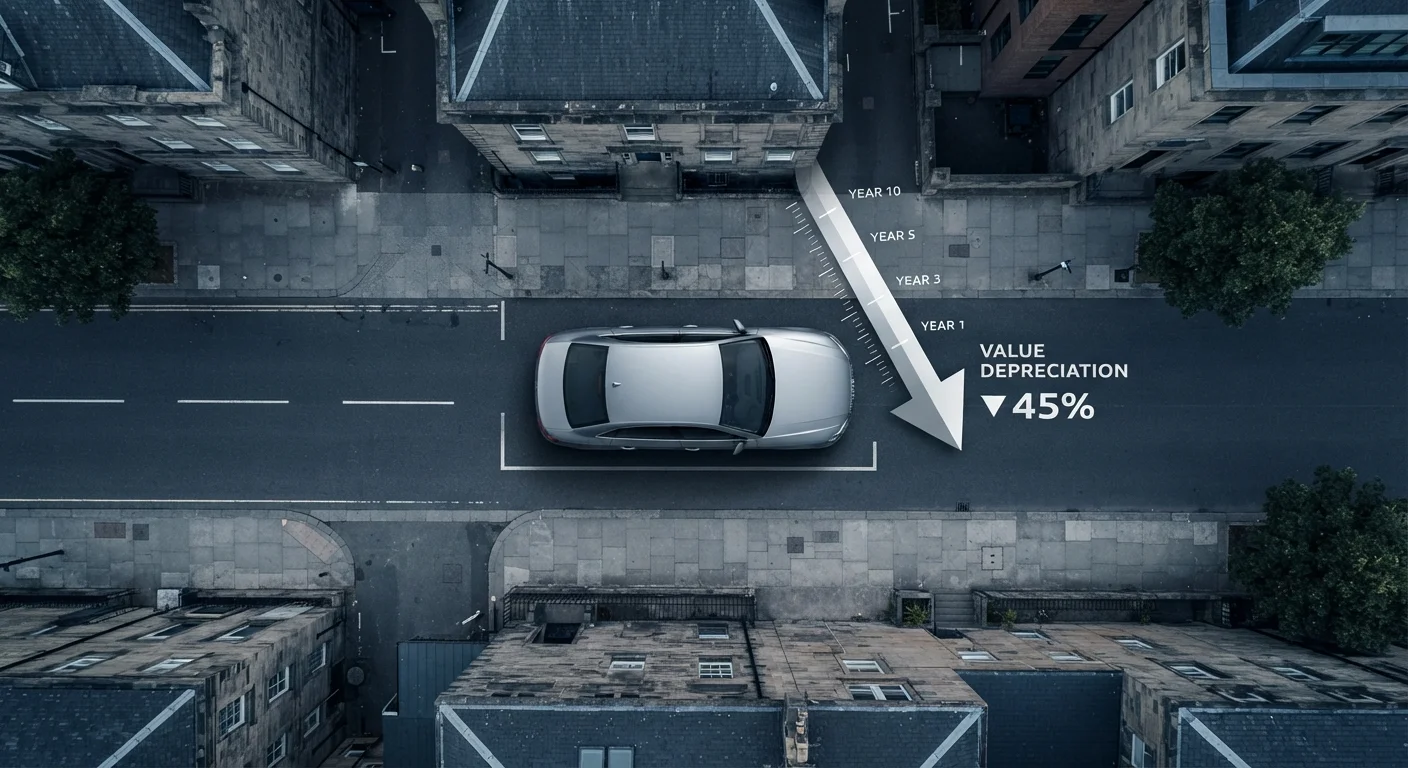
Depreciation does not move in a straight line. The decline is steepest in the early years and gradually flattens.
Year one is the sharpest. A new vehicle is repriced the moment it is registered and becomes a used car in the market's view. From year two through year five, annual losses are still meaningful but smaller in percentage terms. By years six through ten, the dollar drop per year is modest because a large portion of the original value has already been absorbed.
This curve has a direct implication for car buyers. Someone who buys a two- or three-year-old vehicle acquires a car that has already passed through its most expensive depreciation phase. The full picture of hidden ownership costs includes depreciation alongside insurance, taxes, and maintenance, all of which are worth factoring in before signing a purchase agreement.
Factors that speed up or slow down depreciation
Several variables affect how quickly a specific vehicle loses value.
- Mileage. Higher annual mileage compresses value faster. Lenders and resale guides use mileage as a primary input when pricing used vehicles.
- Condition. Paint damage, worn interiors, and mechanical issues all reduce what a buyer will pay. Keeping a vehicle in good condition preserves resale value over time.
- Segment and demand. Vehicle categories with strong buyer demand, such as pickup trucks in the US market, tend to hold value better than sedans in segments where demand has softened.
- Fuel type and efficiency. Market shifts in fuel preferences can affect resale values within specific segments, though this varies by region and economic conditions.
- Color. Neutral colors such as white, silver, and black generally sell faster and at closer to book value than unusual or polarizing colors.
- Service history. A documented maintenance record gives buyers confidence and supports the asking price at resale. This is one area where routine upkeep produces a direct financial return.
For guidance on maintaining a vehicle in a way that also protects its value, car maintenance basics covers the upkeep habits that matter most.
15-25%
First-year value loss on a new car
Industry resale data consistently shows new vehicles lose between 15 and 25 percent of purchase price in the first 12 months.
~50-60%
Typical five-year depreciation rate
Over a five-year ownership period, most vehicles lose roughly half to three-fifths of their original purchase price, according to resale market data.
$300-$350/mo
Estimated monthly depreciation cost on a $35,000 car
Based on a 50 to 60 percent five-year depreciation rate applied to a $35,000 purchase price spread across 60 months.
Depreciation and the buy-versus-keep decision
Depreciation math applies whether you are buying, selling, or deciding whether to hold onto an aging vehicle. When a car is nearly fully depreciated, its monthly cost of lost value is minimal. That changes the financial comparison between keeping an older car and replacing it with something newer.
A vehicle with 120,000 miles may depreciate only $500 to $1,000 per year at that stage. A new replacement vehicle might depreciate $5,000 to $7,000 in its first year alone. If the older car is mechanically sound, the cost of repairs would need to significantly exceed the cost of depreciation on a replacement before trading up makes financial sense. The framework for deciding whether to keep or replace an older vehicle walks through how to make that comparison systematically.
Negative equity is a related concern. If you financed a vehicle with a small down payment over a long loan term, early payments are weighted toward interest rather than principal. Meanwhile, the vehicle depreciates quickly. The result is a period where the loan balance exceeds the car's market value. Selling or totaling the vehicle during that window leaves a gap the owner must cover. Managing car ownership costs over the long run includes strategies for structuring financing to reduce this exposure.