

Key Takeaways
- Each cylinder in a gasoline engine has one spark plug that fires thousands of times per minute.
- Worn spark plugs reduce fuel efficiency, cause misfires, and can damage the catalytic converter over time.
- Most manufacturers recommend replacing spark plugs every 30,000 to 100,000 miles depending on plug type.
- Reading the deposit color and pattern on a used plug reveals useful information about combustion health.
- Replacing spark plugs is one of the more accessible routine maintenance tasks, though some engine layouts require professional access.
Spark plug
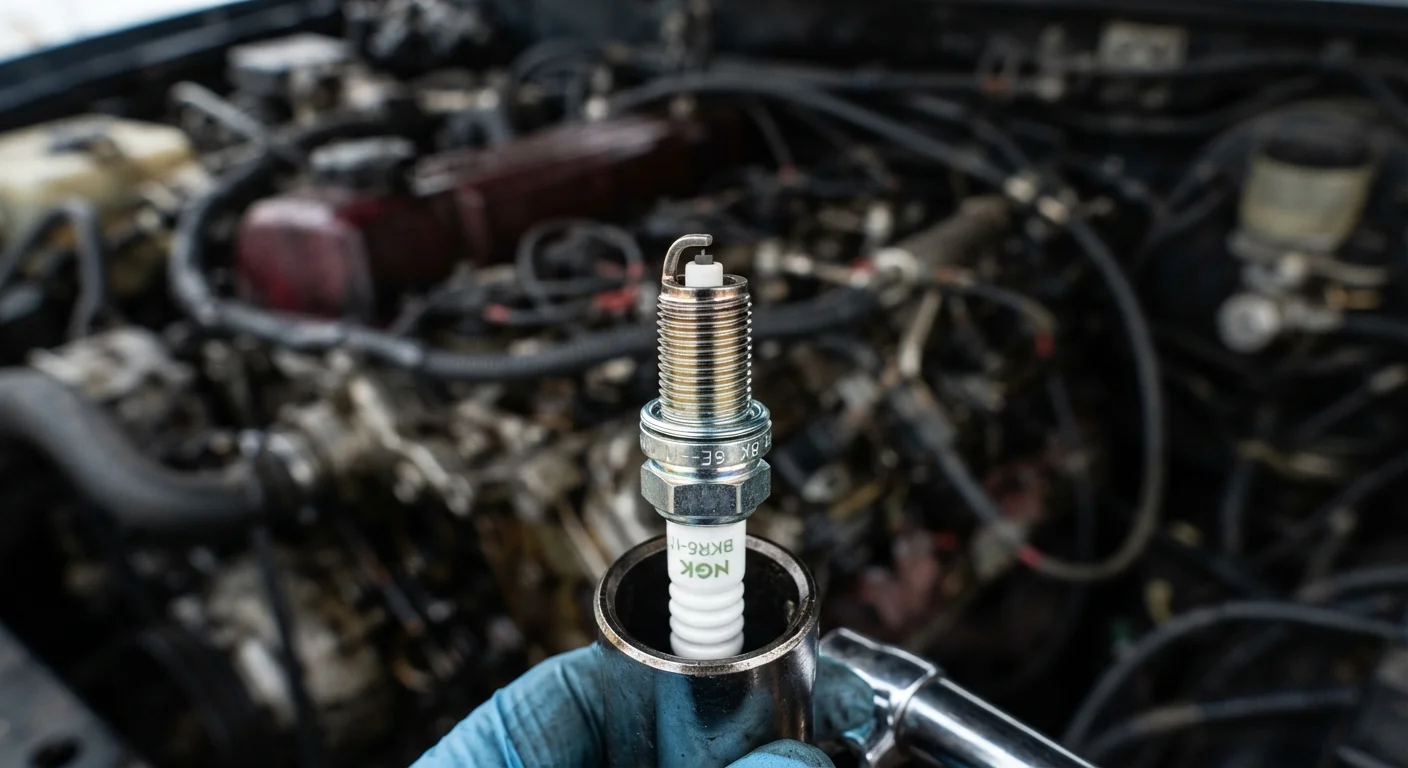
A spark plug is a small electrical device threaded into each cylinder of a gasoline engine. It delivers a timed electrical spark that ignites the compressed fuel-air mixture, producing the controlled combustion that drives the piston. Without a functioning spark plug, that cylinder cannot fire, and the engine loses power or fails to run.
Spark plugs operate in gaps typically between 0.028 and 0.060 inches; the gap width, electrode material, and heat range must match the engine manufacturer's specification.
How spark plugs work
Every gasoline engine runs on a four-stroke cycle: intake, compression, power, and exhaust. The power stroke is what actually moves the car, and a spark plug triggers it. At precisely the right moment in each cycle, the vehicle's ignition system sends a high-voltage pulse (typically 12,000 to 45,000 volts) down the plug wire or coil to the plug's center electrode. That voltage jumps the small air gap to the ground electrode, producing a spark hot enough to ignite the compressed fuel-air mixture.
Combustion then expands rapidly, forcing the piston down and turning the crankshaft. In a four-cylinder engine running at 2,000 RPM, each plug fires roughly 1,000 times per minute. At highway speeds the firing rate climbs further, which is why plug materials and gap tolerances matter so much to engine longevity.
The spark must be timed precisely. Too early (pre-ignition) causes engine knock that stresses internal components. Too late reduces power and wastes fuel. Modern engines use electronic control modules to adjust timing dynamically, but the plug itself must still be in good condition for the spark to form reliably.
Types of spark plugs and their differences
Plugs differ mainly in electrode material, which determines how long they last and how well they fire in various conditions.
- Copper core plugs conduct electricity efficiently and suit older engines designed around them, but the soft copper wears relatively quickly.
- Platinum plugs place a small platinum disc on the center electrode, increasing wear resistance and extending service life to roughly 60,000 miles in many applications.
- Double platinum plugs add platinum to both electrodes, reducing gap erosion in distributor-based ignition systems.
- Iridium plugs use a fine iridium-tipped electrode that handles high temperatures well and maintains a stable gap longer, often reaching 100,000 miles or more when specified by the manufacturer.
The right plug for any vehicle is the one specified in the owner's manual or on the manufacturer's parts reference. Installing a plug with the wrong heat range can cause fouling or pre-ignition regardless of electrode material.
Match the plug to the manual
Using the plug number or specification listed in your owner's manual matters more than price or brand marketing. Plug heat range, gap, and thread size must match engine design. A plug that looks identical externally can have a different heat range that causes fouling or pre-ignition in your specific engine.
Signs that spark plugs need attention
Spark plugs degrade gradually, so symptoms often appear slowly. Drivers may notice reduced fuel economy before any obvious drivability problem. Common indicators include:
- Rough idle or vibration at a stop
- Hesitation or stumbling during acceleration
- A misfire code (typically P030X) stored in the engine control module, triggering the check engine light
- Difficulty starting, especially in cold weather
- Noticeably lower miles per gallon than usual
A visual inspection of removed plugs provides additional information. A plug with a light tan or gray deposit on the electrode area is generally burning correctly. Heavy black carbon buildup points to a rich mixture or oil consumption. A white or blistered insulator indicates the plug is running too hot, possibly because the wrong heat range was installed. Physically damaged electrodes, a widened gap, or cracks in the ceramic insulator are clear signs a replacement is due.
For a broader look at what routine inspections cover and how often they are generally needed, see the routine maintenance guide for car owners.
What replacement involves
Removing and installing spark plugs requires the engine to be cool to prevent thread damage in an aluminum cylinder head. A spark plug socket (typically 5/8-inch or 13/16-inch), a torque wrench, and a gap gauge are the basic tools. Plugs should be torqued to the manufacturer's specification rather than tightened by feel, because overtightening can strip threads or crack the plug, while undertightening allows combustion gases to escape past the seat.
On straightforward inline four-cylinder or V6 engines with accessible valve covers, most mechanically inclined drivers can complete the job in under an hour. Engines with coil-on-plug ignition require removing individual coil packs before accessing each plug. Some V6 and V8 engines have rear bank cylinders tucked against the firewall, and those positions are difficult enough that professional service is the practical choice. A qualified mechanic can also inspect the removed plugs and assess whether any cylinder shows an unusual combustion pattern worth investigating further.