

Key Takeaways
- Smartwatches measure heart rate by shining light into your skin and detecting how blood absorbs it.
- Green LEDs are most common, but some devices also use red or infrared light for different measurements.
- A photodetector converts reflected light into an electrical signal the watch's processor translates into beats per minute.
- Accuracy depends on fit, skin tone, motion, and skin temperature.
- Optical sensors can also estimate blood oxygen levels using a similar principle.
Optical heart rate monitoring
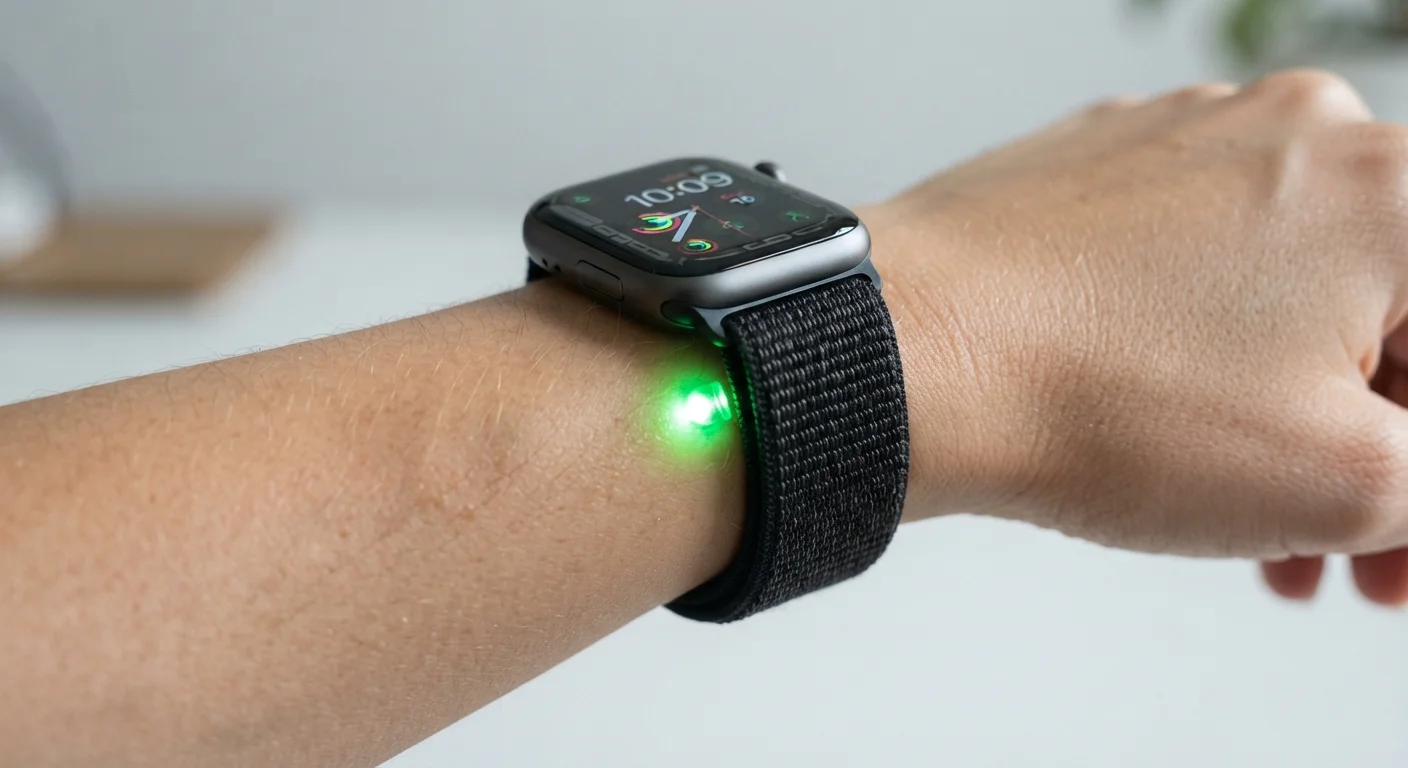
Optical heart rate monitoring is a method smartwatches use to count your heartbeats by shining light into your skin and measuring how much bounces back. Blood absorbs light differently depending on how much of it is flowing through your vessels at any given moment. By tracking those tiny changes in reflected light, the device calculates your heart rate in real time.
This technology is called photoplethysmography (PPG). It relies on the optical properties of oxygenated hemoglobin, which absorbs green light more readily than surrounding tissue.
The basic principle: light and blood
Your heart pumps blood in pulses. With each beat, a fresh surge of blood moves through the small vessels near the surface of your wrist. Between beats, blood volume in those vessels dips. This rhythmic change is what an optical heart rate sensor detects.
The sensor shines small LEDs into your skin. Some of that light scatters back toward the watch's surface. A component called a photodetector sits next to the LEDs and measures the intensity of that returning light. When more blood is present, more green light is absorbed and less comes back. When blood volume drops between beats, more light reflects back. The photodetector records a wave-like pattern that mirrors your pulse.
The watch's processor counts those waves per minute and converts the figure into a beats-per-minute reading displayed on screen.
PPG is not new technology
Photoplethysmography has been used in clinical settings since the 1930s. Pulse oximeters in hospitals have relied on it for decades. Consumer smartwatches adapted the same underlying physics into a wearable form, shrinking the components and adding motion-compensation algorithms to make continuous wrist-based monitoring practical.
Why green light, and what about other colors
Green light sits at a wavelength that oxygenated blood absorbs particularly well. This creates a strong contrast between the peak and trough of each heartbeat wave, which gives the processor a cleaner signal to work with.
Red and infrared light behave differently. Blood absorbs them at rates that shift depending on how much oxygen the hemoglobin is carrying. Watches that measure blood oxygen saturation (SpO2) use red and infrared LEDs alongside a PPG algorithm that compares the absorption ratios at both wavelengths. A lower ratio of oxygenated to deoxygenated blood produces a different absorption pattern, and the device uses that difference to estimate SpO2 percentage.
Some watches cycle through multiple LED colors during a single reading session to collect both heart rate and blood oxygen data simultaneously.
530 nm
Peak green light wavelength used in PPG sensors
Light near 530 nanometers is absorbed strongly by oxyhemoglobin, which is why green LEDs dominate wrist-based heart rate sensors.
2 to 5%
Typical heart rate error margin at rest
Consumer wearable accuracy studies generally find resting heart rate readings within 2 to 5 beats per minute of clinical reference devices under controlled conditions.
What affects accuracy
Optical sensors work best when the watch sits snugly about one finger-width above the wrist bone. A loose band lets in ambient light and allows the watch to shift with movement, both of which introduce noise into the signal.
Motion is the biggest challenge. When you move your arm, muscles and tendons shift under the skin, creating their own light-absorption changes that can be mistaken for heartbeats. Most modern smartwatches pair their PPG sensor with an accelerometer, a motion detector that tracks arm movement. The processor uses accelerometer data to filter out motion-related noise from the light signal, a process called motion artifact removal.
Skin tone and skin thickness also affect how much light reaches the vessels and how much returns. Darker skin tones absorb more light overall, which can reduce the signal strength available to the sensor. Researchers and device makers have worked to address this through improved algorithms and multi-wavelength sensor designs, though the field continues to develop.
Cold temperatures cause blood vessels near the skin to constrict, reducing blood flow to the surface and making the pulse signal harder to detect accurately.
How this compares to medical-grade measurement
Hospital pulse oximeters and ECG machines measure cardiac activity through different means. A clinical pulse oximeter clips to a fingertip, where blood vessels are closer to the surface and the light path is more controlled. An ECG reads the electrical signals the heart generates rather than blood volume changes.
Consumer smartwatches use optical PPG because it works passively and continuously without requiring gel, patches, or specific posture from the wearer. The tradeoff is that a wrist sensor operates further from major vessels and in a much noisier mechanical environment than a fingertip or chest electrode.
Smartwatch heart rate data can be informative for general wellness tracking, but it is not a substitute for clinical measurement when medical decisions are involved. Anyone concerned about heart rhythm irregularities or cardiac health should consult a licensed healthcare provider and use clinically validated equipment.
This article is for informational purposes only and does not constitute medical advice. Consult a qualified healthcare professional for any concerns about your heart health or medical conditions.