

Key Takeaways
- Insurance covers specific, defined losses, not every possible cost you might face.
- Every policy has exclusions, the things it will not pay for, which are just as important as what it does cover.
- Premiums, deductibles, and coverage limits all affect how much protection you actually receive.
- Reading the declarations page and exclusions section of any policy is the only way to know what you have.
- For personal guidance on coverage decisions, consult a licensed insurance agent or financial adviser.
Insurance
Insurance is a financial arrangement where you pay a regular fee (a premium) to a company that agrees to cover certain financial losses if a covered event happens. The core idea is risk pooling: many people pay in, and the funds collected pay out to those who experience a covered loss. It does not prevent bad things from happening; it limits how much those events cost you out of pocket.
Policies are legal contracts governed by state law, meaning coverage terms, exclusions, and claims processes vary by insurer and by state.
The basic deal: what you pay and what you get
When you buy an insurance policy, you enter a contract. You pay a premium, usually monthly or annually, and in return the insurer agrees to cover financial losses that meet the conditions spelled out in the policy. That is the entire mechanism.
Three numbers define how that contract works in practice:
- Premium: the amount you pay to keep the policy active.
- Deductible: the amount you absorb before the insurer pays anything on a claim.
- Coverage limit: the maximum the insurer will pay for a covered loss.
A policy with a low premium often carries a high deductible or a low coverage limit, sometimes both. There is no such thing as full, unlimited protection at a minimal cost. The tradeoffs are real, and understanding them before you file a claim matters.
Read the declarations page first
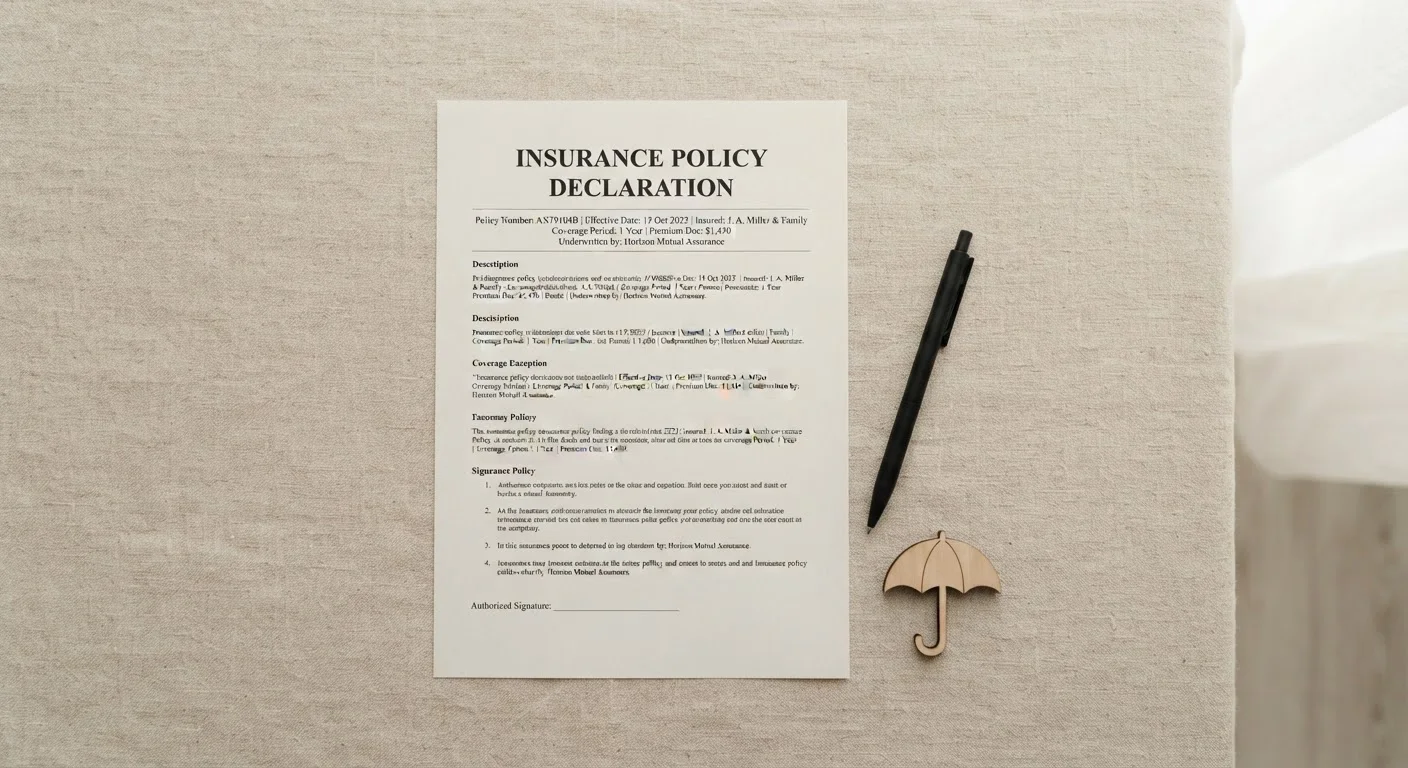
The declarations page at the front of any policy summarizes your coverage limits, deductible, and premium in one place. It takes about five minutes to review and tells you immediately whether your limits match what you actually own or need to protect.
What insurance actually covers
Insurance pays for losses that are sudden, accidental, and specifically named in your policy. Car insurance covers collision damage and liability from accidents. Health insurance covers defined medical services. Homeowners insurance covers fire, windstorm, theft, and liability on your property, among other named perils.
The coverage in any policy depends entirely on what you agreed to when you signed. Two people with "homeowners insurance" from different companies, or even the same company, can have meaningfully different protection. That is why the declarations page, the summary at the front of your policy, is worth reading carefully. It lists what you have, your limits, and your deductible in plain terms.
For a closer look at how this plays out in a specific category, see the major insurance categories and what each covers.
40%
Americans without life insurance coverage
According to LIMRA's 2023 Insurance Barometer Study, roughly 4 in 10 American adults have no life insurance coverage at all.
$1,000+
Average annual homeowners insurance premium
The Insurance Information Institute has reported average annual homeowners premiums above $1,000 nationally, with significant variation by state and property value.
What insurance does not cover
Exclusions are where most surprises happen. Every policy contains a section listing what it will not pay for, and those terms are just as binding as the coverage sections. Common exclusions include:
- Floods (typically excluded from standard homeowners policies; separate flood insurance exists)
- Earthquakes (excluded from most homeowners and renters policies)
- Wear and tear or gradual deterioration
- Intentional acts by the policyholder
- Business activity conducted at a personal residence
Pre-existing conditions are a frequent exclusion in some insurance lines, and certain high-risk activities may void coverage in others. The exclusions section of your policy document is not optional reading if you want to know what you actually have.
For a thorough breakdown of coverage gaps in one specific line, see what homeowners insurance includes and excludes.
Flood and earthquake coverage require separate policies
Standard homeowners and renters policies almost universally exclude flood and earthquake damage. Flood coverage is available through the federal National Flood Insurance Program (NFIP) or private insurers, while earthquake coverage is sold as a separate policy or endorsement. If you live in an area prone to either risk, check whether you have these separately.
How a claim works
When a covered loss happens, you notify the insurer and file a claim. The insurer reviews the claim against your policy terms, may send an adjuster to assess the loss, and then approves or denies payment based on whether the event qualifies under your coverage.
If approved, your payout equals the covered loss minus your deductible, up to your coverage limit. You are responsible for everything above the limit and everything below the deductible. Claims that fall below your deductible result in no payment at all, even if the event itself is covered.
Insurers can deny claims for several legitimate reasons: the event falls under an exclusion, you missed a notification deadline, your premium lapsed, or the loss does not meet the policy's definition of a covered peril. Understanding the claims process in advance puts you in a better position to document losses properly and meet any filing requirements.
If you own or are considering a vehicle, the specific auto coverage types and what each pays for explains how these same mechanics apply to car insurance specifically.
The limits of insurance as a financial tool
Insurance is designed to protect against large, unexpected losses, not to serve as a general savings or expense account. It does not cover routine maintenance, predictable costs, or losses you choose not to insure. If you carry a high deductible to keep premiums low, you need enough savings to cover that deductible when a claim arises.
Being underinsured is a real risk. If your coverage limit is lower than the actual replacement cost of what you are insuring, you absorb the difference. Reviewing your coverage limits after major life changes, such as a home renovation, a new vehicle, or a significant income shift, helps ensure your limits still match your actual exposure.
Insurance also cannot help if it lapses. A missed premium payment can cancel a policy, and a gap in coverage leaves you fully exposed during that period. Setting up automatic payments or calendar reminders is a straightforward way to avoid unintentional lapses.
This article is general information and not personalized insurance, financial, or legal advice. Coverage terms, exclusions, and regulations vary by provider and by state. Consult a licensed insurance agent or a qualified financial adviser for guidance specific to your situation.
This article is for informational purposes only and does not constitute insurance, financial, or legal advice. Always read your policy documents carefully and consult a licensed professional before making coverage decisions.