

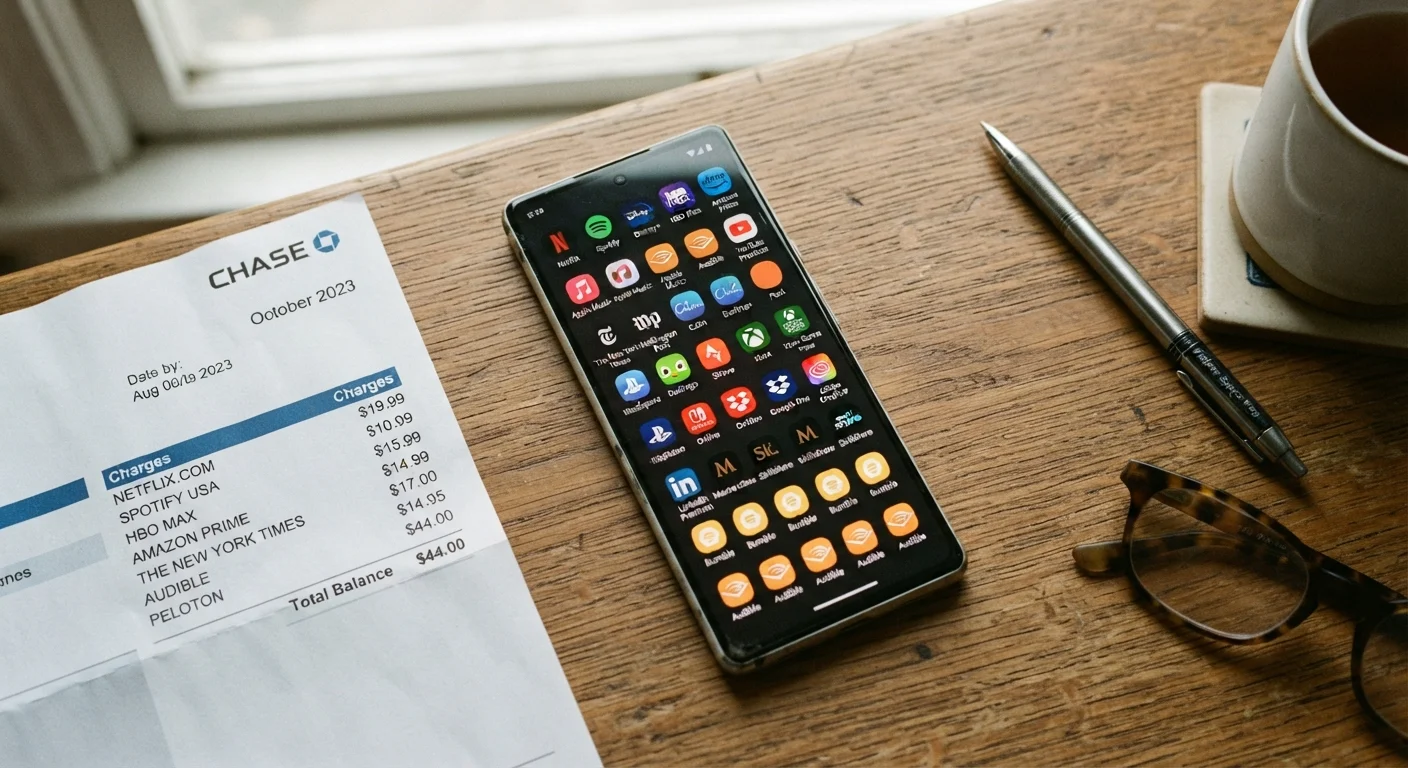
Key Takeaways
- Most households carry more active subscriptions than they can name from memory.
- Automatic billing makes recurring charges easy to ignore month after month.
- Free trials that convert to paid plans are a common entry point for forgotten subscriptions.
- Reviewing one bank or credit card statement per month is enough to catch most subscription creep.
- Canceling unused subscriptions produces immediate, recurring savings with no lifestyle change required.
Subscription creep
Subscription creep is the gradual accumulation of recurring charges on a bank or credit card statement, where each individual cost seems small but the combined total grows significantly over time. It happens because subscriptions are easy to sign up for, automatic billing removes the friction of paying, and canceling feels like a low priority until the total becomes noticeable.
In behavioral economics, this pattern relates to 'status quo bias': people tend to keep existing arrangements in place rather than actively canceling, especially when charges are small enough to avoid triggering concern.
Why small charges add up faster than expected
A streaming service here, a fitness app there, cloud storage for photos, a digital news outlet, a meal-planning tool. Each one costs less than a daily coffee. None of them felt like a significant financial commitment at sign-up. But at $8, $10, $13, and $15 a month, a handful of services clears $50 before you count the ones you forgot.
The math is straightforward. The psychology behind it is worth understanding. Automatic billing is designed to reduce friction, which is exactly why it also reduces awareness. When no one asks you to actively pay each month, you stop noticing the charge. That is the mechanism behind subscription creep: not deception, just the quiet compounding of small decisions that felt low-stakes at the time.
Recurring micro-expenses follow the same pattern, whether the source is a forgotten gym membership or a premium tier you upgraded to during a sale and never downgraded.
$219/mo
Estimated average monthly subscription spend per US household
A 2022 survey by C+R Research found that consumers significantly underestimated their subscription costs, with the average household spending around $219 per month across all recurring services.
2.5x
Gap between estimated and actual subscription spending
The same C+R Research survey found that consumers guessed their monthly subscription total at roughly $86, less than half of the actual average recorded on their statements.
How subscriptions accumulate without much notice
Free trials are the most common entry point. A service offers 30 days at no charge, requires a credit card to start, and converts automatically to a paid plan at the end of the trial. Unless you set a reminder, the transition happens with no notification beyond an easy-to-miss email receipt.
Annual billing compounds the problem. A charge that appears once a year is much harder to remember than a monthly one. By the time it posts, the original sign-up decision is a year old, and canceling feels disruptive even if you barely used the service.
Household subscriptions also multiply when family members sign up independently. Two people in the same home might both pay for the same streaming library without realizing it, or carry three separate cloud storage accounts that together hold less data than one mid-tier plan would cover.
This is not unique to entertainment. Software tools, professional memberships, and even insurance add-ons can sit on a statement for months after the original purpose for them has passed. The insurance category is worth checking specifically: many policies include optional riders or coverage tiers that auto-renew at a higher rate than the base policy.
How to do a subscription audit
Pull two to three months of statements from every bank account and credit card you use. Look for anything that recurs at the same dollar amount, even if the amount is small. Flag charges you do not immediately recognize.
For each flagged charge, answer two questions: do you use this service at least once a month, and would you sign up for it again today at the current price? If the answer to either is no, cancel it. You can always resubscribe later if you miss it, often at the same price or with a promotional offer for returning customers.
Checking your email for receipts and renewal notices fills in gaps that statements sometimes miss, particularly for annual charges that posted outside your review window. Some banking apps now tag recurring charges automatically, which makes this faster, though a manual pass is still worth doing at least once a year.
For households with multiple earners or shared finances, doing this together closes the gap where duplicate subscriptions hide. The same approach applies to other recurring costs: vehicle ownership carries its own set of recurring charges that accumulate in similar ways.
Keeping subscriptions from building up again
One habit change stops most of the accumulation: treat every free trial as a calendar event. Set a reminder two days before the trial ends. That two-day window is enough time to decide whether to keep the service or cancel before the charge posts.
Using a single payment method exclusively for subscriptions makes monthly reviews faster. All recurring charges appear in one place, and any new charge that shows up unexpectedly is immediately visible rather than buried among groceries and gas.
A quick monthly scan of that account, taking maybe ten minutes, catches new charges before they have time to compound. Think of it the way you would a slow spending leak: small, consistent costs rarely feel urgent until you total them.
This article is for general informational purposes only and is not personalized financial advice. For guidance specific to your situation, consider speaking with a licensed financial professional.