
Cash Envelopes vs. Digital Spending Accounts: Two Approaches to Tracking What You Spend

Key Takeaways
- Cash envelopes create a hard physical limit that stops overspending the moment an envelope empties.
- Digital spending accounts track purchases automatically and work well for people who rarely use cash.
- Both methods require you to define your spending categories before you start.
- Your daily payment habits matter more than which method is theoretically superior.
- Combining both approaches is possible and suits people with mixed payment habits.
Option A
Cash Envelope System
The tactile, analog method for hands-on spenders.
Best for: People who overspend on variable categories and want a physical stop built into their wallet.
Option B
Digital Spending Accounts
The automated, app-driven approach for people who rarely handle cash.
Best for: People who pay digitally and want real-time visibility across multiple spending categories.
If you consistently overspend on groceries, dining, or entertainment
Cash Envelope System
Physical cash makes limits concrete. When the envelope is empty, the spending stops without any willpower required.
If most of your purchases happen online or by card
Digital Spending Accounts
Tracking card transactions manually is tedious. A digital account or app syncs purchases automatically and keeps your categories current.
If you want to understand your spending patterns before committing to a system
Digital Spending Accounts
Most apps provide a spending history report after a month, which shows where your money actually goes before you set any limits.
If you share a household budget with a partner
Digital Spending Accounts
Shared digital accounts give both people visibility into the same categories in real time, which physical envelopes cannot replicate easily.
If you have tried apps before and still overspend
Cash Envelope System
Seeing a balance on a screen does not always change behavior. Physically handing over cash triggers a more immediate sense of cost for many people.
How each method actually works
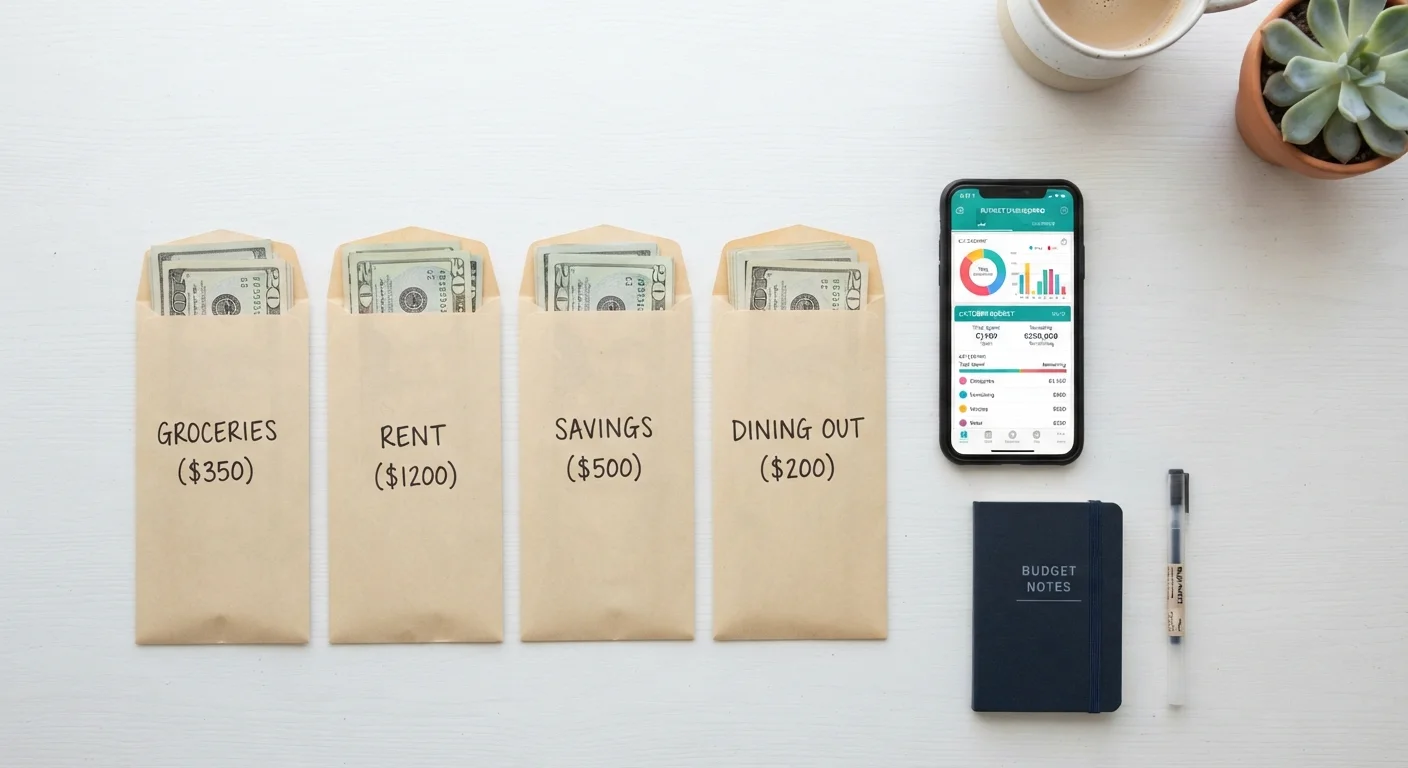
The cash envelope system is straightforward. You withdraw a set amount of cash at the start of a pay period, divide it into labeled envelopes by spending category (groceries, gas, eating out, and so on), and spend only what is in each envelope. Once an envelope is empty, spending in that category stops until the next period. No transfer, no override, no rounding.
Digital spending accounts work differently depending on the tool, but the core idea is the same: you assign a dollar amount to each spending category, then track purchases against those limits in an app or through a dedicated bank account. Some people use a single app with virtual "pockets." Others open separate checking accounts for separate categories. Either way, transactions post automatically when you pay by card, and the running balance updates in real time.
Before either method can work, you need a clear picture of where your money goes. The article understanding your spending categories walks through how to map those out if you have not done it yet.
The practical differences that determine which fits you
The biggest dividing line is payment habit. If you pay by card or phone for most purchases, the envelope system creates friction at every transaction. You either have to convert every expense to cash in advance or carry both cash and cards, which gets confusing fast. Digital accounts are built around card use, so the tracking happens in the background.
The second difference is how each method handles the psychological side of spending. Research in behavioral economics has shown that paying with cash tends to feel more "painful" than tapping a card, which is why physical money creates a stronger brake on impulse spending for some people. A digital balance can feel abstract until you are already over limit.
| Criterion | Cash Envelope System | Digital Spending Accounts |
|---|---|---|
| Works for online purchases | No | Yes |
| Automatic transaction tracking | Manual only | Yes, with card sync |
| Hard stop when limit is reached | Yes, by design | Only if configured |
| Works well for shared budgets | Difficult | Yes |
| Setup time | Low (envelopes and cash) | Moderate (app or account setup) |
| Ongoing maintenance effort | High (count cash regularly) | Low (auto-syncs) |
| Effective for impulse spending | Strong behavioral brake | Depends on self-discipline |
A related consideration is convenience. Withdrawing cash, organizing envelopes, and tracking loose change takes time. Digital accounts require initial setup but then largely run themselves. If a weekly money review matters to you, the article on building a weekly money check-in pairs naturally with either approach.
What each method handles less well
Cash envelopes are difficult to use online. You cannot put physical bills into an Amazon cart or pay a utility bill with an envelope. This forces most people using the system to carve out digital categories separately, which means running two parallel systems for some expenses. Shared spending between partners is also harder to coordinate when money lives in physical envelopes one person holds.
Digital accounts have a different weakness: they inform without automatically stopping you. If a bank account hits zero in a spending category, nothing prevents a card transaction from going through unless you have set up a hard block or are disciplined enough to stop on your own. For people who have already tried apps without success, small spending leaks often persist precisely because the digital record arrives after the fact.
Neither method fixes a budget that assigns too little to realistic categories. Separating fixed from variable expenses first makes it easier to set limits that are actually achievable rather than aspirational.
This article is for general informational purposes only and does not constitute personalized financial advice. Consult a licensed financial professional for guidance specific to your situation.