

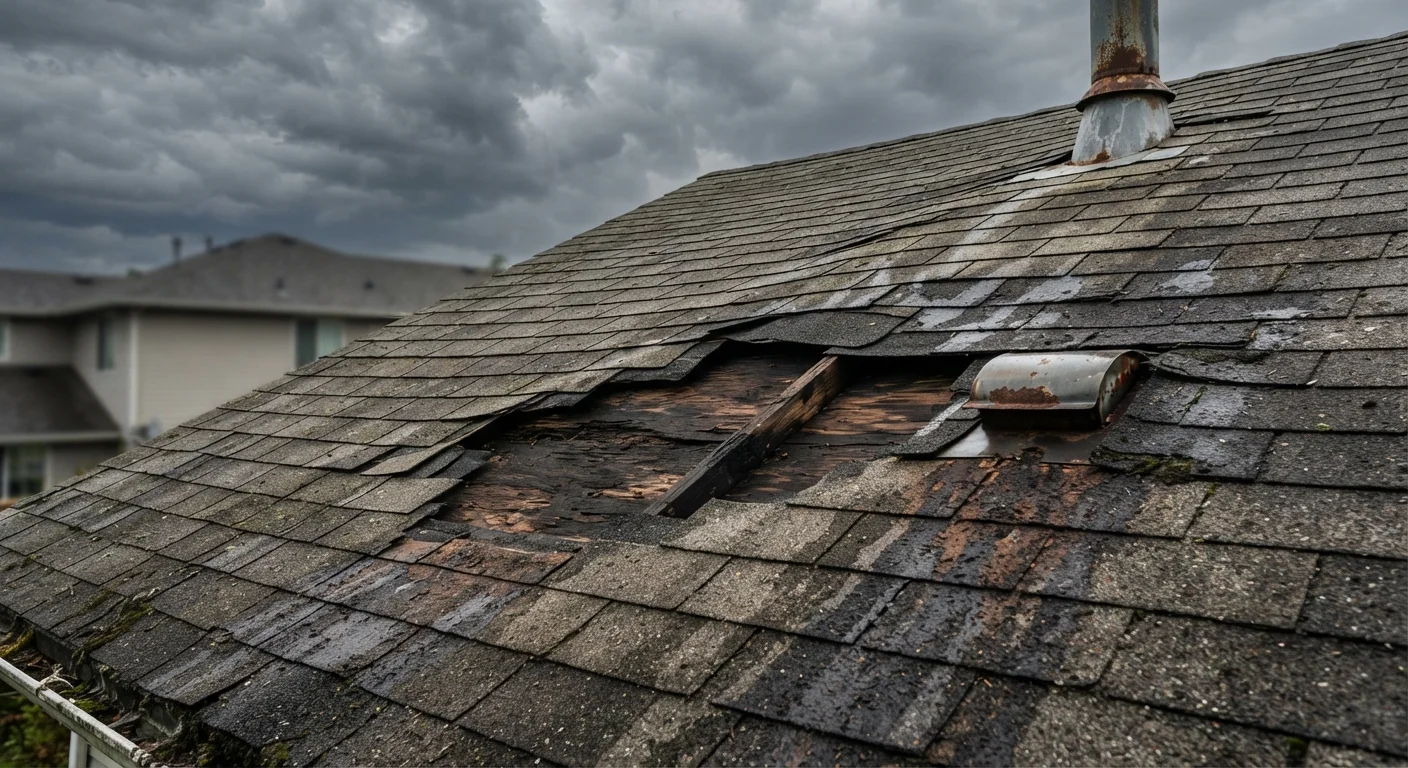
What your roof is trying to tell you
Most roof failures do not happen suddenly. They build from small, visible problems that go unaddressed until the next heavy rain or windstorm turns a minor repair into a major one. Knowing what to look for, from ground level and inside your home, lets you act before the weather does.
This guide covers the most common warning signs for both sloped and flat roofs. For a deeper look at how flat and sloped systems differ in their failure patterns, see the flat roof vs. pitched roof maintenance comparison.
Exterior warning signs you can check from the ground
A pair of binoculars and a safe vantage point from your yard are all you need for an initial exterior check. You do not need to climb onto the roof for this assessment.
Missing, curling, or cracked shingles
Shingles that are absent, lifted at the edges, or visibly cracked can no longer shed water properly. Asphalt shingles typically curl in two ways: cupping, where edges turn upward, and clawing, where the middle buckles while edges stay flat. Both indicate the shingle has aged past its functional life or was installed over an inadequate deck.
Granule loss
Check gutters and downspout discharge areas for a buildup of gritty, sand-like granules. These come from the surface coating of asphalt shingles. Once the granule layer wears away, UV degradation accelerates rapidly and the shingle loses its weather resistance.
Visible sagging
A roof plane that dips or sags in the middle points to structural trouble, most often damage to the decking (the plywood or OSB layer beneath the shingles) or a problem with the rafters or trusses below. Sagging is a strong signal to contact a licensed roofing contractor promptly, as this type of damage can worsen quickly under the weight of rain or snow.
Damaged or missing flashing
Flashing is the metal strip that seals roof transitions: around chimneys, along dormers, at skylights, and in valleys where two roof planes meet. Rust, cracks, or flashing that has pulled away from the surface it seals are common entry points for water. Flashing repairs typically require professional attention, especially around gas appliances with chimney penetrations.
Interior signs that water has already entered
By the time moisture shows up inside your home, it has usually been traveling through your roof assembly for some time. Check your attic and top-floor ceilings regularly, not just after storms.
Stained or discolored ceilings
Brown or yellow staining on a ceiling, particularly in a ring pattern, usually means water is pooling above the drywall. The stain's location does not always match the leak's entry point; water often travels along rafters or insulation before dripping down.
Attic daylight or moisture
Standing in your attic on a bright day and looking for pinpoints of light coming through the roof deck is a quick diagnostic. Any light means a gap. Also check for wet insulation, damp wood, or mold growth on the underside of the deck. Mold in an attic signals both a current or past moisture intrusion and a ventilation problem. Both need to be resolved together, not separately.
Higher-than-usual energy bills
Compromised roof insulation or a breach in the vapor barrier can allow conditioned air to escape. If heating or cooling costs have crept up without an obvious cause, the roof assembly is worth inspecting. This connection is covered in more depth in the article on your home's hidden weak points.
When to call a professional
Ground-level observation and attic checks are within reach for most homeowners and renters. Walking the roof surface, however, carries real fall risk and is best left to a licensed roofing contractor with proper safety equipment.
Contact a professional if you find sagging, widespread shingle failure, damaged flashing around a chimney or gas vent, or any sign of structural compromise. Many contractors offer free or low-cost inspection assessments before storm season.
If your home will be unoccupied for an extended period, a roof check should be part of your pre-departure routine. The guide on preparing your home before a long absence covers what else to address before you leave.
For a full seasonal maintenance schedule that incorporates roof checks alongside other home systems, see the seasonal home maintenance walkthrough.
Flashing
Thin strips of metal, typically aluminum or galvanized steel, installed at roof joints and penetrations to prevent water from seeping under shingles. Common locations include chimney bases, skylight edges, and roof valleys.
Roof deck
The solid panel layer, usually plywood or oriented strand board (OSB), that sits directly beneath the roofing material. It provides structural support and a nailing surface for shingles or membranes.
Granule loss
The shedding of the textured mineral coating on the surface of asphalt shingles. Granules protect the underlying bitumen from UV rays; significant loss indicates the shingle is near the end of its useful life.
Cupping
A type of shingle distortion where the edges of a shingle curl upward, creating a concave surface. It often results from moisture imbalance between the top and bottom of the shingle or inadequate attic ventilation.
Clawing
A shingle distortion where the edges remain flat but the middle of the shingle buckles upward. Like cupping, it signals age or ventilation problems and reduces the shingle's ability to shed water.
Vapor barrier
A material, typically plastic sheeting or foil-faced insulation, installed in the roof or wall assembly to slow the movement of moisture-laden air. Damage to it can lead to condensation and insulation failure.