

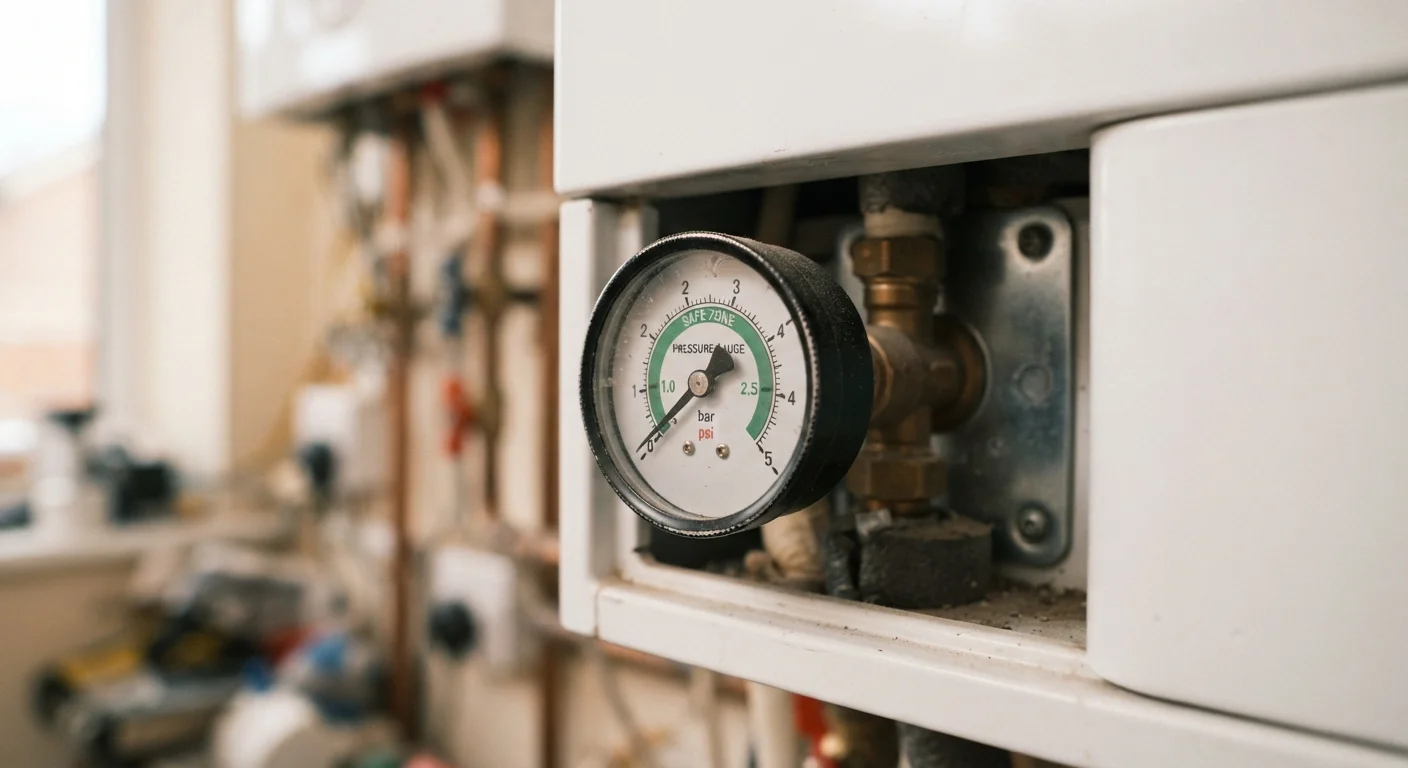
Reading the dial: what the numbers mean
A boiler pressure gauge measures the water pressure inside the sealed central heating system. The unit used is bar, where 1 bar equals roughly 14.5 pounds per square inch. Most residential boilers in the US use pressure expressed in PSI rather than bar, so check which unit your gauge displays before drawing conclusions.
When the boiler is cold (the system has not run for several hours), normal pressure falls between 1 and 1.5 bar, or approximately 15 to 22 PSI. When the system heats up, pressure rises slightly because water expands with heat. A reading between 1.5 and 2 bar (22 to 29 PSI) during operation is normal. Most gauges mark this range in green or label it with a safe-zone indicator.
Red zones typically appear at both ends of the dial: below 0.5 bar (about 7 PSI) on the low end, and above 3 bar (about 43 PSI) on the high end. If the needle sits in either red zone, the system needs attention before you run the boiler.
When pressure is too low
Low pressure, generally below 1 bar when cold, means the system has lost water. Common causes include a small leak somewhere in the pipework or radiators, a recently bled radiator, or a failing pressure relief valve. Some loss over months is normal, but a sudden drop points to an active problem.
The fix for genuinely low pressure (with no visible leak) is repressurizing through the filling loop, a short flexible hose that connects the mains water supply to the heating circuit. The loop has one or two valves. Open them slowly until the gauge reads about 1.2 bar, then close the valves completely. If you cannot locate the filling loop or the gauge climbs too fast and overshoots, stop and call a heating engineer.
If the boiler loses pressure repeatedly within days of repressurizing, treat that as a signal to have a professional inspect the system for leaks rather than continuing to top it up yourself.
When pressure is too high
High pressure, above 2.5 bar when cold or above 3 bar during operation, can strain boiler components and trigger the pressure relief valve to discharge water, usually through a pipe that exits outside the property. Seeing water dripping from that pipe is a sign the valve has activated.
Bar
A metric unit of pressure. One bar equals roughly 14.5 PSI. Boiler gauges outside the US typically use bar; US models often use PSI.
Filling loop
A short hose or pipe assembly that temporarily connects the mains cold water supply to the sealed heating circuit so you can add water to raise system pressure.
Expansion vessel
A small sealed tank pre-charged with air that absorbs the increase in water volume when the heating system heats up, preventing unsafe pressure spikes.
Pressure relief valve
A safety device that opens automatically if system pressure exceeds a set limit, releasing water to prevent damage. It is not designed for routine use or manual operation.
Sealed system
A central heating circuit that does not have an open feed-and-expansion tank in the loft. Pressure is fixed at installation and only changes when water is added or lost.
Excess pressure typically has two causes. First, someone may have overfilled the system through the filling loop. Second, the expansion vessel, a small tank that absorbs the volume change as water heats, may have lost its charge (air pressure). A flat expansion vessel cannot buffer pressure rises, so the gauge climbs too high every time the boiler fires.
Checking and recharging an expansion vessel requires a pressure gauge and a pump, and the system must be depressurized first. Because this involves releasing pressure from a hot system, the work is best left to a qualified heating engineer unless you have direct experience with the procedure.
Do not attempt to reduce pressure by pressing the pin on the pressure relief valve as a shortcut. That valve is a safety component and interfering with it can damage the valve seat, causing a permanent drip or failure.
When to call a professional
Repressurizing a cold system that reads below 1 bar is a straightforward task most homeowners can do once they locate the filling loop and follow the boiler manufacturer's instructions. Everything else on this list warrants a qualified heating engineer:
- Pressure drops repeatedly after repressurizing
- Visible water stains or active drips anywhere on pipework or behind the boiler casing
- High pressure that does not drop after the system cools overnight
- Water discharging from the external pressure relief pipe
- The gauge needle is stuck and does not move when the boiler fires or cools
A stuck needle can mean the gauge itself has failed, which gives a false sense of safety. Replacing a faulty gauge is a minor job for a technician and costs little compared with the risk of running a system blind.
In the US, gas appliance work (including most boiler repairs beyond basic filling and bleeding) typically requires a licensed HVAC or plumbing contractor depending on your state. Check local licensing requirements before hiring anyone.