

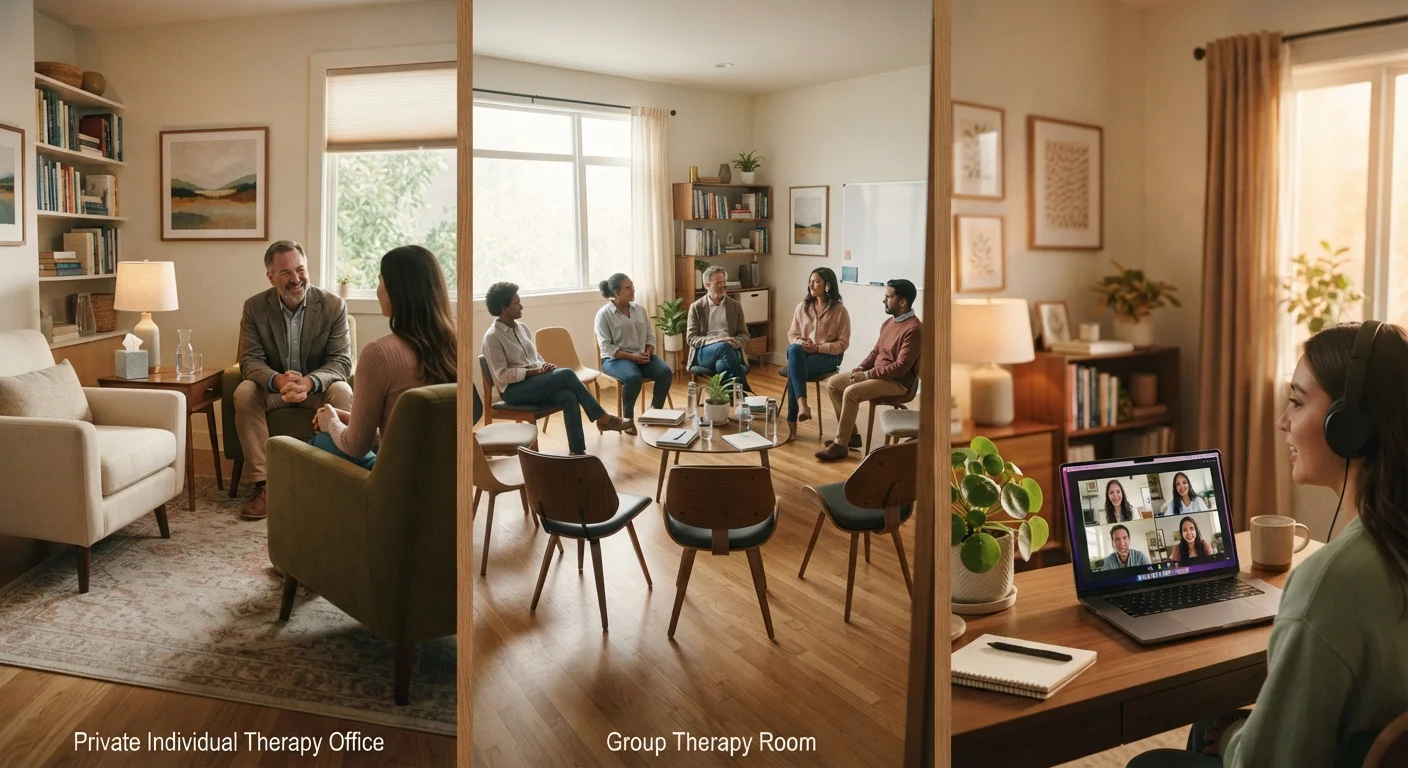
Key Takeaways
- Individual therapy provides the most privacy and personalized attention but is typically the most expensive format.
- Group therapy costs less per session and offers peer support, though it requires comfort with shared disclosure.
- Online therapy removes geographic barriers and suits people with busy schedules or limited local providers.
- No single format is universally better; the right choice depends on your goals, budget, and personal comfort.
Our Verdict
Each therapy format addresses a genuine set of needs. Individual therapy is most suitable when privacy and a tailored focus are priorities. Group therapy works well for those who benefit from peer connection and want a lower-cost option. Online therapy is a practical solution for access, scheduling, or geographic constraints. Many people use more than one format at different points in their lives.
| Best for | Recommended |
|---|---|
| Those who want highly personalized, confidential sessions | Individual therapy |
| Those managing a tight budget or seeking peer connection | Group therapy |
| Those with limited local access or inflexible schedules | Online therapy |
| Those managing a specific, well-defined concern such as social anxiety or grief | Group therapy or a combination approach |
What each format actually involves
Therapy is not one-size-fits-all in structure any more than it is in approach. The three main formats differ in setting, session size, cost, and the kind of work they make possible.
Individual therapy involves one client and one licensed therapist meeting privately, usually for 45 to 60 minutes per session. The therapist tailors goals, pacing, and techniques to that specific person. For a deeper look at one widely used method, see what CBT involves and who it may help.
Group therapy brings several participants together under the guidance of one or two therapists. Groups may focus on a shared concern such as grief, anxiety, or substance recovery, or they may be open-ended. Sessions typically run 60 to 90 minutes.
Online therapy delivers sessions through video call, phone, or asynchronous messaging. It can replicate the individual format or, less commonly, support group sessions. The key variable is the technology channel, not the therapeutic method itself.
Comparing the three formats
The table below sets out how individual, group, and online therapy compare across the factors most people weigh when choosing.
| Individual therapy | Group therapy | Online therapy | |
|---|---|---|---|
| Typical session cost | Higher per session | Lower per session | Varies; often mid-range |
| Privacy level | High; one-on-one | Shared with group members | High; depends on platform security |
| Personalization | Fully tailored to individual | Shared focus; less tailored | Tailored if individual format |
| Geographic access | Limited by local supply | Limited by local supply | Available almost anywhere |
| Scheduling flexibility | Moderate; fixed appointments | Low; fixed group schedule | Higher; more provider options |
| Peer support element | None | Central to the format | None in standard format |
| Comfort requirement | Comfort with one therapist | Comfort with group disclosure | Comfort with technology |
Cost varies considerably by region, provider, and insurance coverage. Consult your insurer or a benefits coordinator about what your plan covers; for a practical overview of how to approach that process, the article shopping for insurance without getting overwhelmed may help you think through coverage questions systematically.
Privacy and disclosure
Individual therapy offers the highest degree of confidentiality. Outside of legally mandated reporting situations, what a client shares stays between that person and their therapist.
Group therapy involves disclosure in front of peers. Therapists establish confidentiality agreements within the group, but those agreements rely on all members honoring them. For some people, the shared experience reduces isolation. For others, the lack of guaranteed privacy is a barrier that outweighs the benefits.
Online therapy through a licensed, regulated platform carries the same legal confidentiality protections as in-person individual therapy. The practical risk shifts to technical security: using a private network, a secure device, and a platform compliant with health privacy regulations matters more than it does in an office setting.
Access and scheduling
Geography limits who can access in-person care. Rural areas, underserved communities, and regions with therapist shortages all present real barriers for individual and group formats. Online therapy reduces those barriers substantially. A person in a small town may have dozens of licensed therapists available through a telehealth platform but only one or two within a reasonable drive.
Scheduling flexibility also differs. Individual in-person sessions require both parties to be free at the same time and in the same place. Online individual sessions drop the commute but still require a real-time commitment. Group therapy runs on a fixed schedule that cannot be adjusted for individual members.
This access dynamic mirrors choices in other areas of life, including how solo and group structures compare in fitness contexts. The article group fitness classes vs. solo training explores a similar trade-off between structured group participation and individual flexibility.
Choosing based on your situation
The right format depends on a combination of practical and personal factors. Budget is often the first constraint: group therapy is generally less expensive per session than individual therapy, and some community mental health centers offer sliding-scale fees.
The nature of what you want to address also matters. Concerns that involve significant personal history, trauma, or complex diagnosis typically receive more targeted attention in individual therapy. Issues rooted in social connection, shared experience, or interpersonal patterns may respond well to a group setting, where peer feedback is part of the process.
Comfort with disclosure and with other people's material affects how useful group therapy feels. Some people find hearing others' experiences normalizing and motivating; others find it distracting or emotionally overwhelming.
Online therapy is not inherently less effective than in-person therapy for many common concerns, though research on specific populations and conditions continues to develop. If you have a preference for face-to-face contact, or if your therapist believes in-person work is clinically preferable for your situation, that preference is worth factoring in.
This article is for general informational purposes only and is not a substitute for professional mental health advice, diagnosis, or treatment. Please consult a licensed mental health professional for guidance specific to your situation.